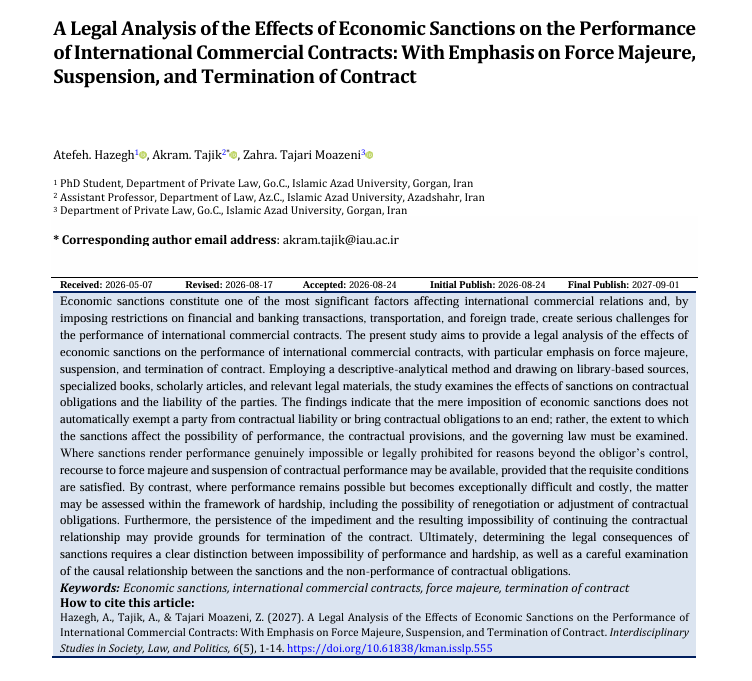
A Legal Analysis of the Effects of Economic Sanctions on the Performance of International Commercial Contracts: With Emphasis on Force Majeure, Suspension, and Termination of Contract
Keywords:
Economic sanctions, international commercial contracts, force majeure, termination of contractAbstract
Economic sanctions constitute one of the most significant factors affecting international commercial relations and, by imposing restrictions on financial and banking transactions, transportation, and foreign trade, create serious challenges for the performance of international commercial contracts. The present study aims to provide a legal analysis of the effects of economic sanctions on the performance of international commercial contracts, with particular emphasis on force majeure, suspension, and termination of contract. Employing a descriptive-analytical method and drawing on library-based sources, specialized books, scholarly articles, and relevant legal materials, the study examines the effects of sanctions on contractual obligations and the liability of the parties. The findings indicate that the mere imposition of economic sanctions does not automatically exempt a party from contractual liability or bring contractual obligations to an end; rather, the extent to which the sanctions affect the possibility of performance, the contractual provisions, and the governing law must be examined. Where sanctions render performance genuinely impossible or legally prohibited for reasons beyond the obligor’s control, recourse to force majeure and suspension of contractual performance may be available, provided that the requisite conditions are satisfied. By contrast, where performance remains possible but becomes exceptionally difficult and costly, the matter may be assessed within the framework of hardship, including the possibility of renegotiation or adjustment of contractual obligations. Furthermore, the persistence of the impediment and the resulting impossibility of continuing the contractual relationship may provide grounds for termination of the contract. Ultimately, determining the legal consequences of sanctions requires a clear distinction between impossibility of performance and hardship, as well as a careful examination of the causal relationship between the sanctions and the non-performance of contractual obligations.
Downloads
References
Dezhpasand, F., Yazdani, M., Taghavi, A., & Moridi Farimani, F. (2025). The Effects of Economic Sanctions on Iran's Oil and Gas Industry. Strategic Studies in Oil and Energy Industry, 17(65).
Ebrahimi, S. N., & Oyarhossein, S. (2012). The Effects of Sanctions on the Performance of International Commercial Contracts from the Perspective of Force Majeure. Civil Law Knowledge, 1(2).
Katouzian, N. (2023). Non-Contractual Obligations. University of Tehran Press.
Kolb, R. (2017). The International Law of State Responsibility. Edward Elgar Publishing.
Oloumi Yazdi, H., & Razi, S. (2024). Methods of Compensation and Assessment of Damages Arising from Sanctions. International Law Review(74).
Razi, S., & Badini, H. (2023). Intellectual Perspectives and Foundations of Civil Liability for the Imposition of Sanctions. Private Law, 20(2).
Sadeghnejad, S., Darvishi Hoveyda, Y., & Taghizadeh Ansari, M. (2024). Economic Sanctions as a Geopolitical Tool of Global Powers and Their Legal Consequences for Iran's Banking System. Quarterly Journal of Geography and Regional Planning, 13(53).
Safaei, S. H., & Rahimi, H. (2020). Civil Liability. Shahr-e Danesh.
Seyed Taghizadeh, S. H., Raeisi, L., & Esmaeili, B. (2019). Examining the Legitimacy of Unilateral U.S. Sanctions after Withdrawal from the JCPOA under the United Nations Charter. Quarterly Journal of International Relations Studies, 12(47).
Ziaei Bigdeli, M. R. (2022). Public International Law. Ganj-e Danesh.
Downloads
Additional Files
Publication Timeline
- Submitted
- Revised
- Accepted
Issue
Section
License
Copyright (c) 2025 Atefeh Hazegh (Author); Akram Tajik (Corresponding author); Zahra Tajari Moazeni (Author)

This work is licensed under a Creative Commons Attribution-NonCommercial 4.0 International License.