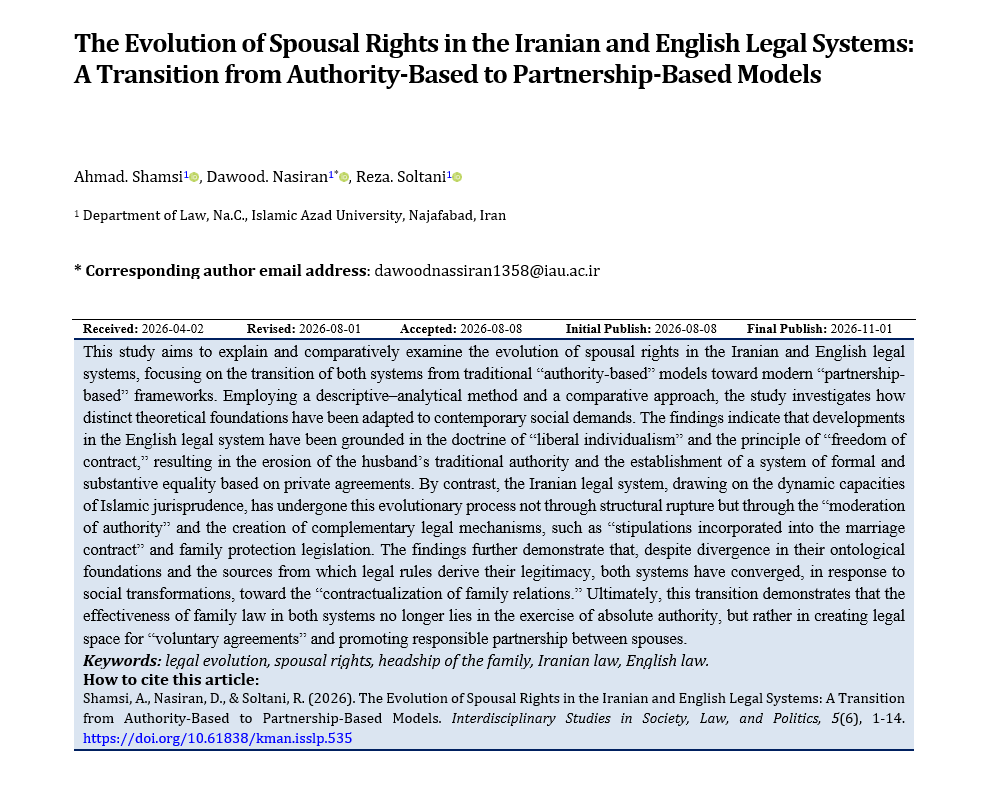
The Evolution of Spousal Rights in the Iranian and English Legal Systems: A Transition from Authority-Based to Partnership-Based Models
Keywords:
legal evolution, spousal rights, headship of the family, Iranian law, English lawAbstract
This study aims to explain and comparatively examine the evolution of spousal rights in the Iranian and English legal systems, focusing on the transition of both systems from traditional “authority-based” models toward modern “partnership-based” frameworks. Employing a descriptive–analytical method and a comparative approach, the study investigates how distinct theoretical foundations have been adapted to contemporary social demands. The findings indicate that developments in the English legal system have been grounded in the doctrine of “liberal individualism” and the principle of “freedom of contract,” resulting in the erosion of the husband’s traditional authority and the establishment of a system of formal and substantive equality based on private agreements. By contrast, the Iranian legal system, drawing on the dynamic capacities of Islamic jurisprudence, has undergone this evolutionary process not through structural rupture but through the “moderation of authority” and the creation of complementary legal mechanisms, such as “stipulations incorporated into the marriage contract” and family protection legislation. The findings further demonstrate that, despite divergence in their ontological foundations and the sources from which legal rules derive their legitimacy, both systems have converged, in response to social transformations, toward the “contractualization of family relations.” Ultimately, this transition demonstrates that the effectiveness of family law in both systems no longer lies in the exercise of absolute authority, but rather in creating legal space for “voluntary agreements” and promoting responsible partnership between spouses.
Downloads
References
Abed Khorasani, M. R. (2016). An Introduction to Children's Rights. Mizan.
Araujo, R. J. (2000, 2000/06). Sovereignty, Human Rights and Self-Determination: The Meaning of International Law. Brigham Young University Conference on the United Nations and the Family,
Azad Armaki, T. (2019). Sociology of the Iranian Family (7th ed.). SAMT.
Ghasemzadeh, S. M. (2016). Commentary on the Civil Code. SAMT.
Giddens, A. (2017). Sociology. Ney Publishing.
Hekmatnia, M., & Kazemi, S. M. H. (2011). An Introduction to Legal Issue Identification with Emphasis on Family Rights in Islam. Nedaye Sadegh(53).
Jafari Langroudi, M. J. (2023). Legal Terminology. Ganj-e Danesh.
Katouzian, N. (2022). Introduction to the Science of Law. Enteshar Joint Stock Company.
Katouzian, N. (2023). Family Law. Enteshar Joint Stock Company.
Mirzaei, A. (2016). Collection of Legal Laws and Regulations. Behnami.
Mohaghegh Damad, S. M. (2019). A Jurisprudential Examination of Family Law: Marriage and Its Dissolution. Center for the Publication of Islamic Sciences.
Safaei, S. H., & Emami, A. (2021). A Concise Treatise on Family Law (25th ed.). Mizan.
Saroukhani, B. (2023). Encyclopedia of Social Sciences. Soroush.
Stones, B. (2006). Statutes on Family Law (1st ed.). Oxford University Press.
Vik, I. (2013). Lobbying for Faith and Family: A Study of Religious NGOs at the United Nations.
Zibaeinejad, M. R. (2014). An Analysis of the Most Important Issues Concerning Women and the Family in Iran. Office for Women's Studies and Research.
Downloads
Additional Files
Publication Timeline
- Submitted
- Revised
- Accepted
Issue
Section
License
Copyright (c) 2025 Ahmad Shamsi (Author); Dawood Nasiran (Corresponding author); Reza Soltani (Author)

This work is licensed under a Creative Commons Attribution-NonCommercial 4.0 International License.