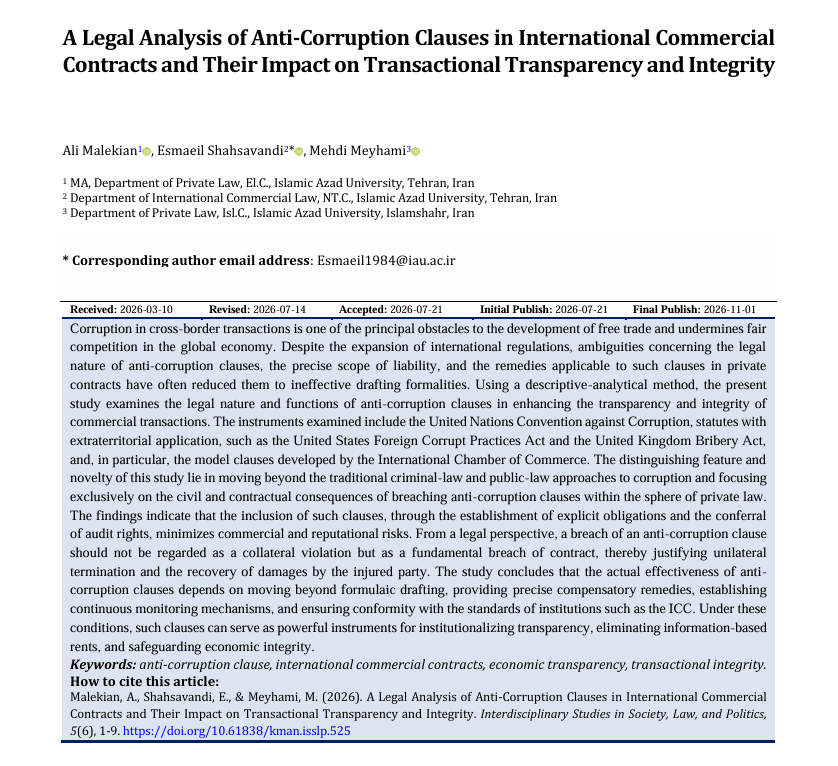
A Legal Analysis of Anti-Corruption Clauses in International Commercial Contracts and Their Impact on Transactional Transparency and Integrity
Keywords:
anti-corruption clause, international commercial contracts, economic transparency, transactional integrityAbstract
Corruption in cross-border transactions is one of the principal obstacles to the development of free trade and undermines fair competition in the global economy. Despite the expansion of international regulations, ambiguities concerning the legal nature of anti-corruption clauses, the precise scope of liability, and the remedies applicable to such clauses in private contracts have often reduced them to ineffective drafting formalities. Using a descriptive-analytical method, the present study examines the legal nature and functions of anti-corruption clauses in enhancing the transparency and integrity of commercial transactions. The instruments examined include the United Nations Convention against Corruption, statutes with extraterritorial application, such as the United States Foreign Corrupt Practices Act and the United Kingdom Bribery Act, and, in particular, the model clauses developed by the International Chamber of Commerce. The distinguishing feature and novelty of this study lie in moving beyond the traditional criminal-law and public-law approaches to corruption and focusing exclusively on the civil and contractual consequences of breaching anti-corruption clauses within the sphere of private law. The findings indicate that the inclusion of such clauses, through the establishment of explicit obligations and the conferral of audit rights, minimizes commercial and reputational risks. From a legal perspective, a breach of an anti-corruption clause should not be regarded as a collateral violation but as a fundamental breach of contract, thereby justifying unilateral termination and the recovery of damages by the injured party. The study concludes that the actual effectiveness of anti-corruption clauses depends on moving beyond formulaic drafting, providing precise compensatory remedies, establishing continuous monitoring mechanisms, and ensuring conformity with the standards of institutions such as the ICC. Under these conditions, such clauses can serve as powerful instruments for institutionalizing transparency, eliminating information-based rents, and safeguarding economic integrity.
Downloads
References
Akbari, M., Yavari, A., & Shamsi, J. (2022). Feasibility of the validity of arbitration clauses in international contracts based on Islamic jurisprudence. Comparative Research on Islamic and Western Law, 9(2), 37-74. https://doi.org/10.22091/csiw.2022.7069.2107
Alavi Qazvini, S. A., & Beigi Habibabadi, Q. (2015). The effect of financial corruption on the status of government contracts. Private Law Studies, 45(2), 285-299. https://doi.org/10.22059/jlq.2015.54449
Amundsen, I. (1999). Political Corruption: An Introduction to the Issues.
Argandona, A. (2024). Private-to-private corruption. In Elgar Encyclopedia of Corruption and Society (pp. 276-280). Edward Elgar Publishing.
Bahoo, S., Alon, I., & Paltrinieri, A. (2020). Corruption in international business: A review and research agenda. International Business Review, 29(4), 101660. https://doi.org/10.1016/j.ibusrev.2019.101660
Bismuth, R., Dunin-Wasowicz, J., & Nichols, P. (2021). The Transnationalization of Anti-corruption Law. Routledge, Taylor & Francis Group. https://doi.org/10.4324/9781003174639
Bonell, M. J., & Meyer, O. The Effects of Corruption in International Commercial Contracts.
Borlini, L. S. (2017). The Emergence of the International Anti-Corruption Framework and Its Domestic Implementation: The Case of Italy (Bocconi Legal Studies Research Paper, Issue. https://ssrn.com/abstract=3010753
Hassanzadeh, N. (2022). The effect of the anti-corruption clause on international commercial contracts.
Landmeier, L. M., Gusman, L. Y., Healy, N. M., & Keiser, A. (2002). Anti-Corruption International Legal Developments. In International Lawyer (Vol. 36, pp. 589). https://heinonline.org/hol-cgi-bin/get_pdf.cgi?handle=hein.journals/intlyr36§ion=44
Nakajima, C., & Palmer, P. (2010). Anti-Corruption Law and Practice. In Organizational Immunity to Corruption: Building Theoretical and Research Foundations (pp. 99). https://books.google.com/books?hl=en&lr=&id=5_wnDwAAQBAJ&oi=fnd&pg=PA99&dq=Nakajima,+C.+H.+I.+Z.+U.,+%26+Palmer,+P.+A.+U.+L.+(2010).+Anti-Corruption+Law+and+Practice.+Organizational+immunity+to+corruption:+Building+theoretical+and+research+foundations,+99.&ots=x4wz3j-90C&sig=wOxc7nrFPH-LWOXMb43NFEKsOoo
Perez Torres, G. (2020). The effectiveness of the international anti-corruption legal framework in the context and practice of Colombia. Journal of Financial Crime, 27(2), 437-476.
Ponti, B., Cerrillo-i-Martinez, A., & Di Mascio, F. (2022). Transparency, digitalization and corruption. In Understanding and Fighting Corruption in Europe: From Repression to Prevention (pp. 97-126). Springer International Publishing.
Rezaei, M., & Yavari, A. (2020). The principle of transparency in Iranian public tenders in light of World Trade Organization and European Union regulations. Encyclopedia of Economic Law, 27(18), 295-324. https://doi.org/10.22067/lowecon.2021.49340.0
Rogers, C. A. (2005). Transparency in international commercial arbitration. University of Kansas Law Review, 54, 1301.
Rose-Ackerman, S., & Palifka, B. J. (2016). Corruption and Government: Causes, Consequences, and Reform. Cambridge University Press. https://books.google.com/books?hl=en&lr=&id=GGSSCwAAQBAJ&oi=fnd&pg=PR17&dq=orruption+and+government:+Causes,+consequences,+and+reform&ots=PfxUtm2OE3&sig=csVFYndHAPPB2JEtzKPZrfMGXgo
Shirovi, A. (2022). International Trade Law. SAMT Publications.
Shirovi, A., & Eshraghi, M. (2023). A comparative study of the inefficiency of the sanction of nullity for corruption-based contracts. Private Law Scientific Journal, 19(2), 337-349. https://doi.org/10.22059/jolt.2023.345376.1007115
Shleifer, A., & Vishny, R. W. (1993). Corruption. The Quarterly Journal of Economics, 108(3), 599-617.
Srivastava, A. (2020). Modern Law of International Trade. Springer Singapore. https://doi.org/10.1007/978-981-15-5475-9
Sykes, A. O. (2023). The Law and Economics of International Trade Agreements. Edward Elgar Publishing. https://books.google.com/books?hl=en&lr=&id=8ki-EAAAQBAJ&oi=fnd&pg=PR1&dq=The+Law+and+Economics+of+International+Trade+Agreements&ots=3aOpoFOSqx&sig=WJRlHH8yksne2wzwJD9haTL0kpE
Topchii, V., Zadereiko, S., Didkivska, G., Bodunova, O., & Shevchenko, D. (2021). International anti-corruption standards. Baltic Journal of Economic Studies, 7(5), 277-286. https://cyberleninka.ru/article/n/international-anti-corruption-standards
Turnes, P. B., & Ernst, R. (2015). A framework for transparency in international trade. Investigaciones Europeas de Dirección y Economía de la Empresa, 21(1), 1-8.
Zal Nejad, A. H., & Ramezani, G. (2022). Inclusion of anti-corruption clauses in international investment agreements and its possible consequences. Journal of Jurisprudence, Law, and Criminal Sciences, 7(23), 84-105. https://www.magiran.com/p2468843
Downloads
Additional Files
Publication Timeline
- Submitted
- Revised
- Accepted
Issue
Section
License
Copyright (c) 2025 Ali Malekian (Author); Esmaeil Shahsavandi (Corresponding author); Mehdi Meyhami (Author)

This work is licensed under a Creative Commons Attribution-NonCommercial 4.0 International License.