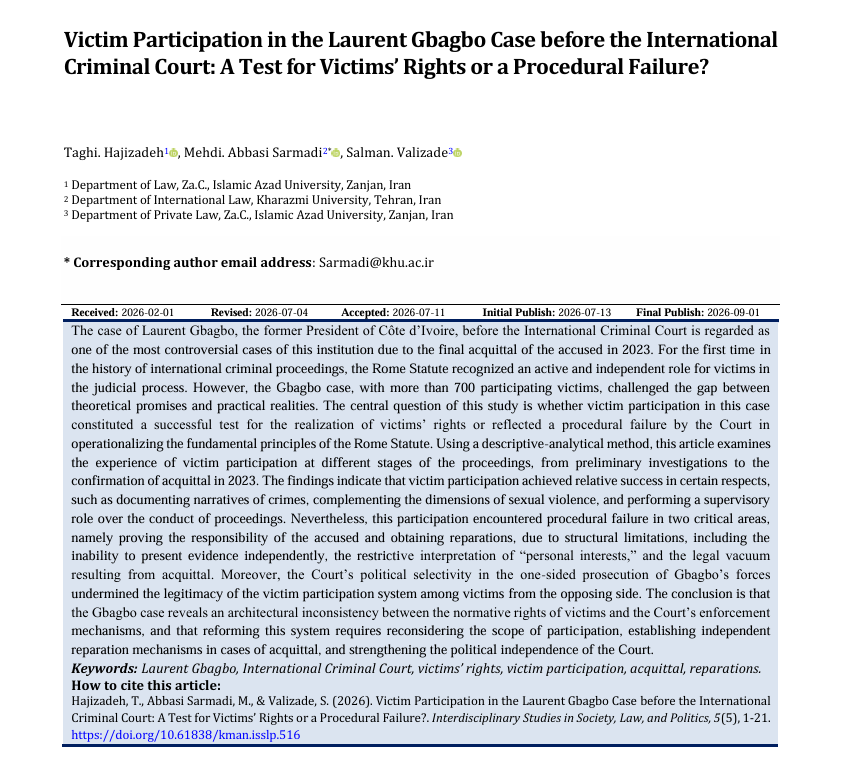
Victim Participation in the Laurent Gbagbo Case before the International Criminal Court: A Test for Victims’ Rights or a Procedural Failure?
Keywords:
Laurent Gbagbo, International Criminal Court, victims’ rights, victim participation, acquittal, reparationsAbstract
The case of Laurent Gbagbo, the former President of Côte d’Ivoire, before the International Criminal Court is regarded as one of the most controversial cases of this institution due to the final acquittal of the accused in 2023. For the first time in the history of international criminal proceedings, the Rome Statute recognized an active and independent role for victims in the judicial process. However, the Gbagbo case, with more than 700 participating victims, challenged the gap between theoretical promises and practical realities. The central question of this study is whether victim participation in this case constituted a successful test for the realization of victims’ rights or reflected a procedural failure by the Court in operationalizing the fundamental principles of the Rome Statute. Using a descriptive-analytical method, this article examines the experience of victim participation at different stages of the proceedings, from preliminary investigations to the confirmation of acquittal in 2023. The findings indicate that victim participation achieved relative success in certain respects, such as documenting narratives of crimes, complementing the dimensions of sexual violence, and performing a supervisory role over the conduct of proceedings. Nevertheless, this participation encountered procedural failure in two critical areas, namely proving the responsibility of the accused and obtaining reparations, due to structural limitations, including the inability to present evidence independently, the restrictive interpretation of “personal interests,” and the legal vacuum resulting from acquittal. Moreover, the Court’s political selectivity in the one-sided prosecution of Gbagbo’s forces undermined the legitimacy of the victim participation system among victims from the opposing side. The conclusion is that the Gbagbo case reveals an architectural inconsistency between the normative rights of victims and the Court’s enforcement mechanisms, and that reforming this system requires reconsidering the scope of participation, establishing independent reparation mechanisms in cases of acquittal, and strengthening the political independence of the Court.
Downloads
References
Ambos, K. (2020). The ICC Prosecutor's proprio motu investigation in Côte d'Ivoire: A critical assessment. Journal of International Criminal Justice, 18(3), 445-468. https://doi.org/10.1093/jicj/mqaa032
Amnesty, I. (2011). "They Looked at His Identity Card and Shot Him Dead": Six Months of Post-Electoral Violence in Côte d'Ivoire.
Banégas, R. (2011). Post-Election Crisis in Côte d'Ivoire: The Gbonhi War. African Affairs, 110(440), 457-468.
Baumgartner, E. (2018). Aspects of victim participation in the proceedings of the International Criminal Court. International Review of the Red Cross, 90(870), 409-440. https://doi.org/10.1017/S1816383109000277
Bovcon, M. (2009). France's Conflict Resolution Strategy in Côte d'Ivoire and its Ethical Implications. African Studies Quarterly, 11(1), 1-24.
Carbuccia, H. (2019). Dissenting Opinion, ICC-02/11-01/15.
De Vos, C. K. S., & Stahn, C. (2015). Contested justice: The politics and practice of International Criminal Court interventions. Cambridge University Press.
De Vos, C. K. S., & Stahn, C. (2020). Victim participation before the International Criminal Court: Practice, legacy and potential (2nd ed. TMC Asser Press.
Donat-Cattin, D. (2014). Article 68: Protection of the victims and witnesses and their participation in the proceedings. In O. Triffterer & K. Ambos (pp. 1656-1698). C.H. Beck/Hart/Nomos.
Grey, R. (2015). The ICC's first 'forced pregnancy' case in historical perspective. Journal of International Criminal Justice, 13(5), 905-930. https://doi.org/10.1093/jicj/mqv047
Grey, R. (2020). The prosecution of sexual violence in conflict: The importance of human rights as means of interpretation. Oxford University Press.
Human Rights, W. (2011). "They Killed Them Like It Was Nothing": The Need for Justice for Côte d'Ivoire's Post-Election Crimes.
Human Rights, W. (2014). Justice for serious crimes before national courts: Côte d'Ivoire's important challenge. https://www.hrw.org/report/2014/10/01
Human Rights, W. (2015). Unfinished Business: Closing Gaps in the Selection of ICC Cases.
Human Rights, W. (2019). ICC: Mixed legacy on victims' rights after 20 years. https://www.hrw.org/news/2019/07/17
International Crisis, G. (2011a). Côte d'Ivoire: Is War the Only Option? Africa Report No.
International Crisis, G. (2011b). A Critical Period for Ensuring Stability in Côte d'Ivoire.
Kendall, S. (2017). 'UbuRwanda': Implementing transitional justice in Rwanda. In S. Buckley-Zistel & R. Stanley (pp. 169-195). Palgrave Macmillan.
Kendall, S. (2018). Donors' justice: Recasting international criminal accountability. Leiden Journal of International Law, 31(1), 585-608. https://doi.org/10.1017/S0922156518000225
Kendall, S. (2019). Accountable spectators: International witnesses and the prosecution of mass violence. Stanford University Press.
Kendall, S., & Nouwen, S. (2013). Representational Practices at the International Criminal Court. Michigan Journal of International Law, 35(2), 235-249.
Kersten, M. (2016). Justice in Conflict: The Effects of the ICC's Interventions on Ending Wars and Building Peace. Oxford University Press.
Kersten, M. (2019a). A hollow victory? The acquittal of Laurent Gbagbo and its implications for victims. Journal of International Criminal Justice, 17(1), 125-144. https://doi.org/10.1093/jicj/mqz003
Kersten, M. (2019b). The ICC's Côte d'Ivoire Acquittals and the Politics of International Criminal Justice. Journal of International Criminal Justice, 17(3), 455-478.
Kersten, M. (2020). The Acquittal of Laurent Gbagbo and the Crisis of Legitimacy at the ICC. Journal of International Criminal Justice, 18(1), 137-152.
Kersten, M. (2022). A Decade of Failure? Reflections on the Gbagbo Case. International Justice Monitor, 15(2), 223-245.
McGonigle Leyh, B. (2015). Procedural justice? Victim participation in international criminal proceedings. Intersentia.
McGonigle Leyh, B. (2020). Two-way mirror trauma: Victim participation and secondary victimization at the ICC. international criminal law review, 20(1), 81-106. https://doi.org/10.1163/15718123-02001004
McGovern, M. (2011). Making War in Côte d'Ivoire. University of Chicago Press.
Mégret, F. (2012). The anxieties of international criminal justice. European Journal of International Law, 23(1), 197-221. https://doi.org/10.1093/ejil/chr098
Mégret, F. (2019). Victim participation as 'a special species of procedural participation'. Oxford University Press.
Mouthaan, S. (2013). Sexual Violence in Conflict and the Relevance of the ICC. international criminal law review, 13(2), 285-305.
Nouwen, S., & Werner, W. (2011). Doing Justice to the Political. European Journal of International Law, 22(4), 941-965.
Piccolino, G. (2012). David against Goliath in Côte d'Ivoire? Laurent Gbagbo's War against Global Governance. African Affairs, 111(442), 1-23.
Schabas, W. A. (2016). The International Criminal Court: A Commentary on the Rome Statute (2nd ed. Oxford University Press.
Schabas, W. A. (2020). Acquittals at the ICC: Three problems with the Gbagbo case. Journal of International Criminal Justice, 18(2), 443-467. https://doi.org/10.1093/jicj/mqaa025
Smeulers, A. W. M., & Hola, B. (2015). The Selection of Situations by the ICC. international criminal law review, 15(1), 225-246.
Stahn, C. (2015a). The Law and Practice of the International Criminal Court. Oxford University Press.
Stahn, C. (2015b). Taking complementarity seriously: On the sense and sensibility of 'classical', 'positive' and 'negative' complementarity. Oxford University Press.
Stahn, C. (2019). A critical introduction to international criminal law. Cambridge University Press.
Stahn, C. (2020). Justice delivered? The legacy of the Gbagbo acquittal. Criminal Law Forum, 31(3), 725-758. https://doi.org/10.1007/s10609-020-09398-w
Stover, E. (2015). The witnesses: War crimes and the promise of justice in The Hague. University of Pennsylvania Press.
United Nations Human Rights, C. (2011). Report of the International Commission of Inquiry on Côte d'Ivoire.
Vasiliev, S. (2015). Victim participation revisited: What the ICC is learning about itself. Oxford University Press.
Vasiliev, S. (2019). The ICC and the problem of witness proofing. international criminal law review, 19(4), 545-592. https://doi.org/10.1163/15718123-01904003
Vasiliev, S. (2020). Consistency of jurisprudence, finality of acquittals, and ne bis in idem at the ICC. Journal of International Criminal Justice, 18(1), 69-107. https://doi.org/10.1093/jicj/mqaa003
Victims' Rights Working, G. (2010). The Position of Victims in the Proceedings of the International Criminal Court.
Victims' Rights Working, G. (2014). Participation and Reparations: Enhancing Victims' Rights.
Victims' Rights Working, G. (2015a). Access to Justice for Victims at the ICC.
Victims' Rights Working, G. (2015b). Victim participation at the ICC: Analysis and recommendations. https://www.vrwg.org/publications/2015
Victims' Rights Working, G. (2016a). Financial Aspects of Victims' Participation at the ICC.
Victims' Rights Working, G. (2016b). Procedural challenges for victims at the ICC: The Côte d'Ivoire cases. https://www.vrwg.org/publications/2016
Victims' Rights Working, G. (2018). Witness protection and victim participation: Finding the balance. https://www.vrwg.org/publications/2018
Victims' Rights Working, G. (2019). Victim participation in the Gbagbo case: Achievements and shortcomings. https://www.vrwg.org/publications/2019
Victims' Rights Working, G. (2020). Reparations after acquittal: The forgotten victims. https://www.vrwg.org/publications/2020
Downloads
Additional Files
Publication Timeline
- Submitted
- Revised
- Accepted
Issue
Section
License
Copyright (c) 2025 Taghi Hajizadeh (Author); Mehdi Abbasi Sarmadi (Corresponding author); Salman Valizade (Author)

This work is licensed under a Creative Commons Attribution-NonCommercial 4.0 International License.