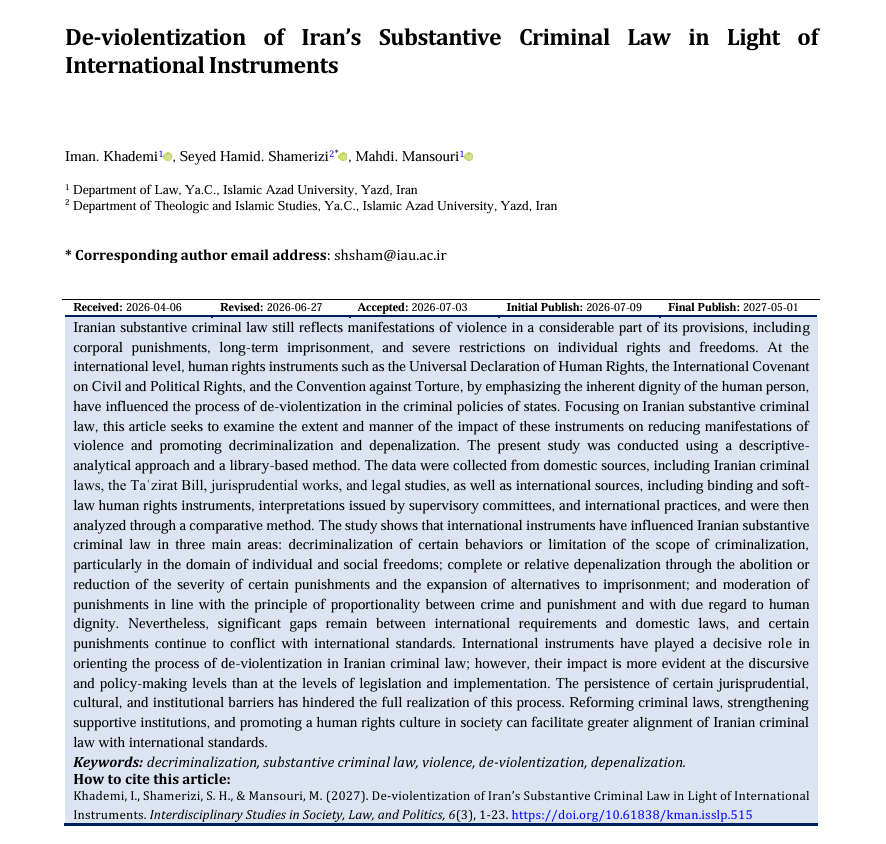
De-violentization of Iran’s Substantive Criminal Law in Light of International Instruments
Keywords:
decriminalization, substantive criminal law, violence, de-violentization, depenalizationAbstract
Iranian substantive criminal law still reflects manifestations of violence in a considerable part of its provisions, including corporal punishments, long-term imprisonment, and severe restrictions on individual rights and freedoms. At the international level, human rights instruments such as the Universal Declaration of Human Rights, the International Covenant on Civil and Political Rights, and the Convention against Torture, by emphasizing the inherent dignity of the human person, have influenced the process of de-violentization in the criminal policies of states. Focusing on Iranian substantive criminal law, this article seeks to examine the extent and manner of the impact of these instruments on reducing manifestations of violence and promoting decriminalization and depenalization. The present study was conducted using a descriptive-analytical approach and a library-based method. The data were collected from domestic sources, including Iranian criminal laws, the Taʿzirat Bill, jurisprudential works, and legal studies, as well as international sources, including binding and soft-law human rights instruments, interpretations issued by supervisory committees, and international practices, and were then analyzed through a comparative method. The study shows that international instruments have influenced Iranian substantive criminal law in three main areas: decriminalization of certain behaviors or limitation of the scope of criminalization, particularly in the domain of individual and social freedoms; complete or relative depenalization through the abolition or reduction of the severity of certain punishments and the expansion of alternatives to imprisonment; and moderation of punishments in line with the principle of proportionality between crime and punishment and with due regard to human dignity. Nevertheless, significant gaps remain between international requirements and domestic laws, and certain punishments continue to conflict with international standards. International instruments have played a decisive role in orienting the process of de-violentization in Iranian criminal law; however, their impact is more evident at the discursive and policy-making levels than at the levels of legislation and implementation. The persistence of certain jurisprudential, cultural, and institutional barriers has hindered the full realization of this process. Reforming criminal laws, strengthening supportive institutions, and promoting a human rights culture in society can facilitate greater alignment of Iranian criminal law with international standards.
Downloads
References
Aghaei Jannat Makan, H. (2020). General Criminal Law: The Science of Enforcement of Criminal Judgments (2nd ed., Vol. 4). Jangal.
Ahmadi, O. (2002). Collection of Articles and Speeches of the First International Conference on Examining Alternatives to Imprisonment. Rah-e Tarbiat.
Bigzadeh, E., & Azarpandar, A. (2025). The European Court of Human Rights' Interpretation of the Right to Liberty and Its Role in Clarifying the Concept of the Best Interests of the Child in the Asylum Process. Journal of Legal Studies, 17(1), 1-24. https://doi.org/10.22099/JLS.2024.48667.5036
Cassese, A. (2008). International Criminal Law (2nd ed.). Oxford University Press.
Coyle, M. J., & Scott, D. (2023). Six Hues of Penal Abolitionism. In Routledge International Handbook of Penal Abolition. Routledge.
Donnelly, J. (2003). Universal Human Rights in Theory and Practice. Cornell University Press.
Ebrahimi, S., & Bazouband, Z. (2018). Penology of the Nature of Supplementary Punishments. Prevention Approach Quarterly, 1(3), 91-108.
Foucault, M. (2016). Discipline and Punish: The Birth of the Prison (N. Sarkhosh & A. Jahandideh, Trans.). Ney.
Haji Molla, H., & Mohammadi, A. (2021). Measuring the Relationship Between the Principle of Necessity and the Principle of Proportionality in the Scope of Restricting and Suspending Human Rights. Journal of Legal Studies, 13(1), 29-54. https://doi.org/10.22099/JLS.2020.38517.4077
Hemmati, M. (2012). Enforcement of Judgments of Monetary-Fine Convictions in Iranian and English Criminal Law. Legal Research Journal, 21.
Keehn, E. N. (2018). Decriminalization and the U.N. Human Rights Bodies.
Mahmoudi Janaki, F. (2008). Decriminalization as a Change. Private Law Research, 38(1).
Murray, R. (2004). Human Rights in Africa: From the OAU to the African Union. Cambridge University Press.
Najafi Abrandabadi, A. H., & Hashem Beigi, H. (2016). Encyclopedia of Criminology (4th ed.). Ganj-e Danesh.
Najibian, A., Sadeghi, M. H., Foroughi, F., & Ebrahimi, S. (2020). A Comparative Study of Instances of Criminal Sanctions from the Perspective of Dualization in Iranian and French Law. Journal of Legal Studies, 17(4), 301-337. https://doi.org/10.22099/jls.2020.34501.3551
Nobahar, R., & Ghaffari, M. (2023). Islamic Teachings and Decriminalization. Specialized Scientific Biannual Journal of Jurisprudential Foundations of Islamic Law, 16(12).
Nowak, M., & McArthur, E. (2008). The United Nations Convention Against Torture: A Commentary. Oxford University Press.
Pacul, R. L., MacCoun, R., Reuter, P., Chriqui, J., Kilmer, B., Harris, K., Paoli, L., & Schaefer, C. (2005). What Does It Mean to Decriminalize Marijuana? A Cross-National Empirical Examination. In B. Lindgren & M. Grossman (Eds.).
Pourghahramani, B., & Teymouri, M. (2021). A Reflection on Consequential Punishments in Iranian Criminal Law. Biannual Journal of Islamic Jurisprudence Studies and Foundations of Law, 11(44). https://doi.org/10.22034/FVH.2021.10047.1310
Sadeghi, A., & Gholampour, F. (2021). Application of the Risk Assessment System in Reducing the Penal Population of Prisons. Contemporary Criminal Law and Criminology Quarterly, 9(3).
Salmanpour, A., & Kazemi, A. (2016). Legislative Developments of Rehabilitation in Iranian Criminal Law. Criminal Law Research, 8(1).
Sassoli, M. (2019). International Humanitarian Law: Rules, Controversies, and Solutions to Problems Arising in Warfare. Edward Elgar Publishing.
Schabas, W. A. (2002). The International Covenant on Civil and Political Rights: Cases, Materials, and Commentary. Oxford University Press.
Shaw, M. (2017). International Law. Cambridge University Press.
Shirian Nasl, M., Beigi, J., & Pourghahramani, B. (2020). Penal Population Inflation in Prisons and Violation of International Human Rights Regulations. International Studies Journal, 17(3). https://doi.org/10.22034/ISJ.2021.251690.1229
Shojaei, K., Gholami Don, H., & Moazenzadegan, H. (2023). Strategies for Reducing the Penal Population of Prisons. Comparative Law Research Quarterly, 27(4).
Downloads
Additional Files
Publication Timeline
- Submitted
- Revised
- Accepted
Issue
Section
License
Copyright (c) 2025 Iman Khademi (Author); Seyed Hamid Shamerizi (Corresponding author); Mahdi Mansouri (Author)

This work is licensed under a Creative Commons Attribution-NonCommercial 4.0 International License.