The Role of Emerging Technologies in Enhancing Contractual Security: A Comparative Study of the Iranian and English Legal Systems
Keywords:
Contractual Security, Emerging Technologies, Smart Contracts, Blockchain, Iranian Law, English Law.Abstract
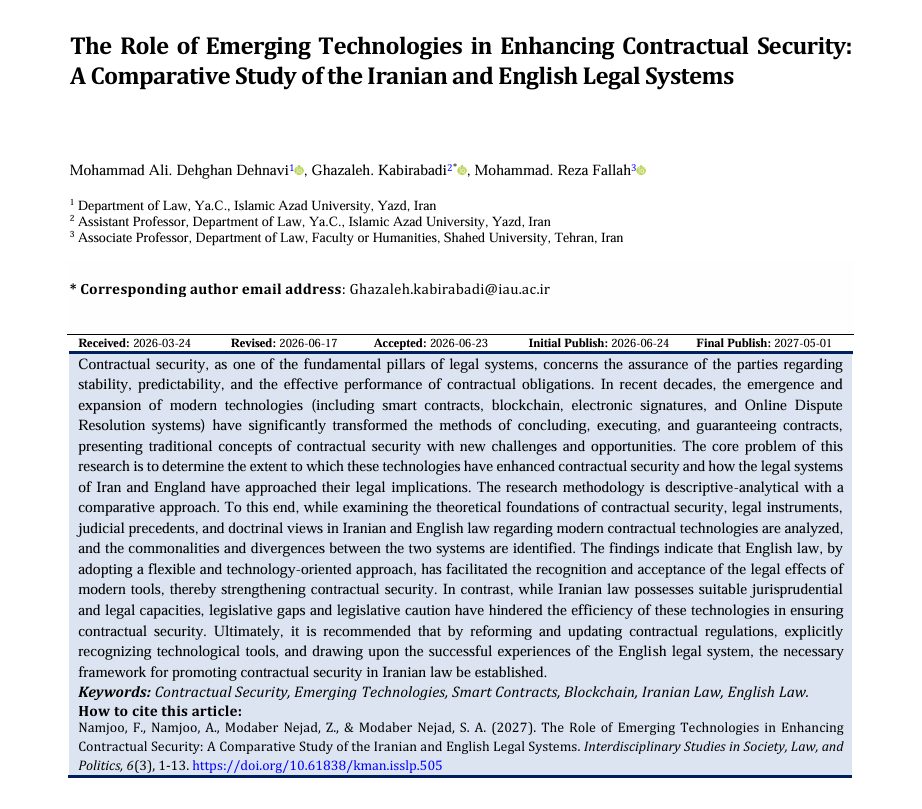
Contractual security, as one of the fundamental pillars of legal systems, concerns the assurance of the parties regarding stability, predictability, and the effective performance of contractual obligations. In recent decades, the emergence and expansion of modern technologies (including smart contracts, blockchain, electronic signatures, and Online Dispute Resolution systems) have significantly transformed the methods of concluding, executing, and guaranteeing contracts, presenting traditional concepts of contractual security with new challenges and opportunities. The core problem of this research is to determine the extent to which these technologies have enhanced contractual security and how the legal systems of Iran and England have approached their legal implications. The research methodology is descriptive-analytical with a comparative approach. To this end, while examining the theoretical foundations of contractual security, legal instruments, judicial precedents, and doctrinal views in Iranian and English law regarding modern contractual technologies are analyzed, and the commonalities and divergences between the two systems are identified. The findings indicate that English law, by adopting a flexible and technology-oriented approach, has facilitated the recognition and acceptance of the legal effects of modern tools, thereby strengthening contractual security. In contrast, while Iranian law possesses suitable jurisprudential and legal capacities, legislative gaps and legislative caution have hindered the efficiency of these technologies in ensuring contractual security. Ultimately, it is recommended that by reforming and updating contractual regulations, explicitly recognizing technological tools, and drawing upon the successful experiences of the English legal system, the necessary framework for promoting contractual security in Iranian law be established.
Downloads
References
Abbasi, H. R. (2022). The Role of Legal Institutions in Guaranteeing the Security of Transactions. Mizan Publications.
Anahid, F., & Zareh-Sani, A. (2024). An examination of smart contracts in Iranian private law. Second International Conference on Law, Management, Educational Sciences, Psychology, and Educational Planning Management, Tehran.
Ansari, M. R. (2022). Legal analysis of smart contracts in Iranian law. Private Law Research Quarterly, 10(2), 75-102.
Beatty, D. M. (2018). The Ultimate Rule of Law. Oxford University Press.
Brownsword, R. (2019). Law, Technology and Society: Re-Imagining the Regulatory Environment. Routledge.
Cartwright, J. (2019). Contract Law: An Introduction to the English Law of Contract. Hart Publishing.
De Filippi, P., & Wright, A. (2018). Blockchain and the Law: The Rule of Code. Harvard University Press.
Dehghan Dehnavi, M. A., Kabirabadi, G., & Fallah, M. R. (2026). Contractual security: An analytical approach to Iranian and English law with emphasis on international instruments. Legal Studies in Digital Age, 5(1), 1-10.
Emami, S. H. (2021). Civil Law (Vol. 1). Islamieh Publications.
Green, S., & Randall, J. (2021). The Law of Smart Contracts. Sweet & Maxwell.
Heidari, A. (2022). Smart contracts and the challenges of legal security in Iranian law. Information Technology Law Quarterly, 4(2), 129-152.
Jafari, M. H. (2022). Legal security and the efficiency of the contract system in Iranian law. Private Law Research Quarterly, 10(2), 25-48.
Katouzian, N. (2019). General Rules of Contracts (Vol. 1). Sahami Enteshar Co.
Kazemi, A. A. (2023). Contractual risk management in modern contracts. Law and Technology Quarterly, 5(1), 53-78.
Kazemi, R. (2023). Contractual risk and legal security in technological contracts. Economic Law Research, 9(1), 53-78.
Lessig, L. (2006). Code: Version 2.0. Basic Books.
McKendrick, E. (2023). Contract Law: Text, Cases, and Materials (8th ed.). Oxford University Press.
Mirzaii, H. (2023). Blockchain and the re-reading of traditional institutions of contract law. Private Law Studies Quarterly, 6(3), 75-102.
Murray, A. (2022). Information Technology Law: The Law and Society. Oxford University Press.
Nouri, F. (2020). The role of courts in the validity of electronic contracts. Modern Adjudication Quarterly, 3(4), 91-115.
Nouri, S. M. (2020). Evolution of the concept of intent and consent in electronic contracts. Islamic Jurisprudence and Law Studies Quarterly, 7(4), 95-122.
Poole, J. (2020). Textbook on Contract Law (15th ed.). Oxford University Press.
Rezaei, M. (2021). Institutional analysis of contractual security in the digital age. Public and Private Law Research, 8(1), 45-72.
Sadeghi, M. (2021a). A critical analysis of the role of judicial precedent in the development of contract law. Dadgostar Legal Journal, 8(3), 71-94.
Sadeghi, M. (2021b). Legal security of electronic transactions in Iranian law. Journal of Information Technology Law, 2(1), 65-89.
Safai, S. H. (2020). Law of Obligations. Mizan Publications.
Shahidi, M. (2021). Formation of Contracts and Obligations. Majd Publications.
Smith, J. (2020). Judicial approaches to automated contracts. Law Quarterly Review, 136, 132-158.
Szabo, N. (1997). Formalizing and securing relationships on public networks. First Monday, 2(9).
Werbach, K. (2022). The Blockchain and the New Architecture of Trust. MIT Press.
Williamson, O. E. (1985). The Economic Institutions of Capitalism. Free Press.
Zetzsche, D. A., Buckley, R. P., Arner, D. W., & Fohr, L. (2020). The ICO gold rush. Harvard International Law Journal, 61(1), 85-130.
Downloads
Additional Files
Publication Timeline
- Submitted
- Revised
- Accepted
Issue
Section
License
Copyright (c) 2025 Mohammad Ali Dehghan Dehnavi (Author); Ghazaleh Kabirabadi (Corresponding author); Mohammad Reza Fallah (Author)

This work is licensed under a Creative Commons Attribution-NonCommercial 4.0 International License.