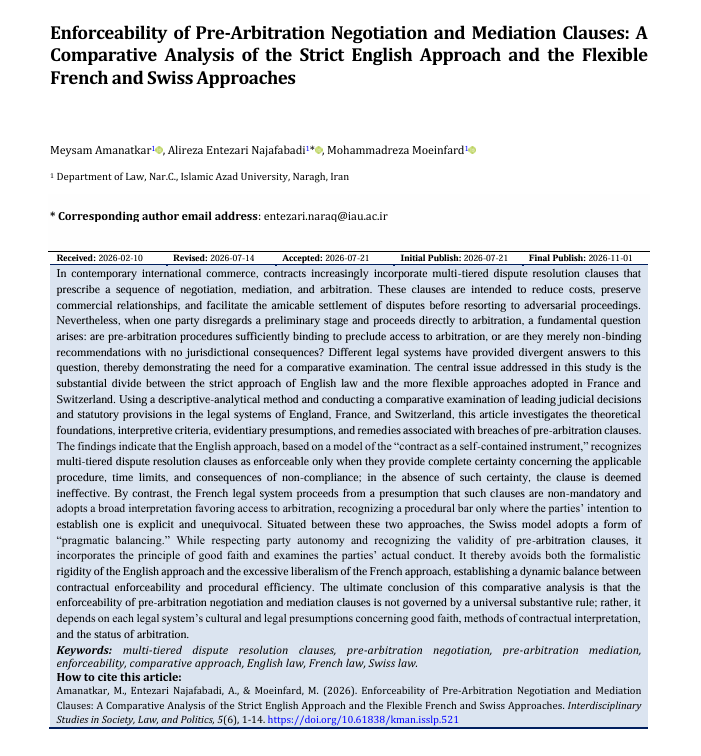
Enforceability of Pre-Arbitration Negotiation and Mediation Clauses: A Comparative Analysis of the Strict English Approach and the Flexible French and Swiss Approaches
Keywords:
multi-tiered dispute resolution clauses, pre-arbitration negotiation, pre-arbitration mediation, enforceability, comparative approach, English law, French law, Swiss lawAbstract
In contemporary international commerce, contracts increasingly incorporate multi-tiered dispute resolution clauses that prescribe a sequence of negotiation, mediation, and arbitration. These clauses are intended to reduce costs, preserve commercial relationships, and facilitate the amicable settlement of disputes before resorting to adversarial proceedings. Nevertheless, when one party disregards a preliminary stage and proceeds directly to arbitration, a fundamental question arises: are pre-arbitration procedures sufficiently binding to preclude access to arbitration, or are they merely non-binding recommendations with no jurisdictional consequences? Different legal systems have provided divergent answers to this question, thereby demonstrating the need for a comparative examination. The central issue addressed in this study is the substantial divide between the strict approach of English law and the more flexible approaches adopted in France and Switzerland. Using a descriptive-analytical method and conducting a comparative examination of leading judicial decisions and statutory provisions in the legal systems of England, France, and Switzerland, this article investigates the theoretical foundations, interpretive criteria, evidentiary presumptions, and remedies associated with breaches of pre-arbitration clauses. The findings indicate that the English approach, based on a model of the “contract as a self-contained instrument,” recognizes multi-tiered dispute resolution clauses as enforceable only when they provide complete certainty concerning the applicable procedure, time limits, and consequences of non-compliance; in the absence of such certainty, the clause is deemed ineffective. By contrast, the French legal system proceeds from a presumption that such clauses are non-mandatory and adopts a broad interpretation favoring access to arbitration, recognizing a procedural bar only where the parties’ intention to establish one is explicit and unequivocal. Situated between these two approaches, the Swiss model adopts a form of “pragmatic balancing.” While respecting party autonomy and recognizing the validity of pre-arbitration clauses, it incorporates the principle of good faith and examines the parties’ actual conduct. It thereby avoids both the formalistic rigidity of the English approach and the excessive liberalism of the French approach, establishing a dynamic balance between contractual enforceability and procedural efficiency. The ultimate conclusion of this comparative analysis is that the enforceability of pre-arbitration negotiation and mediation clauses is not governed by a universal substantive rule; rather, it depends on each legal system’s cultural and legal presumptions concerning good faith, methods of contractual interpretation, and the status of arbitration.
Downloads
References
Alhasan, T. K. (2025). From Pathology to Precision: Transforming Multi-Tiered Dispute Resolution Clauses in International Contracts. Conflict Resolution Quarterly, 42(4), 557-563.
Born, G. B. (2014). International Commercial Arbitration (2nd ed., Vol. 2). Kluwer Law International.
Danaei Elmi, M. (2024). The Scope of Judicial Review of Arbitral Awards by National Judges: A Comparative Study in Iranian and French Law (1st ed.). Ganj-e Danesh.
Fauvarque-Cosson, B., & Mazeaud, D. (2009). European Contract Law: Materials for a Common Frame of Reference: Terminology, Guiding Principles, Model Rules. Sellier European Law Publishers.
Fouchard, P., Gaillard, E., & Goldman, B. (1999). Fouchard Gaillard Goldman on International Commercial Arbitration. Kluwer Law International.
Herati, M. (2025). Conflict between the Principle of Freedom of Contract and Public Policy Requirements in Private and Government Contracts in French and Iranian Law. Research and Development in Private Law, 2(4).
Joneydi, L., & Mansouri Razi, A. (2021). The Nature and Effect of Multi-Tiered Dispute Resolution Clauses in Contracts. Private Law Research, 9(34), 97-121.
Lew, J. D. M. (2012). Comparative International Commercial Arbitration (M. Habibi Mojandeh, Trans.; 1st ed.). Mofid University.
Moqiseh, H. (2022). Non-Recognition of Arbitral Awards: In Iranian Law, French Law, and UNCITRAL Rules (1st ed.). Raz-e Nahan.
Pryles, M. (2001). Multi-Tiered Dispute Resolution Clauses. Journal of International Arbitration, 18(2).
Redfern, A., Hunter, M., Blackaby, N., & Partasides, C. (2015). Redfern and Hunter on International Arbitration (6th ed.). Oxford University Press.
Shiravi, A. (2013). International Trade Law (6th ed.). SAMT Publications.
Westerlund, J. (2021). The Enforceability of Multi-Tier Dispute Resolution Clauses.
Downloads
Additional Files
Publication Timeline
- Submitted
- Revised
- Accepted
Issue
Section
License
Copyright (c) 2025 Meysam Amanatkar (Author); Alireza Entezari Najafabadi (Corresponding author); Mohammadreza Moeinfard (Author)

This work is licensed under a Creative Commons Attribution-NonCommercial 4.0 International License.