International Privacy Protection Laws in Smart Contracts
Keywords:
Smart contracts, privacy protection, blockchain, data protection law, international privacy law, privacy by design, personal data, decentralized governanceAbstract
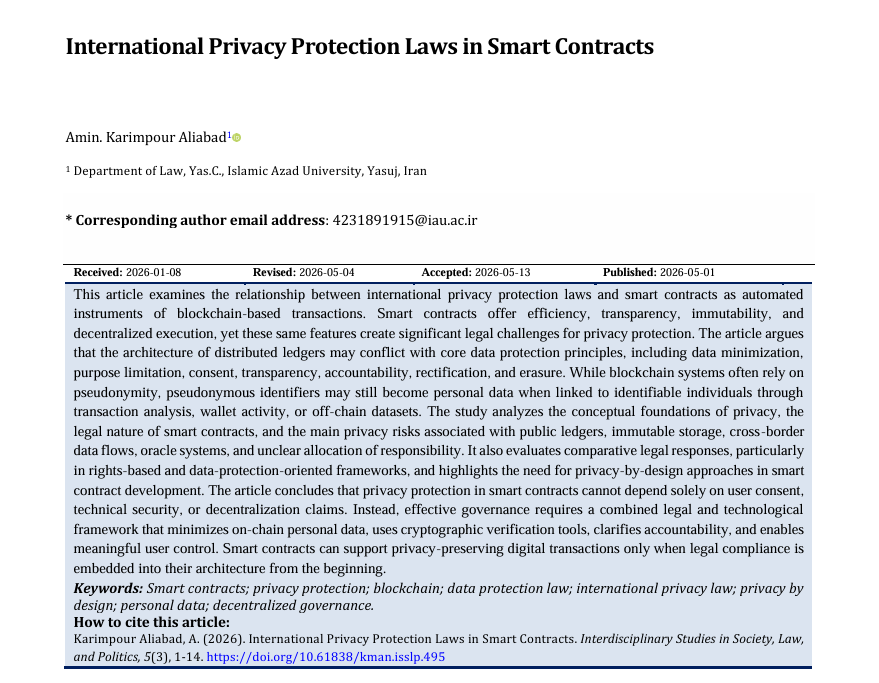
This article examines the relationship between international privacy protection laws and smart contracts as automated instruments of blockchain-based transactions. Smart contracts offer efficiency, transparency, immutability, and decentralized execution, yet these same features create significant legal challenges for privacy protection. The article argues that the architecture of distributed ledgers may conflict with core data protection principles, including data minimization, purpose limitation, consent, transparency, accountability, rectification, and erasure. While blockchain systems often rely on pseudonymity, pseudonymous identifiers may still become personal data when linked to identifiable individuals through transaction analysis, wallet activity, or off-chain datasets. The study analyzes the conceptual foundations of privacy, the legal nature of smart contracts, and the main privacy risks associated with public ledgers, immutable storage, cross-border data flows, oracle systems, and unclear allocation of responsibility. It also evaluates comparative legal responses, particularly in rights-based and data-protection-oriented frameworks, and highlights the need for privacy-by-design approaches in smart contract development. The article concludes that privacy protection in smart contracts cannot depend solely on user consent, technical security, or decentralization claims. Instead, effective governance requires a combined legal and technological framework that minimizes on-chain personal data, uses cryptographic verification tools, clarifies accountability, and enables meaningful user control. Smart contracts can support privacy-preserving digital transactions only when legal compliance is embedded into their architecture from the beginning.
Downloads
References
Casey, M., & Vigna, P. (2018). The Truth Machine: The Blockchain and the Future of Everything. St. Martin’s Press.
Cavoukian, A. (2012). Privacy by Design: The Definitive Workshop. Information & Privacy Commissioner of Ontario.
Christidis, K., & Devetsikiotis, M. (2016). Blockchains and Smart Contracts for the Internet of Things. IEEE Access, 4, 2292-2303.
De Filippi, P., & Wright, A. (2018). Blockchain and the Law: The Role of Smart Contracts in Privacy Compliance. Harvard Journal of Law & Technology, 31(2), 487-524.
Finck, M. (2018). Blockchains and Data Protection in the European Union. Eur. Law J., 24(6), 923-947.
Finck, M. (2020). Blockchain and Data Protection: Challenges and Legal Implications. Oxford University Press.
Huckle, S., & White, M. (2019). FinTech and the GDPR: Implications for Blockchain Privacy. Journal of Financial Regulation and Compliance, 27(2), 190-205.
Kahn, R., & Kellaris, G. (2021). Data Protection Challenges in Cross-Border Blockchain Systems. Computer Law & Security Review, 41(3), 105-124.
Katz, J., & Lindell, Y. (2014). Introduction to Modern Cryptography. Journal of Cryptology, 27(1), 1-30.
Kshetri, N. (2021). Blockchain’s Roles in Strengthening Cybersecurity and Protecting Privacy. MIT Press.
Kuner, C. (2013). Transborder Data Flows and Data Privacy Law. Oxford University Press.
Moerel, L., & Prins, C. (2016). Privacy for the Homo Digitalis: Proposal for a Revised Privacy Framework. International Data Privacy Law, 6(2), 82-104.
Narayanan, A., Bonneau, J., Felten, E., Miller, A., & Goldfeder, S. (2016). Bitcoin and Cryptocurrency Technologies: A Comprehensive Introduction. Princeton University Press.
Raskin, M. (2017). The Law and Legality of Smart Contracts. Georgetown Law Technology Review, 1(2), 305-341.
Solove, D. J. (2008). Understanding Privacy. Harvard University Press.
Solove, D. J., & Schwartz, P. M. (2021). Information Privacy Law. Aspen Publishers.
Swire, P., & Litan, A. (2018). Privacy and Blockchain: Fitting Square Pegs into Round Holes. Journal of Law, Technology & Policy, 2018, 1-36.
Tapscott, D., & Tapscott, A. (2016). Blockchain Revolution: How the Technology Behind Bitcoin Is Changing Money, Business, and the World. Portfolio.
Warren, S. D., & Brandeis, L. D. (1890). The Right to Privacy. Harvard Law Review.
Wirtz, B. W., & Lihotzky, N. (2020). Smart Contracts as a Governance Mechanism. Electronic Markets, 30(2), 277-294.
Zwitter, A. (2014). Big Data and International Privacy Regulation. Journal of International Affairs, 67(1) 1-14.
Zyskind, G., Nathan, O., & Pentland, A. (2015). Decentralizing Privacy: Using Blockchain to Protect Personal Data. IEEE Security & Privacy, 13(5), 23-33.
Downloads
Additional Files
Publication Timeline
- Submitted
- Revised
- Accepted
Issue
Section
License
Copyright (c) 2026 Amin Karimpour Aliabad (Author)

This work is licensed under a Creative Commons Attribution-NonCommercial 4.0 International License.