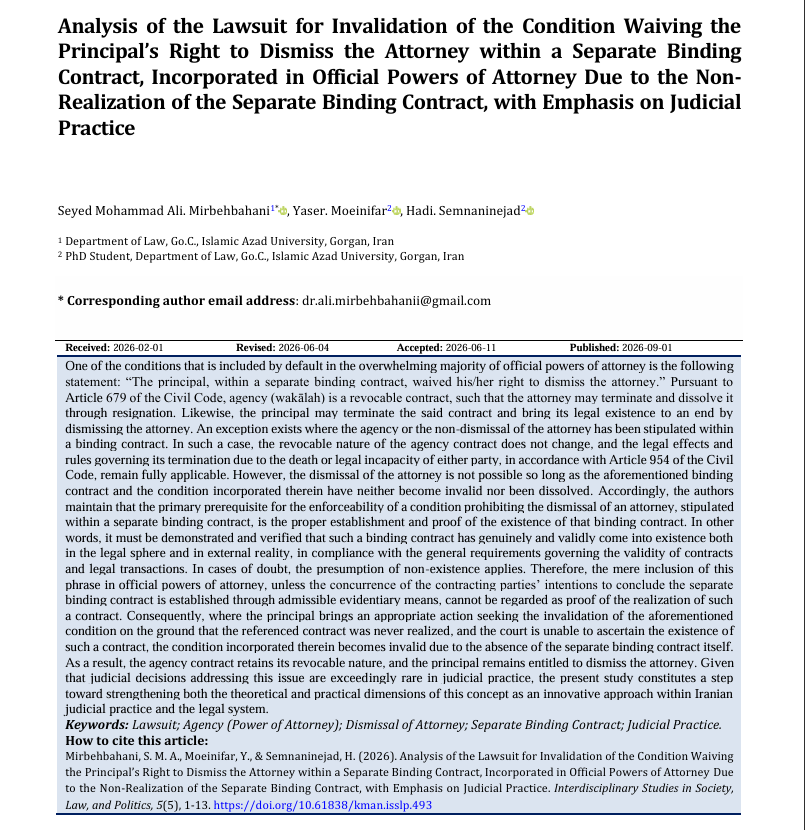
Analysis of the Lawsuit for Invalidation of the Condition Waiving the Principal’s Right to Dismiss the Attorney within a Separate Binding Contract, Incorporated in Official Powers of Attorney Due to the Non-Realization of the Separate Binding Contract, with Emphasis on Judicial Practice
Keywords:
Lawsuit, Agency (Power of Attorney), Dismissal of Attorney, Separate Binding Contract, Judicial PracticeAbstract
One of the conditions that is included by default in the overwhelming majority of official powers of attorney is the following statement: “The principal, within a separate binding contract, waived his/her right to dismiss the attorney.” Pursuant to Article 679 of the Civil Code, agency (wakālah) is a revocable contract, such that the attorney may terminate and dissolve it through resignation. Likewise, the principal may terminate the said contract and bring its legal existence to an end by dismissing the attorney. An exception exists where the agency or the non-dismissal of the attorney has been stipulated within a binding contract. In such a case, the revocable nature of the agency contract does not change, and the legal effects and rules governing its termination due to the death or legal incapacity of either party, in accordance with Article 954 of the Civil Code, remain fully applicable. However, the dismissal of the attorney is not possible so long as the aforementioned binding contract and the condition incorporated therein have neither become invalid nor been dissolved. Accordingly, the authors maintain that the primary prerequisite for the enforceability of a condition prohibiting the dismissal of an attorney, stipulated within a separate binding contract, is the proper establishment and proof of the existence of that binding contract. In other words, it must be demonstrated and verified that such a binding contract has genuinely and validly come into existence both in the legal sphere and in external reality, in compliance with the general requirements governing the validity of contracts and legal transactions. In cases of doubt, the presumption of non-existence applies. Therefore, the mere inclusion of this phrase in official powers of attorney, unless the concurrence of the contracting parties’ intentions to conclude the separate binding contract is established through admissible evidentiary means, cannot be regarded as proof of the realization of such a contract. Consequently, where the principal brings an appropriate action seeking the invalidation of the aforementioned condition on the ground that the referenced contract was never realized, and the court is unable to ascertain the existence of such a contract, the condition incorporated therein becomes invalid due to the absence of the separate binding contract itself. As a result, the agency contract retains its revocable nature, and the principal remains entitled to dismiss the attorney. Given that judicial decisions addressing this issue are exceedingly rare in judicial practice, the present study constitutes a step toward strengthening both the theoretical and practical dimensions of this concept as an innovative approach within Iranian judicial practice and the legal system.
Downloads
References
Amini, A., & Ayati, S. M. R. (2009). Tahrir al-Rawda fi Sharh al-Lum'a (13th ed., Vol. 1). SAMT Publications.
Emami, S. H. (2011). Civil Law (31st ed., Vol. 1). Islamieh Bookstore Publications.
Ghasemi Hamed, A. (2010). Essential Conditions for the Formation of Contract (2nd ed.). Derak Publications.
Jafari Langroudi, M. J. (2008). The Effect of Will in Civil Law (2nd ed.). Ganj-e Danesh Publications.
Karimi, S., & Saadatmandi, F. S. (2024). A New Look at the Rule of Dependence of a Condition on the Contract in the Essential Conditions of Transaction Validity Based on the Rule of Toleration. Studies in Islamic Jurisprudence and Law(35).
Katouzian, N. (1997). Res Judicata in Civil Actions (5th ed.). Dadgostar Publications.
Katouzian, N. (2004). Introduction to the Science of Law and Study of the Iranian Legal System (39th ed.). Enteshar Joint Stock Company Publications.
Katouzian, N. (2009a). The Civil Code in the Current Legal Order (21st ed.). Mizan Publications.
Katouzian, N. (2009b). General Rules of Contracts (1st ed., Vol. 2). Enteshar Joint Stock Company Publications.
Katouzian, N. (2010). Legal Acts (2nd ed.). Enteshar Joint Stock Company Publications.
Katouzian, N. (2011). Introductory Course in Civil Law: Lessons from Specific Contracts (15th ed., Vol. 1). Ganj-e Danesh Publications.
Katouzian, N. (2012). General Rules of Contracts (10th ed., Vol. 1). Enteshar Joint Stock Company Publications.
Legal Deputy of the Presidency. (2015a). Collection of Civil Procedure Laws and Regulations (11th ed., Vol. 1). Department for Printing and Publication of Laws and Regulations of the Presidency.
Legal Deputy of the Presidency. (2015b). Collection of the Civil Code (10th ed.). Presidency Publications.
Mashayeghi, S., & Adabi, H. R. (2019). Scope and Characteristics of the Rule of Estoppel in Domestic Public Law. International Journal of Nations Research, 4(40).
Matin-Daftari, A. (1970). Civil and Commercial Procedure (4th ed., Vol. 1).
Mirzaei, A. (2012). Annotated Civil Code (7th ed.). Behnami Publications.
Moein, M. (1981). Moein Persian Dictionary (4th ed., Vol. 2). Amir Kabir Publications.
Shahri, G. (2016). The Consolidated Collection of Legal Laws and Regulations (3rd ed., Vol. 1). Official Gazette Publications.
Shams, A. (2010). Civil Procedure: Advanced Course (24th ed., Vol. 1). Derak Publications.
Downloads
Additional Files
Publication Timeline
- Submitted
- Revised
- Accepted
Issue
Section
License
Copyright (c) 2026 Seyed Mohammad Ali Mirbehbahani (Corresponding author); Yaser Moeinifar, Hadi Semnaninejad (Author)

This work is licensed under a Creative Commons Attribution-NonCommercial 4.0 International License.