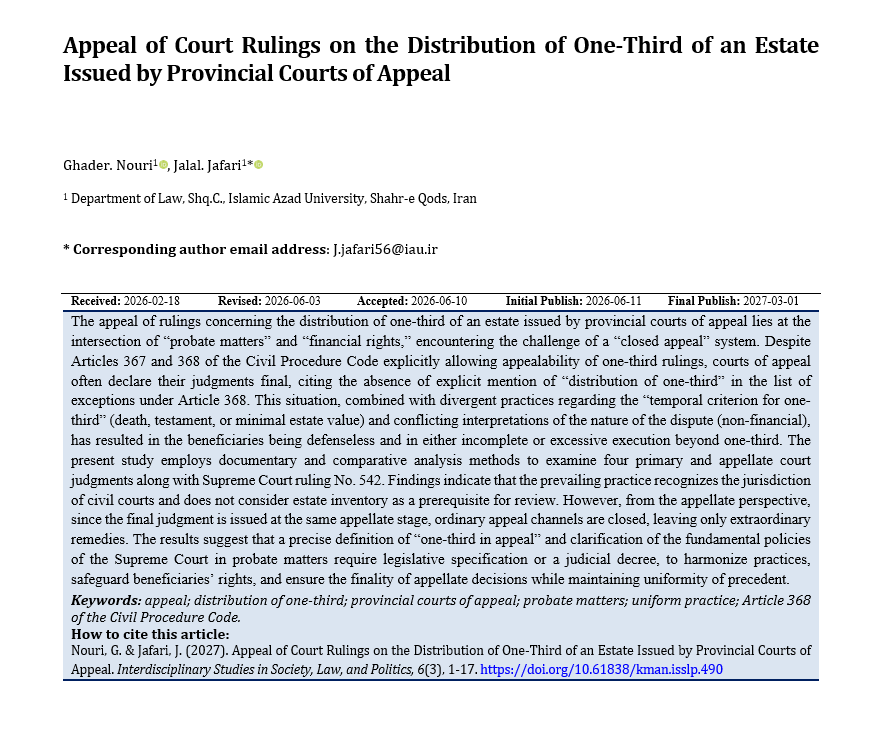
Appeal of Court Rulings on the Distribution of One-Third of an Estate Issued by Provincial Courts of Appeal
Keywords:
appeal, distribution of one-third, provincial courts of appeal, probate matters, uniform practice, Article 368 of the Civil Procedure CodeAbstract
The appeal of rulings concerning the distribution of one-third of an estate issued by provincial courts of appeal lies at the intersection of “probate matters” and “financial rights,” encountering the challenge of a “closed appeal” system. Despite Articles 367 and 368 of the Civil Procedure Code explicitly allowing appealability of one-third rulings, courts of appeal often declare their judgments final, citing the absence of explicit mention of “distribution of one-third” in the list of exceptions under Article 368. This situation, combined with divergent practices regarding the “temporal criterion for one-third” (death, testament, or minimal estate value) and conflicting interpretations of the nature of the dispute (non-financial), has resulted in the beneficiaries being defenseless and in either incomplete or excessive execution beyond one-third. The present study employs documentary and comparative analysis methods to examine four primary and appellate court judgments along with Supreme Court ruling No. 542. Findings indicate that the prevailing practice recognizes the jurisdiction of civil courts and does not consider estate inventory as a prerequisite for review. However, from the appellate perspective, since the final judgment is issued at the same appellate stage, ordinary appeal channels are closed, leaving only extraordinary remedies. The results suggest that a precise definition of “one-third in appeal” and clarification of the fundamental policies of the Supreme Court in probate matters require legislative specification or a judicial decree, to harmonize practices, safeguard beneficiaries’ rights, and ensure the finality of appellate decisions while maintaining uniformity of precedent.
Downloads
References
Beigi Habibabadi, A., & Beigi Habibabadi, M. (2024). Challenges of the Action for Division of Inheritance Estate in Judicial Practice. Biannual Journal of Research and Development in Private Law, 1(2), 8-45.
Emami, S. H. (2000). Civil Law, Vol. 5: Wills (Vol. 5). Islamieh Publishing.
Hasani, M. (2016). Extraordinary Methods of Complaining against Judicial Decisions (1st ed.). Mizan Publishing.
Katouzian, N. (2019). Civil Law, Vol. 4: Inheritance and Wills (28th ed., Vol. 4).
Kulayni, M. i. Y. q. (2009). Al-Kafi (1st ed.). Dar al-Hadith for Printing and Publishing.
Maqdisi, M. a.-D. (1968). Al-Mughni by Ibn Qudamah. Maktabat al-Qahirah.
Matin Daftari, R. (2019). Civil Procedure in Iranian Law (3rd ed., Vol. 2). Jangal Publishing.
Downloads
Additional Files
Publication Timeline
- Submitted
- Revised
- Accepted
Issue
Section
License
Copyright (c) 2025 Ghader Nouri (Author); Jalal Jafari (Corresponding author)

This work is licensed under a Creative Commons Attribution-NonCommercial 4.0 International License.