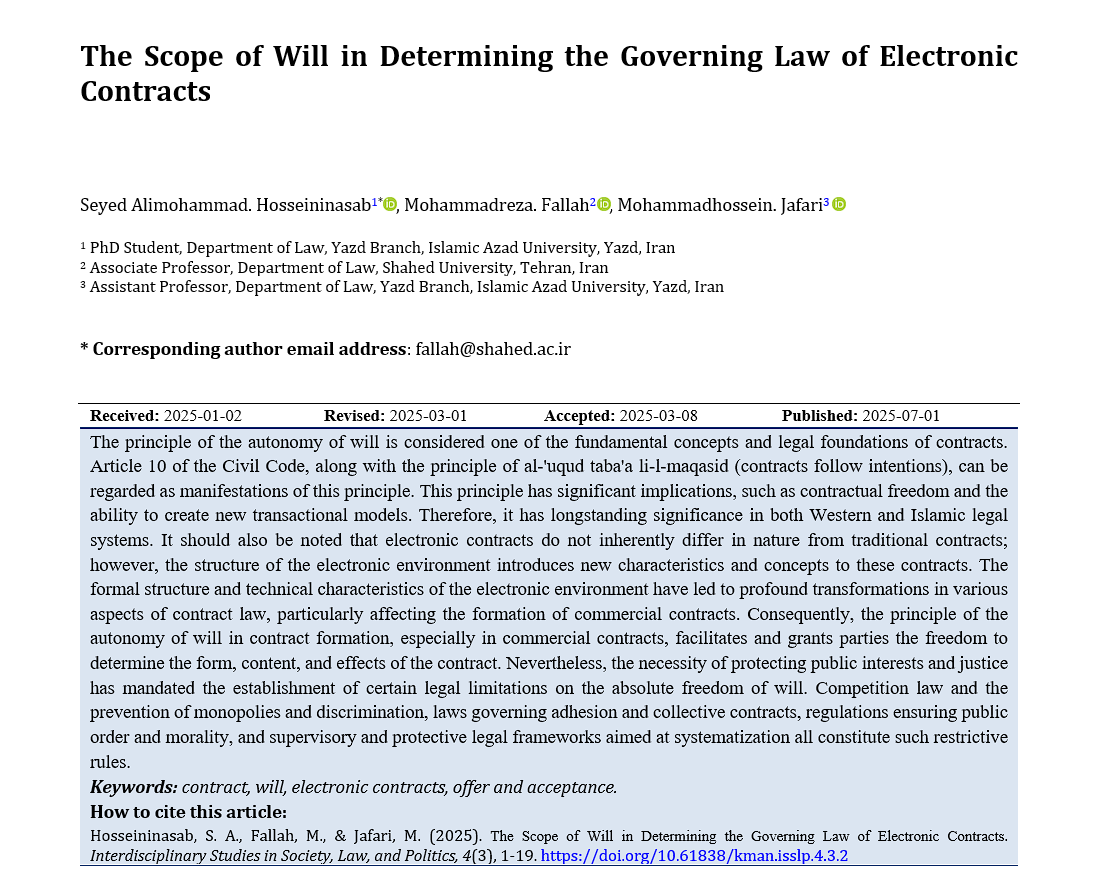
The Scope of Will in Determining the Governing Law of Electronic Contracts
DOI:
https://doi.org/10.61838/kman.isslp.4.3.2Keywords:
contract, will, electronic contracts, offer and acceptanceAbstract
The principle of the autonomy of will is considered one of the fundamental concepts and legal foundations of contracts. Article 10 of the Civil Code, along with the principle of al-'uqud taba'a li-l-maqasid (contracts follow intentions), can be regarded as manifestations of this principle. This principle has significant implications, such as contractual freedom and the ability to create new transactional models. Therefore, it has longstanding significance in both Western and Islamic legal systems. It should also be noted that electronic contracts do not inherently differ in nature from traditional contracts; however, the structure of the electronic environment introduces new characteristics and concepts to these contracts. The formal structure and technical characteristics of the electronic environment have led to profound transformations in various aspects of contract law, particularly affecting the formation of commercial contracts. Consequently, the principle of the autonomy of will in contract formation, especially in commercial contracts, facilitates and grants parties the freedom to determine the form, content, and effects of the contract. Nevertheless, the necessity of protecting public interests and justice has mandated the establishment of certain legal limitations on the absolute freedom of will. Competition law and the prevention of monopolies and discrimination, laws governing adhesion and collective contracts, regulations ensuring public order and morality, and supervisory and protective legal frameworks aimed at systematization all constitute such restrictive rules.
Downloads
References
Ahangaran, M. R., & Ahmadi, A. (2021). Electronic Contracts: Formation to Termination (Comparative Study in Islamic Jurisprudence, Iranian Law, and the 2005 Geneva Convention). Majd Publications.
Ahmadi Jashfaqani, H. A., Mashayekh, R., Azizian, S., & Azizian, S. (2018). Nature, Characteristics, and Principles of Electronic Contract Formation (Case Study: Laws of the Islamic Republic of Iran). National Conference on New Ideas and Creativity in Management, Accounting, Legal, and Social Studies, Tehran.
Al-Dusouqi, I. A. (2003). Legal Aspects of Electronic Transactions. Kuwait University Publications.
Al-Ghurawi al-Na’ini, M. H. (1992). Al-Makasib wa al-Bay’. Islamic Publications Institute.
Al-Jawhari, I. b. H. (1987). Al-Sahah Taj al-Lughah wa al-Sahah al-Arabiyah. Dar al-Ilm lil-Malayin.
Al-Raghib al-Isfahani. (1996). Al-Mufradat fi Gharib al-Quran. Dhawi al-Qurba.
Al-San, M. (2006). Determining the Governing Law of Electronic Contracts. Journal of Law and Politics, 19.
Almasi, N. (2003). Conflict of Laws. University Publishing Center.
Amid, H. (2005). Persian Dictionary (Pocket Edition). Amir Kabir Publications.
Amiri Qa’em Maqami, A. (1999). Contractual Obligations. Mizan Publications.
Amirmoezi, A. (2012). Rules for Resolving Conflicts in the Governing Law of Contractual Obligations. Dadgostar Publications.
Bahrami Ahmadi, H. (2011). Contractual Obligations and Contracts. Imam Sadiq University Publications.
Bajaj Dijani, N. (2005). From Electronic Information Exchange to Electronic Commerce. Business Studies and Research Institute Publications.
Emami, H. (2004). Civil Law. Islamic Publications.
Farrell, H. (2003). Constructing the International Foundations of E-Commerce-The EU- U.S. Safe Harbor Arrangement (Vol. 57).
Hadi Zadeh Moghaddam, A. (2008). Marketing and Electronic Commerce: How to Market in the Electronic Commerce Environment. Journal of Advertising Knowledge, 27.
Husayni al-Maraghi, S. M. A. (1997). Al-Anawin al-Fiqhiyah. Islamic Publications Institute.
Jafari Langroudi, M. J. (1990). Civil Law Course. University of Tehran Publications.
Jafari Langroudi, M. J. (1999a). Mabsut in Legal Terminology. Ganj Danesh Publications.
Jafari Langroudi, M. J. (1999b). Mabsut in Terminology. Ganj Danesh Publications.
Katouzian, N. (1985). Civil Law - General Rules of Contracts. Mizan Publications.
Katouzian, N. (1997). Preliminary Course in Civil Law - Legal Acts. Samt Publications.
Katouzian, N. (1998). Civil Law in the Current Legal Order. Dadgostar Publications.
Katouzian, N. (2009). General Rules of Contracts. Sahami Publications.
Katouzian, N. (2011). Civil Law (General Rules of Contracts). Sahami Publications.
Khosro Pour, H. (2011). Formation of Electronic Contracts Tarbiat Moallem University]. Tehran.
Khu’i, A. Q. (1987). Kitab al-Nikah. Dar al-Hadi Publications.
Khu’i, A. Q. (1998). Misbah al-Fiqhah fi al-Mu’amalat. Al-Hadi Publications.
Mafi, H., & Kaviar, H. (2013). Comparative Study of the Governing Law of Electronic Contracts Concluded in the Internet Environment from the Perspective of American, European, and Iranian Legal Systems. Journal of Comparative Law Studies, 4(1).
Matulionyte, R. (2011). Law Applicable to Copyright. Edward Elgar Publishing Limited. https://doi.org/10.1017/S0020818303572022
Najafi, M. H. (1981). Jawahir al-Kalam. Dar al-Ihya al-Turath al-Arabi.
Naraqi, A. b. M. M. (1996). Awaid al-Ayyam fi Bayan Qawa’id al-Ahkam. Islamic Propagation Office.
Nasiri, M. (2004). International Trade Law in the Iranian Legal System. Amir Kabir Publications.
Nikbakht, H. R. (1997). Determining the Governing Law of Contractual Obligations. Journal of Legal Research, 21.
Pointon, L. (2004). Developments in Electronic Contract Laws.
Qanavati, J., Vahdati Shabiri, H., Abdipour, E., & Mohaqeq Damad, S. M. (2014). Contract Law in Imami Jurisprudence. Samt Publications.
Rafi’i Moghaddam, A. (2011). The Principle of Consent in Legal Acts (Comparative Study in Imami Jurisprudence, Iranian Law, and French Law). Imam Sadiq University Publications.
Rah Peyk, H. (1996). Defects of Will and Consent: Error in Contracts. Journal of Legal Views, 2.
Sadeghi Nashat, A. (2000). Electronic Commerce Law. Journal of the Bar Association, 170.
Sadri, S. M. (2009). Electronic Transactions (Foundations, Nature, Legitimacy). Andisheh-ye Hoquqi Publications.
Safa’i, S. H. (2005). General Rules of Contracts. Mizan Publications.
Shahidi, M. (2016). Civil Law (Obligations). Majd Publications.
Shiravi, A. H. (2010). International Trade Law. Samt Publications.
Tabataba’i, S. M. H. (2014). Al-Mizan fi Tafsir al-Quran. Al-A’lami Publications.
Vasali Nasih, M. (2006). Electronic Contracts and Their Basis of Validity. Journal of the Bar Association, 66.
Zanjani, A. (1991). International Contractual Obligations in Islamic Jurisprudence and Law. Journal of International Law, 14.
Downloads
Additional Files
Publication Timeline
- Submitted
- Revised
- Accepted
Issue
Section
License
Copyright (c) 2025 Seyed Alimohammad Hosseininasab (Author); Mohammadreza Fallah (Corresponding author); Mohammadhossein Jafari (Author)

This work is licensed under a Creative Commons Attribution-NonCommercial 4.0 International License.