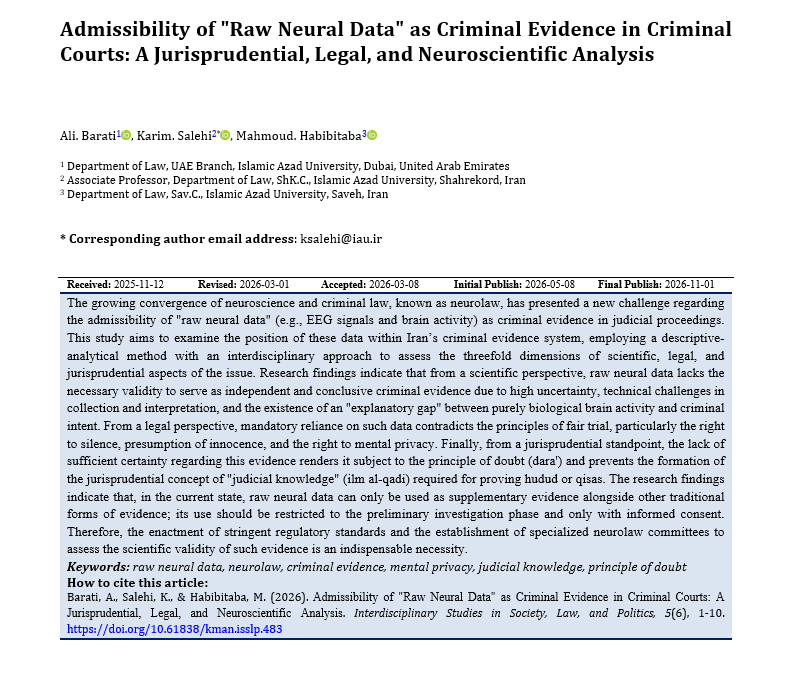
Admissibility of "Raw Neural Data" as Criminal Evidence in Criminal Courts: A Jurisprudential, Legal, and Neuroscientific Analysis
Keywords:
raw neural data, neurolaw, criminal evidence, mental privacy, judicial knowledge, principle of doubtAbstract
The growing convergence of neuroscience and criminal law, known as neurolaw, has presented a new challenge regarding the admissibility of "raw neural data" (e.g., EEG signals and brain activity) as criminal evidence in judicial proceedings. This study aims to examine the position of these data within Iran’s criminal evidence system, employing a descriptive-analytical method with an interdisciplinary approach to assess the threefold dimensions of scientific, legal, and jurisprudential aspects of the issue. Research findings indicate that from a scientific perspective, raw neural data lacks the necessary validity to serve as independent and conclusive criminal evidence due to high uncertainty, technical challenges in collection and interpretation, and the existence of an "explanatory gap" between purely biological brain activity and criminal intent. From a legal perspective, mandatory reliance on such data contradicts the principles of fair trial, particularly the right to silence, presumption of innocence, and the right to mental privacy. Finally, from a jurisprudential standpoint, the lack of sufficient certainty regarding this evidence renders it subject to the principle of doubt (dara') and prevents the formation of the jurisprudential concept of "judicial knowledge" (ilm al-qadi) required for proving hudud or qisas. The research findings indicate that, in the current state, raw neural data can only be used as supplementary evidence alongside other traditional forms of evidence; its use should be restricted to the preliminary investigation phase and only with informed consent. Therefore, the enactment of stringent regulatory standards and the establishment of specialized neurolaw committees to assess the scientific validity of such evidence is an indispensable necessity.
Downloads
References
Faqih, N., Jafari, S. A., & Dehghani, H. (2022). Legal and ethical challenges of neuroscience use in criminal courts: Emphasis on criminal evidence. Contemporary Legal Studies, 13(38), 55-78.
Gandy, O. H. (2016). The Panoptic Sort: A Political Economy of Personal Information. Oxford University Press.
Gazzaniga, M. S. (2015). Cognitive Neuroscience: The Biology of the Mind. W. W. Norton & Company.
Greene, J., & Cohen, J. (2004). For the law, neuroscience changes nothing and everything. Philosophical Transactions of the Royal Society B, 359(1451), 1775-1785.
Ienca, M., & Haselager, P. (2016). Hacking the Brain: Neurotechnology, cognitive enhancement and the law. Neuroethics, 9(1), 30-46.
Krimsky, S. (2011). The Legal Regulatory Context of Neurotechnologies in the Criminal Justice System
The Oxford Handbook of Neuroethics. In J. Illes & B. J. Sahakian (Eds.), (pp. 14-58). Oxford University Press.
Nabavi-Fard, S., Shirez, H., & Jalili, S. (2019). A review of brain mapping applications in criminology and neural prediction of criminal behavior. Military Medicine Journal, 9, 67-81.
Norian, M. (2018). Feasibility of brainwave technology in detecting deception in criminal matters. Criminal Law Research Journal, 11(1), 227-250.
O'Shea, T., & Murrie, D. C. (2014). Forensic Neuropsychology: Science and Practice. Guilford Press.
Raine, A. (2013). The Anatomy of Violence: The Biological Roots of Crime. Pantheon.
Rosenfeld, J. P. (2011). P300-based memory detection: An effective countermeasure to deception. Legal and Criminological Psychology, 16(1), 108-121.
Safaripour, Z., & Saadati, S. (2021). The Challenge of Neuroscience in Criminal Justice: A Juridical Analysis of Mental Privacy. Journal of Legal Studies, 13(2), 105-125.
Shabazi, A. R., & Mirhoseini, S. A. R. (2020). Criminal evidence in light of scientific advances with emphasis on artificial intelligence. Kerman Law Studies, 7(16), 23-50.
Shamlou, B., & Norouzi, M. H. (2021). Legal analysis of neuroscience applications in criminal evidence and its impact on fair trial principles. Judicial Law Journal, 85(114), 83-102.
Sharma, S. (2013). Brain Mapping and the Indian Legal System: A Critical Appraisal. Indian Journal of Clinical and Experimental Hypnosis, 5(2), 125-135.
Shen, F. X. (2013). Law and Neuroscience: The New Frontier. Annual Review of Law and Social Science, 9, 117-133.
Downloads
Additional Files
Publication Timeline
- Submitted
- Revised
- Accepted
Issue
Section
License
Copyright (c) 2025 Ali Barati (Author); Karim Salehi (Corresponding author); Mahmoud Habibitabar (Author)

This work is licensed under a Creative Commons Attribution-NonCommercial 4.0 International License.