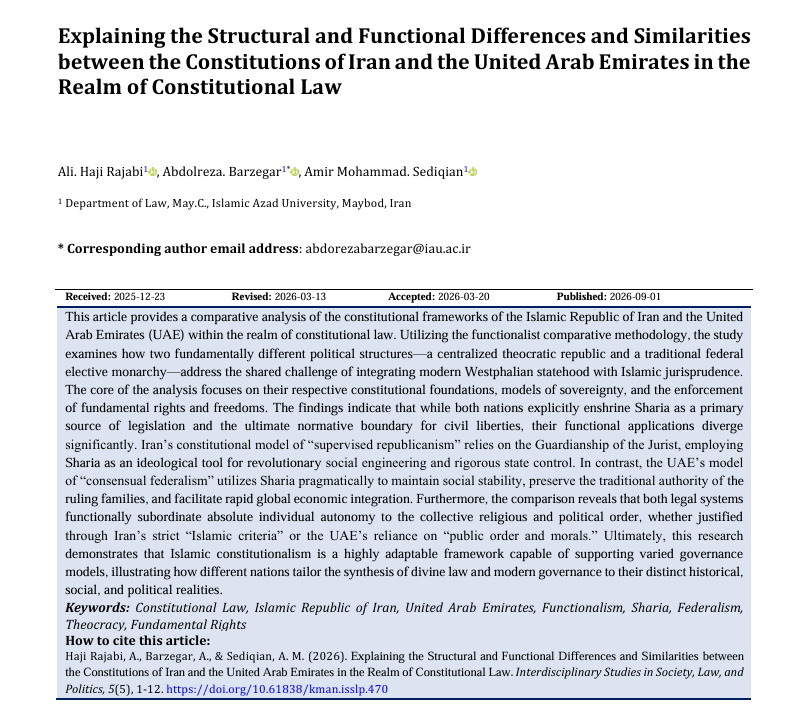
Explaining the Structural and Functional Differences and Similarities between the Constitutions of Iran and the United Arab Emirates in the Realm of Constitutional Law
Keywords:
Constitutional Law, Islamic Republic of Iran, United Arab Emirates, Functionalism, Sharia, Federalism, Theocracy, Fundamental RightsAbstract
This article provides a comparative analysis of the constitutional frameworks of the Islamic Republic of Iran and the United Arab Emirates (UAE) within the realm of constitutional law. Utilizing the functionalist comparative methodology, the study examines how two fundamentally different political structures—a centralized theocratic republic and a traditional federal elective monarchy—address the shared challenge of integrating modern Westphalian statehood with Islamic jurisprudence. The core of the analysis focuses on their respective constitutional foundations, models of sovereignty, and the enforcement of fundamental rights and freedoms. The findings indicate that while both nations explicitly enshrine Sharia as a primary source of legislation and the ultimate normative boundary for civil liberties, their functional applications diverge significantly. Iran’s constitutional model of “supervised republicanism” relies on the Guardianship of the Jurist, employing Sharia as an ideological tool for revolutionary social engineering and rigorous state control. In contrast, the UAE’s model of “consensual federalism” utilizes Sharia pragmatically to maintain social stability, preserve the traditional authority of the ruling families, and facilitate rapid global economic integration. Furthermore, the comparison reveals that both legal systems functionally subordinate absolute individual autonomy to the collective religious and political order, whether justified through Iran’s strict “Islamic criteria” or the UAE’s reliance on “public order and morals.” Ultimately, this research demonstrates that Islamic constitutionalism is a highly adaptable framework capable of supporting varied governance models, illustrating how different nations tailor the synthesis of divine law and modern governance to their distinct historical, social, and political realities.
Downloads
References
Al-Jurf, T. a. (1990). Constitutional Law and Principles of the Constitutional System in Iraq. Cairo Modern Library.
Al-Khaitan, F. (2015). Human Rights in the Arab Constitution. Dar Wael for Publishing.
Al-Khatib, N. (1989). Constitutional Texts as the Most Important Guarantees of Human Rights. Dar Al-Ilm Lil-Malayin.
Al-Shawi, M. (1981). Constitutional Law: Theory of the Constitution. Legal Research Center Publications.
Arghavani Pirsalamei, D. (2017). The Constitution and Human Rights in the Legal System of the Islamic Republic of Iran. Quarterly Journal of Islamic Revolution Research, 6(1), 33-59.
Baderin, M. A. (2005). International Human Rights and Islamic Law. Oxford University Press (Persian Trans. Mofid University).
Basha, A. H. (2007). Political Systems. International Press.
Haji Rajabi, A. (2026). Explaining the Structural and Functional Differences and Similarities between the Constitutions of Iran and the United Arab Emirates in the Realm of Constitutional Law.
Hashemi, S. M. (2005). Human Rights and Fundamental Freedoms. Mizan Publications.
Hashemi, S. M. (2012). Human Rights and Islamic Freedoms. Mizan Legal Foundation.
Mehrpour, H. (1995). Human Rights in International Documents and the Position of the Islamic Republic of Iran. Ettela'at Publications.
Mehrpour, H. (1998). The International System of Human Rights. Ettela'at Publications.
Raei Dehaghi, M. (2011). Reservations and Human Rights Documents from the Perspective of Public International Law and Islamic International Law. Imam Khomeini Educational and Research Institute.
Salehi, D. (2015). Discursive Formulation of Human Rights in the Constitution of the Islamic Republic of Iran. Legal Studies, 7(1), 169-196.
Salimi, H. (2005). Various Theories on Globalization. SAMT Publications.
Sami, J. a.-D. (2004). Political Systems and Constitutional Law. Monsha'at al-Ma'aref.
Sharifi Tarazkouhi, H. (1998). Human Rights in Light of International Developments. Dadgostar Publications.
Shiha, I. A. A., & Abdel Wahab, M. R. (1990). Political Systems. Dar al-Nahda al-Arabiya.
Sorour, A. F. (2004). Constitutional Protection of Rights and Freedoms. Dar Al-Shorouk.
Tabatabai Motameni, M. (2018). Public Liberties and Human Rights. University of Tehran Press.
Zakerian, M. (2004). Key Concepts of International Human Rights. Mizan Publications.
Downloads
Additional Files
Publication Timeline
- Submitted
- Revised
- Accepted
Issue
Section
License
Copyright (c) 2025 Ali Haji Rajabi (Author); Abdolreza Barzegar (Corresponding author); Amir Mohammad Sediqian (Author)

This work is licensed under a Creative Commons Attribution-NonCommercial 4.0 International License.