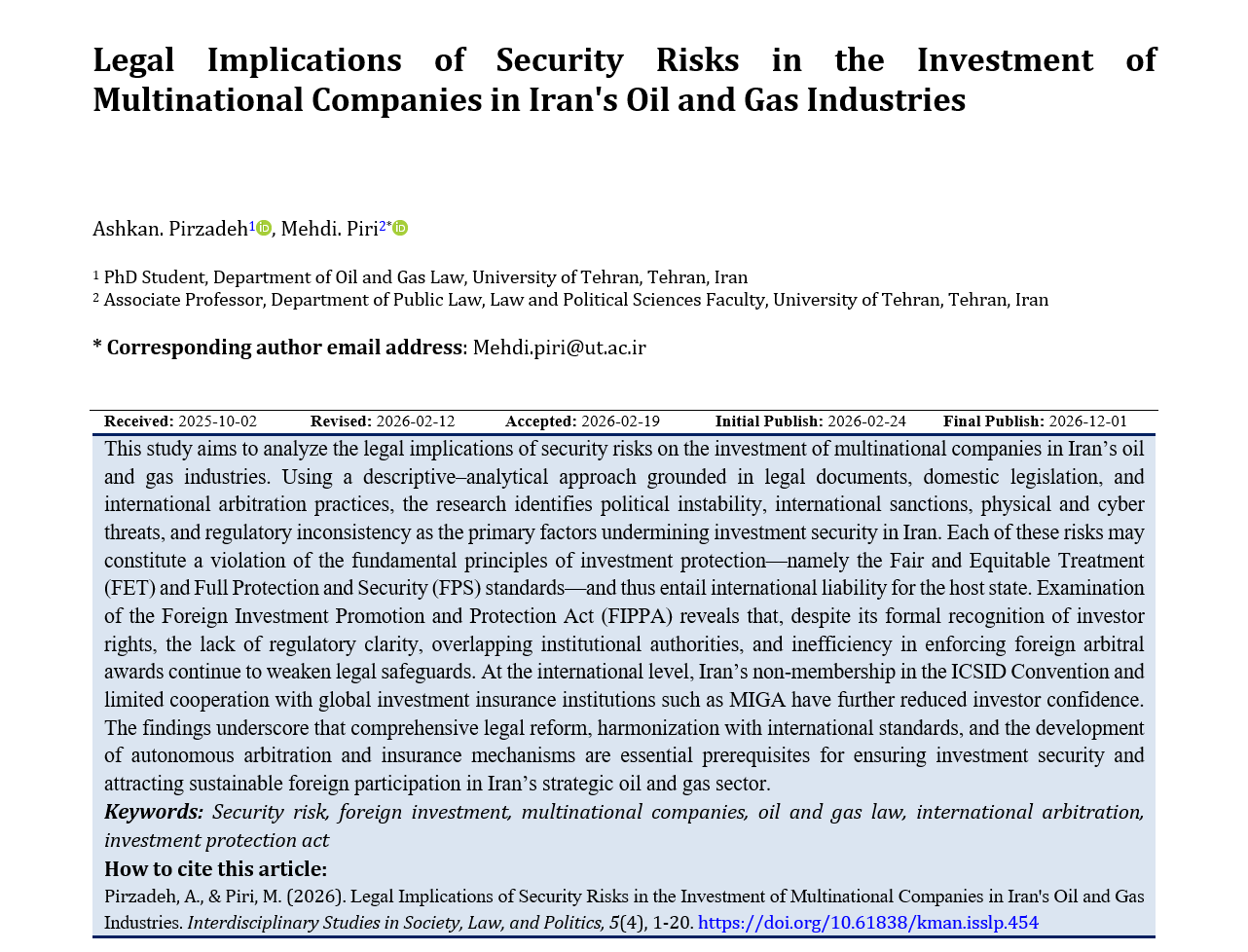
Legal Implications of Security Risks in the Investment of Multinational Companies in Iran's Oil and Gas Industries
Keywords:
Security risk, foreign investment, multinational companies, oil and gas law, international arbitration, investment protection actAbstract
This study aims to analyze the legal implications of security risks on the investment of multinational companies in Iran’s oil and gas industries. Using a descriptive–analytical approach grounded in legal documents, domestic legislation, and international arbitration practices, the research identifies political instability, international sanctions, physical and cyber threats, and regulatory inconsistency as the primary factors undermining investment security in Iran. Each of these risks may constitute a violation of the fundamental principles of investment protection—namely the Fair and Equitable Treatment (FET) and Full Protection and Security (FPS) standards—and thus entail international liability for the host state. Examination of the Foreign Investment Promotion and Protection Act (FIPPA) reveals that, despite its formal recognition of investor rights, the lack of regulatory clarity, overlapping institutional authorities, and inefficiency in enforcing foreign arbitral awards continue to weaken legal safeguards. At the international level, Iran’s non-membership in the ICSID Convention and limited cooperation with global investment insurance institutions such as MIGA have further reduced investor confidence. The findings underscore that comprehensive legal reform, harmonization with international standards, and the development of autonomous arbitration and insurance mechanisms are essential prerequisites for ensuring investment security and attracting sustainable foreign participation in Iran’s strategic oil and gas sector.
Downloads
References
Akhlaqi, A. (2014). Oil and gas law: Petroleum contracts in the Iranian legal system. Mizan Publishing.
Amani, M., & Hamidzadeh, M. H. (2015). Legal Analysis of Production Sharing Contracts in Upstream Oil and Gas Industries and Their Applicability in Iranian Law. Islamic Law Research Journal, 16(1).
Azizi, H. (2020). Comparative Study of Environmental Legal Obligations in Upstream Oil and Gas Contracts in Iran and U.S. Law Allameh Tabataba'i University.
Ebrahimi, S. N., & Shirijian, M. (2013). Iran's upstream oil and gas contracts: Legal implications and requirements of new models. Iranian Journal of Energy Economics, 3(10), 21-43.
Ebrahimi, S. N., Taghizadeh, E., & Sarir, F. (2014). Investigating the Legal Principles Governing Upstream Oil and Gas Contracts in Iran. Civil Law Knowledge Journal, 3(2). https://clk.journals.pnu.ac.ir/article_1526.html
Ezeh, M. O., Ogbu, A. D., Ikevuje, A. H., & George, E. P. (2024). Optimizing Risk Management in Oil and Gas Trading: A Comprehensive Analysis. International Journal of Applied Research in Social Sciences, 6(7), 1461-1480. https://doi.org/10.51594/ijarss.v6i7.1335
Iranpour, F. (2023). Legal Analysis of Oil Contracts. Majd Publications.
Kardel, M. F. (2019). Iran’s Oil and Gas Legal Framework: From Exploration to Revolution. Asia Pacific Journal of Energy and Environment, 6(1), 15-22. https://doi.org/10.18034/apjee.v6i1.259
Montazer, M., & Ebrahimi, S. N. (2013). The Position of Buyback Contracts in Iran's Upstream Oil and Gas Projects and Comparison with Production Sharing Contracts. International Legal Journal(49).
Montazer, M., & Ebrahimi, S. N. (2013). The role of buy-back contracts in Iran’s upstream oil and gas projects. International Legal Journal, 29(47), 99-124.
Montazeri, M., & Ebrahimi, S. N. A. (2014). Reasons for using counter-sale contracts in the upstream oil and gas industry in Iran. International Legal Journal, 47, 99-136.
Niazimohseni, M., Shahrestani, H., Hojabr Kiani, K., & Ghafari, F. (2020). Examination of the Effect of the Shock Caused by Monetary Policy and Oil Revenue on Inflation and Economic Growth in Iran. Monetary & Financial Economics, 27(19), 29-46. https://doi.org/10.22067/pm.v27i19.85109
Olujobi, O. J., Irumekhai, O. S., Olujobi, O. M., Aina-Pelemo, A. D., & Olipede, D. E. (2024). Challenges Militating Against Indigenous Oil Companies Operating in Nigeria’s Upstream Petroleum Industry: Strategies and Panaceas for Their Sustainability. Journal of Sustainable Development Law and Policy (The), 15(3), 145-176. https://doi.org/10.4314/jsdlp.v15i3.6
Rafiei, M. T. (2020). Comparative Study of the General Legal Principle of Mutual Cooperation in International Contract Documents and Iranian Law with Emphasis on Oil Contracts. New Technology Law, 1(2), 133-150.
Razavi, S. M. H., & Salari, M. R. (2020). Reducing the risk of sanctions on subsidiaries of the National Iranian Oil Company: Analyzing solutions with a focus on European Union laws. Legal Studies, 1(12), 75-110. https://jls.shirazu.ac.ir/article_5693.html?lang=en
Vitryk, I. (2025). State Regulation of Strategically Important Enterprises in Ukraine's Oil and Gas Sector. Проблеми Сучасних Трансформацій Серія Економіка Та Управління(21). https://doi.org/10.54929/2786-5738-2025-21-03-02
Пащенко, О., Khomenko, V., Koroviakа, Y., & Расцвєтаєв, В. О. (2024). Main Security Threats to Oil and Gas Infrastructure. https://doi.org/10.3233/nhsdp240009

Downloads
Additional Files
Published
Submitted
Revised
Accepted
Issue
Section
License
Copyright (c) 2025 Ashkan Pirzadeh (Author); Mehdi Piri (Corresponding author)

This work is licensed under a Creative Commons Attribution-NonCommercial 4.0 International License.