Management of Political Crises in the Islamic Republic of Iran: An Examination of Challenges and Solutions
DOI:
https://doi.org/10.61838/kman.isslp.427Keywords:
crisis management, political crisis, Islamic Republic of Iran, political stability, political institutionsAbstract
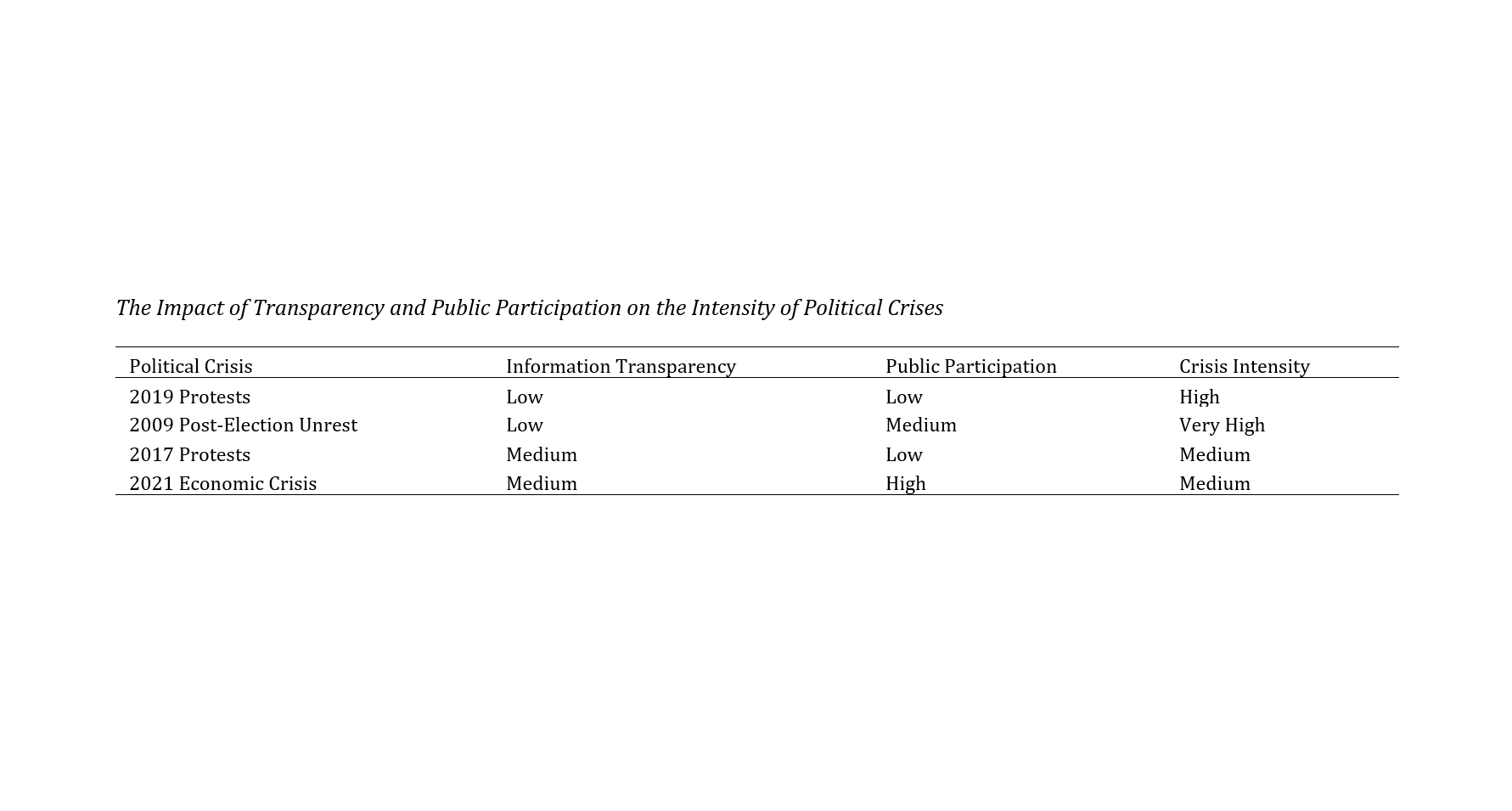
The political system of the Islamic Republic of Iran, given its distinct historical, cultural, and structural characteristics, has encountered numerous political crises throughout more than four decades of its existence, the management of which has required scientific and practical approaches. The primary objective of this study is to examine the mechanisms, challenges, and solutions related to the management of political crises in the Islamic Republic of Iran. In this regard, using a qualitative research method and the analysis of authoritative domestic and international documents and texts, the formal and informal structures of crisis management in Iran have been analyzed. The findings indicate that Iran’s unique political structure, the distribution of power among parallel institutions, and certain ideological and political contradictions constitute the most influential factors contributing to the complexity of crisis management. Moreover, the role of media and social networks has been critical in accelerating or controlling crises. Deficiencies in transparency, the lack of broad public participation in decision-making, and legal constraints are fundamental obstacles to the effective management of political crises in Iran. At the same time, successful experiences—such as the management of certain domestic protests and the containment of external pressures—demonstrate that improved institutional interaction, the strengthening of civil structures, and the leadership’s capacity to mobilize the public can reduce the severity of crises.
Downloads
References
Agranoff, R. (2007). Managing within networks: Adding value to public organizations. Georgetown University Press.
Alizadeh, M. (2021). The Role of Various Institutions in Confronting Recent Political Protests. Iranian Political Science Journal, 12(3), 87-102.
Austin, L., Fisher Liu, B., & Jin, Y. (2012). How audiences seek out crisis information: Exploring the social-mediated crisis communication model. Journal of Applied Communication Research, 40(2), 188-207. https://doi.org/10.1080/00909882.2012.654498
Bayat, A. (2020). The Revolt of the Subaltern Class. Iran-e Fardā Monthly, New Period(57), 35.
Beck, U. (2018). Risk Society: Towards a New Modernity. Sales Publications.
Boin, A., t Hart, P., Stern, E., & Sundelius, B. (2005). The politics of crisis management: Public leadership under pressure. Cambridge University Press. https://doi.org/10.1017/CBO9780511490880
Buchta, W. (2000). Who rules Iran? The structure of power in the Islamic Republic. Washington Institute for Near East Policy.
Castells, M. (2012). Networks of outrage and hope: Social movements in the internet age. Polity.
Castells, M. (2017). Networks of Outrage and Hope: Social Movements in the Age of the Internet. Markaz Publishing. https://doi.org/10.1002/net.21701
Coleman, J. S. (1988). Social capital in the creation of human capital. American Journal of Sociology, 94, S95-S120. https://doi.org/10.1086/228943
Coombs, W. T. (2007). Ongoing crisis communication: Planning, managing, and responding. SAGE Publications.
Fukuyama, F. (1995). Trust: The social virtues and the creation of prosperity. Free Press.
Golvardi, M. (2018). National Resilience: A Review of the Research Literature. Strategic Public Policy Studies Quarterly, 7(25), 298.
Heath, R. L., & O'Hair, H. D. (2010). Handbook of risk and crisis communication. Routledge. https://doi.org/10.4324/9780203891629
Heidari, A. (2020). The Role of Social Networks in the Aban 1398 Protests. Political Studies Quarterly, 5(2), 45-60.
Jafari, M., & Sharifi, H. (2022). Institutional frameworks for political crisis management in Iran. Journal of Political Studies, 18(3), 205-220.
Katzman, K. (2020). Iran: Internal politics and U.S. policy (CRS Report No. RL32048). https://crsreports.congress.gov/product/pdf/RL/RL32048
Kazemi, N. (2022). Power Institutions and the Management of Political Crises. Governance Studies, 10(1), 138-150.
Khamenei, S. A. (2014). Statements Made at a Meeting with Entrepreneurs. www.leader.ir
Khamenei, S. A. (2016). Statements Made Among Students. Official Website of the Office of the Supreme Leader
Khamenei, S. A. (2019a). Statements Made at the Graduation Ceremony of Officer University Students. Official Website of the Office of the Supreme Leader
Khamenei, S. A. (2019b). Statements Made on the Anniversary of the Victory of the Islamic Revolution. Official Website of the Office of the Supreme Leader
Khodabakhshi, S. (2021). Political Crises and Management Challenges in the Islamic Republic of Iran. University of Tehran Press.
Khomeini, S. R. (1999). The Book of Imam. Institute for the Compilation and Publication of the Works of Imam Khomeini (RA).
Kriesi, H. (2004). Political conflict and collective action. Cambridge University Press.
Maloney, S. (2015). Iran's political economy since the revolution. Cambridge University Press. https://doi.org/10.1017/CBO9781316182466
March, J. G., & Olsen, J. P. (1984). The new institutionalism: Organizational factors in political life. American Political Science Review, 78(3), 734-749. https://doi.org/10.2307/1961840
Mohammadi, A., & Yazdani, M. (2022). Political crises and governance stability in Iran: A social perspective. Middle East Journal of Social Sciences, 10(2), 150-165.
Moradi, R. (2020). Power Structure and Political Crises in Iran. Contemporary Political Research, 5(2), 75-95.
Moradi, R. (2021). Absence of Institutionalized Mechanisms in the Management of Political Crises. Social Sciences Quarterly, 14(4), 110-125.
Moslem, M. (2002). Factional politics in post-Khomeini Iran. Syracuse University Press.
North, D. C. (1990). Institutions, institutional change and economic performance. Cambridge University Press. https://doi.org/10.1017/CBO9780511808678
Putnam, R. D. (1993). Making democracy work: Civic traditions in modern Italy. Princeton University Press. https://doi.org/10.2307/j.ctt7s8r7
Putnam, R. D. (2000). Bowling alone: The collapse and revival of American community. Simon & Schuster. https://doi.org/10.1145/358916.361990
Rahimi, B., & Khosravi, A. (2021). Social networks and political crisis: The case of recent Iranian protests. Journal of Digital Society, 7(1), 105-120.
Rosenthal, U., Charles, M. T., & t Hart, P. (1989). Coping with crises: The management of disasters, riots and terrorism. Charles C Thomas Publisher.
Sadeghi, F. (2021). Social Capital and the Decline of Political Participation in Iran. Journal of Political Sociology, 9(1), 70-90.
Sinkaya, B. (2015). The Revolutionary Guards in Iranian politics: Elites and shifting relations. Routledge. https://doi.org/10.4324/9781315727250
Tabatabai, A. M. (2020). No conquest, no defeat: Iran's national security strategy. Oxford University Press. https://doi.org/10.1093/oso/9780197534601.001.0001
Vesali, S., & Ghasemi Nejad, A. (2020). Grounded Theory Study of Marginalization and Social Development. 14(2), 119-120.
Downloads
Additional Files
Publication Timeline
- Submitted
- Revised
- Accepted
Issue
Section
License
Copyright (c) 2025 Ali Asghar Asgharzadeh, Mohammad Bagher Khorramshad, Ebrahim Barzagar (Author)

This work is licensed under a Creative Commons Attribution-NonCommercial 4.0 International License.