The Status of Quasi-Legislative Institutions in the Legal Systems of Iran and Iraq: With Emphasis on Non-Parliamentary Authorities and Normative Pluralism
Keywords:
quasi-legislative institution, non-parliamentary norm-making, comparative public law, legal pluralism, rule of lawAbstract
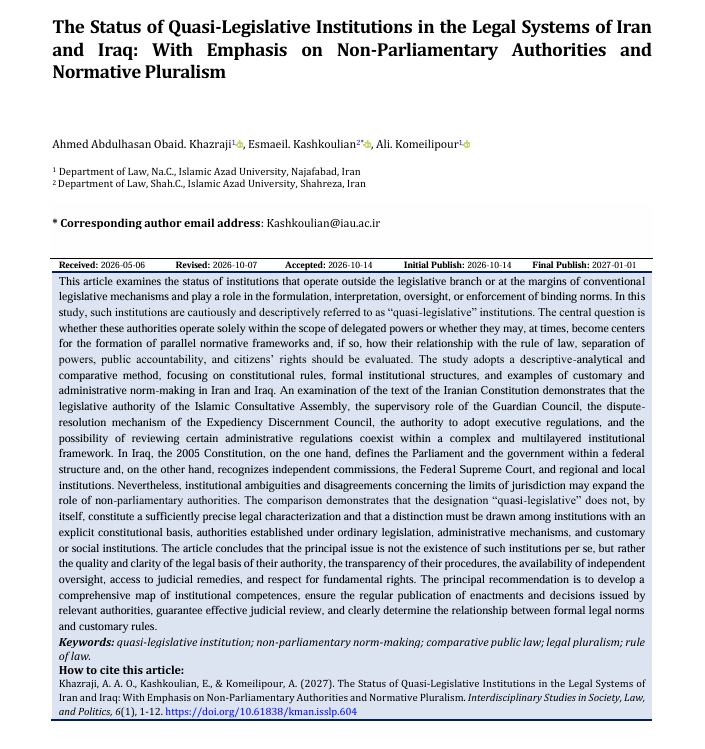
This article examines the status of institutions that operate outside the legislative branch or at the margins of conventional legislative mechanisms and play a role in the formulation, interpretation, oversight, or enforcement of binding norms. In this study, such institutions are cautiously and descriptively referred to as “quasi-legislative” institutions. The central question is whether these authorities operate solely within the scope of delegated powers or whether they may, at times, become centers for the formation of parallel normative frameworks and, if so, how their relationship with the rule of law, separation of powers, public accountability, and citizens’ rights should be evaluated. The study adopts a descriptive-analytical and comparative method, focusing on constitutional rules, formal institutional structures, and examples of customary and administrative norm-making in Iran and Iraq. An examination of the text of the Iranian Constitution demonstrates that the legislative authority of the Islamic Consultative Assembly, the supervisory role of the Guardian Council, the dispute-resolution mechanism of the Expediency Discernment Council, the authority to adopt executive regulations, and the possibility of reviewing certain administrative regulations coexist within a complex and multilayered institutional framework. In Iraq, the 2005 Constitution, on the one hand, defines the Parliament and the government within a federal structure and, on the other hand, recognizes independent commissions, the Federal Supreme Court, and regional and local institutions. Nevertheless, institutional ambiguities and disagreements concerning the limits of jurisdiction may expand the role of non-parliamentary authorities. The comparison demonstrates that the designation “quasi-legislative” does not, by itself, constitute a sufficiently precise legal characterization and that a distinction must be drawn among institutions with an explicit constitutional basis, authorities established under ordinary legislation, administrative mechanisms, and customary or social institutions. The article concludes that the principal issue is not the existence of such institutions per se, but rather the quality and clarity of the legal basis of their authority, the transparency of their procedures, the availability of independent oversight, access to judicial remedies, and respect for fundamental rights. The principal recommendation is to develop a comprehensive map of institutional competences, ensure the regular publication of enactments and decisions issued by relevant authorities, guarantee effective judicial review, and clearly determine the relationship between formal legal norms and customary rules.
Downloads
References
Ahmadi, R. (2018). Normative pluralism and the role of custom in Iran's legal system. Journal of Legal Sociology, 4(2), 12-35.
al-Amiri, A. (2023). The problem of overlapping jurisdictions between formal judicial bodies and quasi-judicial committees in Iraq. Journal of Legal Research, 12(1), 120-145.
al-Hasani, Y. (2020). The role of the Federal Court in protecting rights and freedoms under the Iraqi Constitution. Journal of Law and Politics, 5(2), 15-40.
al-Juburi, A. (2019). The limits of administrative judicial review of regulatory decisions in Iraq: A comparative study. Journal of Legal and Political Sciences, 11(2), 112-135.
al-Kaabi, S. (2022). The interaction between positive law and custom in rural Iraq: A socio-legal study. Journal of Legal Studies, 14(4), 300-328.
al-Khafaji, M. (2017). The independence of quasi-judicial bodies in the Iraqi legal system. Journal of Law and Political Sciences, 9(2), 55-78.
al-Saadi, H. (2021). The role of tribal customs in dispute resolution: A study of legal pluralism in Iraqi society. University of Baghdad Journal of Legal Sciences, 8(1), 201-225.
al-Ubaydi, R. (2018). Constitutional review and the balance of powers in Iraq after 2005. Al-Rafidain Journal of Law, 21(3), 89-114.
Berman, P. S. (2022). Global legal pluralism. Southern California Law Review, 80(4), 1155-1237.
Ghasemi, M. (2023). The position of supervisory boards and regulators in Iran's legal system: A rule-of-law approach. Journal of Legal and Political Research, 11(1), 77-102.
Karimi, J. (2022). Analyzing the role of quasi-judicial bodies in guaranteeing the right to a fair trial in Iran's administrative system. Journal of Justice Studies, 12(4), 88-112.
Mahdavi, K. (2021). Review of decisions of non-parliamentary authorities and its challenges for the rule of law. Journal of Legal Studies, 8(3), 201-228.
Merry, S. (2020). Legal pluralism. Law & Society Review, 22(5), 869-896.
Mousavi, A. (2020). Examining the position of the Supreme Council of the Cultural Revolution's resolutions in the Guardian Council's opinions. Quarterly Journal of Constitutional Law Studies, 5(18), 145-170.
Pakzad, M. (2022). A review of the role of the Expediency Discernment Council in the effectiveness of the Islamic Republic of Iran's legislative criminal policy. Constitutional Law Research, 7(2), 15-42.
Rezaei, S. (2021). A critique of the composition of the General Board of the Court of Administrative Justice for reviewing government regulations and proposing an optimal model. Journal of Legal Research, 9(3), 210-235.
Ubayd, M. (2014). The jurisdiction of the Federal Supreme Court in reviewing the constitutionality of laws. Kufa Journal of Legal and Political Sciences, 4(12), 45-68.
Zamani, H. (2019). Overlapping jurisdictions of formal courts and dispute resolution boards in civil proceedings. Quarterly Journal of Law and Politics, 6(2), 33-58.
Downloads
Additional Files
Publication Timeline
- Submitted
- Revised
- Accepted
Issue
Section
License
Copyright (c) 2025 Ahmed abdulhasan obaid Khazraji (Author); Esmaeil Kashkoulian (Corresponding author); Ali Komeilipour (Author)

This work is licensed under a Creative Commons Attribution-NonCommercial 4.0 International License.