Priority of Preferential Claims in Iranian and Iraqi Law
Keywords:
Preferential claim, ranking of creditors, privileged debt, right of priority, equality of creditors principle.Abstract
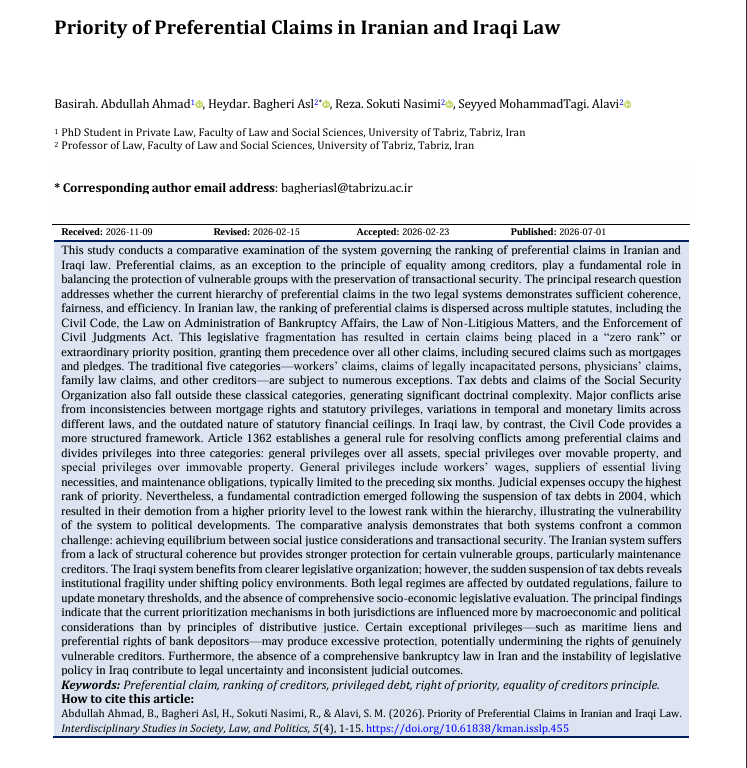
This study conducts a comparative examination of the system governing the ranking of preferential claims in Iranian and Iraqi law. Preferential claims, as an exception to the principle of equality among creditors, play a fundamental role in balancing the protection of vulnerable groups with the preservation of transactional security. The principal research question addresses whether the current hierarchy of preferential claims in the two legal systems demonstrates sufficient coherence, fairness, and efficiency. In Iranian law, the ranking of preferential claims is dispersed across multiple statutes, including the Civil Code, the Law on Administration of Bankruptcy Affairs, the Law of Non-Litigious Matters, and the Enforcement of Civil Judgments Act. This legislative fragmentation has resulted in certain claims being placed in a “zero rank” or extraordinary priority position, granting them precedence over all other claims, including secured claims such as mortgages and pledges. The traditional five categories—workers’ claims, claims of legally incapacitated persons, physicians’ claims, family law claims, and other creditors—are subject to numerous exceptions. Tax debts and claims of the Social Security Organization also fall outside these classical categories, generating significant doctrinal complexity. Major conflicts arise from inconsistencies between mortgage rights and statutory privileges, variations in temporal and monetary limits across different laws, and the outdated nature of statutory financial ceilings. In Iraqi law, by contrast, the Civil Code provides a more structured framework. Article 1362 establishes a general rule for resolving conflicts among preferential claims and divides privileges into three categories: general privileges over all assets, special privileges over movable property, and special privileges over immovable property. General privileges include workers’ wages, suppliers of essential living necessities, and maintenance obligations, typically limited to the preceding six months. Judicial expenses occupy the highest rank of priority. Nevertheless, a fundamental contradiction emerged following the suspension of tax debts in 2004, which resulted in their demotion from a higher priority level to the lowest rank within the hierarchy, illustrating the vulnerability of the system to political developments. The comparative analysis demonstrates that both systems confront a common challenge: achieving equilibrium between social justice considerations and transactional security. The Iranian system suffers from a lack of structural coherence but provides stronger protection for certain vulnerable groups, particularly maintenance creditors. The Iraqi system benefits from clearer legislative organization; however, the sudden suspension of tax debts reveals institutional fragility under shifting policy environments. Both legal regimes are affected by outdated regulations, failure to update monetary thresholds, and the absence of comprehensive socio-economic legislative evaluation. The principal findings indicate that the current prioritization mechanisms in both jurisdictions are influenced more by macroeconomic and political considerations than by principles of distributive justice. Certain exceptional privileges—such as maritime liens and preferential rights of bank depositors—may produce excessive protection, potentially undermining the rights of genuinely vulnerable creditors. Furthermore, the absence of a comprehensive bankruptcy law in Iran and the instability of legislative policy in Iraq contribute to legal uncertainty and inconsistent judicial outcomes.
Downloads
References
Abd al-Baqi, A. a.-F. (1954). The Intermediate in Real Securities. Egyptian Universities Publishing House.
Abu Ata, M. (2010). Maritime Liens: Debt or Security for Debt. Legal Quarterly, Journal of the Faculty of Law and Political Science, 40(3), 1-16.
Ahmadi, K. (2018). Preferred Debt in Iranian Law. Shahid Chamran University Press.
Al-Obaidi, A. H. (1999). The Concise Explanation of Civil Law (Rights in Rem). Dar Al-Thaqafa Publishing.
Al-Sanhuri, A. a.-R. A. (1970). The Intermediate in the Explanation of Civil Law: Real and Personal Securities. Dar Al-Nahda Al-Arabiya Publishing.
Al-Sharqawi, J. Personal and Real Securities. Dar Al-Nahda Al-Arabiya Publishing.
Daryai, R., & Karbalai Aghazadeh, M. (2014). The Legal Nature of Bank Deposits. Shiraz University Journal of Legal Studies, 6(2).
Hammad Abd, D. (2019). Accessory Rights in Rem. Dar Sanhouri Publishing.
Ismail Ibrahim, I., & Obeid, R. (2018). The Lien of the Vendor of Movable Property (A Study in Iraqi Law). Al-Muhaqiq Al-Hilli Journal(3).
Izanloo, M., & Mirshekari, A. (2013). A Comparative Study of the Principle of Equality of Creditors. Journal of Comparative Law(2), 3-20.
Karami, M., & Naghibi, A. a.-Q. (2021). Types, Effects, and Liability Arising from the Right of Priority. Quarterly of Interdisciplinary Studies in Law(3).
Mahdi Pour Saeed, M., Hashemi, S. A., Forghani, M. A., & Barzgarpour, M. (2019). Identification and Classification of Bank Depositors' Mentality for Financial Crowdsourcing in Startup and Knowledge-Based Companies using the Q Method. Entrepreneurship Development Quarterly, 12(1).
Mahdi, S. (2013). Topics in Civil Procedure. http://www.ekhtebar.com
Ramezani, A. (1992). Maritime Transport Law. Islamic Republic of Iran Shipping Training Institute Press.
Sadeghloo, A. Y., & Rajabi, E. (2021). Examination of the Status of Preferred Debts of Debtors in Civil and Commercial Laws and Judicial Precedent. Judgment Quarterly(106).
Sawar, M. W. a.-D. (2006). Explanation of Civil Law: Accessory Rights in Rem (First Edition ed.). Dar Al-Thaqafa Publishing.
Downloads
Additional Files
Publication Timeline
- Submitted
- Revised
- Accepted
Issue
Section
License
Copyright (c) 2026 Basirah Abdullah Ahmad (Author); Heydar Bagheri Asl (Corresponding author); Reza Sokuti Nasimi, Seyyed MohammadTagi Alavi (Author)

This work is licensed under a Creative Commons Attribution-NonCommercial 4.0 International License.