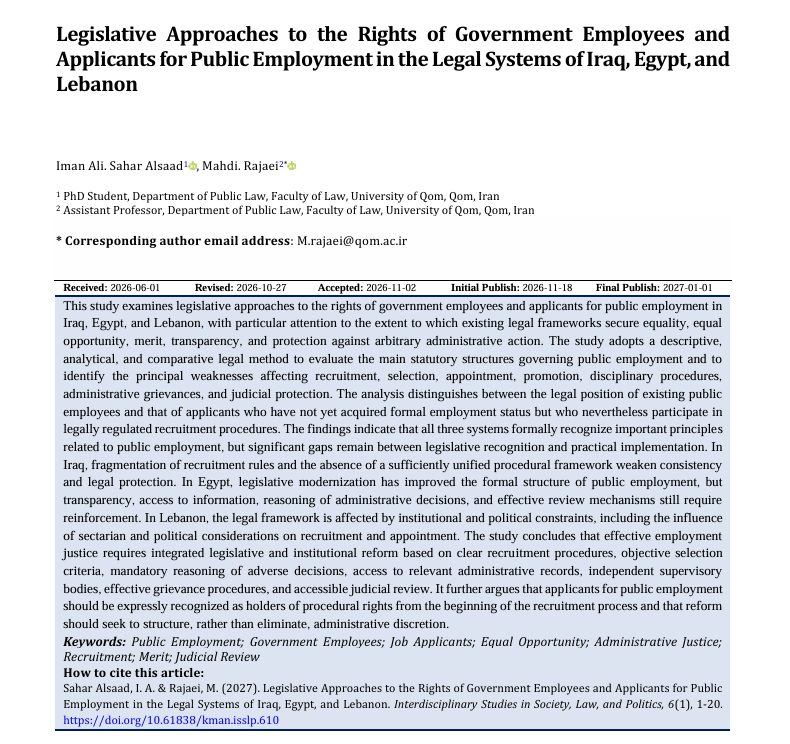
Legislative Approaches to the Rights of Government Employees and Applicants for Public Employment in the Legal Systems of Iraq, Egypt, and Lebanon
DOI:
https://doi.org/10.61838/kman.isslp.610Keywords:
Public Employment, Government Employees, Job Applicants, Equal Opportunity, Administrative Justice, Recruitment, Merit, Judicial ReviewAbstract
This study examines legislative approaches to the rights of government employees and applicants for public employment in Iraq, Egypt, and Lebanon, with particular attention to the extent to which existing legal frameworks secure equality, equal opportunity, merit, transparency, and protection against arbitrary administrative action. The study adopts a descriptive, analytical, and comparative legal method to evaluate the main statutory structures governing public employment and to identify the principal weaknesses affecting recruitment, selection, appointment, promotion, disciplinary procedures, administrative grievances, and judicial protection. The analysis distinguishes between the legal position of existing public employees and that of applicants who have not yet acquired formal employment status but who nevertheless participate in legally regulated recruitment procedures. The findings indicate that all three systems formally recognize important principles related to public employment, but significant gaps remain between legislative recognition and practical implementation. In Iraq, fragmentation of recruitment rules and the absence of a sufficiently unified procedural framework weaken consistency and legal protection. In Egypt, legislative modernization has improved the formal structure of public employment, but transparency, access to information, reasoning of administrative decisions, and effective review mechanisms still require reinforcement. In Lebanon, the legal framework is affected by institutional and political constraints, including the influence of sectarian and political considerations on recruitment and appointment. The study concludes that effective employment justice requires integrated legislative and institutional reform based on clear recruitment procedures, objective selection criteria, mandatory reasoning of adverse decisions, access to relevant administrative records, independent supervisory bodies, effective grievance procedures, and accessible judicial review. It further argues that applicants for public employment should be expressly recognized as holders of procedural rights from the beginning of the recruitment process and that reform should seek to structure, rather than eliminate, administrative discretion.
Downloads
References
Abu Al-Ula, H. A. a.-R. (1998). Public Employment in Egyptian Administrative Law. Dar Al-Nahda Al-Arabiya.
Al-Ajarmeh, N. A.-A. (2003). The Authority to Discipline Public Employees. Dar Al-Thaqafa Publishing.
Al-Basyouni, A. a.-G. A. A. (2000). Administrative Law: A Comparative Study. Dar Al-Fikr Al-Arabi.
Al-Muhanna, M. F. (1978). Principles and Provisions of Administrative Law. Dar Al-Ma'arif.
Al-Qabbani, M. B. (2001). The Theory of the Professional Public Institution in Administrative Law. Dar Al-Matbu'at Al-Jami'iya.
Al-Qaisi, H. (2009). Expiration of Disciplinary Sanctions. Dar Al-Thaqafa Publishing.
Al-Saidi, Z. J. S. (2010). Balancing Administrative Control, Public Freedoms, and Judicial Oversight Thereof. Dar Al-Thaqafa Publishing.
Al-Sanhuri, A. a.-R. A. (1959). Principles of Administrative Law. Dar Al-Nahda Al-Arabiya.
Amr, A. (2005). Principles of Administrative Law: The Nature of Administrative Law. Dar Al-Jami'a Al-Jadida.
Fayyad, M. F. (1996). The Legal System of Public Employment. Dar Al-Nahda Al-Arabiya.
Hani, M. (2004). Human Rights and Fundamental Freedoms. Dar Al-Nahda Al-Arabiya.
Ibrahim, T. M. (2012). Principles and Provisions of Administrative Law. Dar Al-Nahda Al-Arabiya.
Imran, A. S. (2004). The Iraqi and Comparative Administrative Judiciary. Dar Al-Kutub Al-Qanuniya.
Jawad, M. A. (2008). Principles of Administrative Law. Dar Al-Kutub Al-Qanuniya.
Kazim, M. (1999). Human Rights, Democracy, and Public Freedoms. Center for Legal Studies.
Downloads
Additional Files
Publication Timeline
- Submitted
- Revised
- Accepted
Issue
Section
License
Copyright (c) 2025 Iman Ali Sahar Alsaad (Author); Mahdi Rajaei (Corresponding author)

This work is licensed under a Creative Commons Attribution-NonCommercial 4.0 International License.