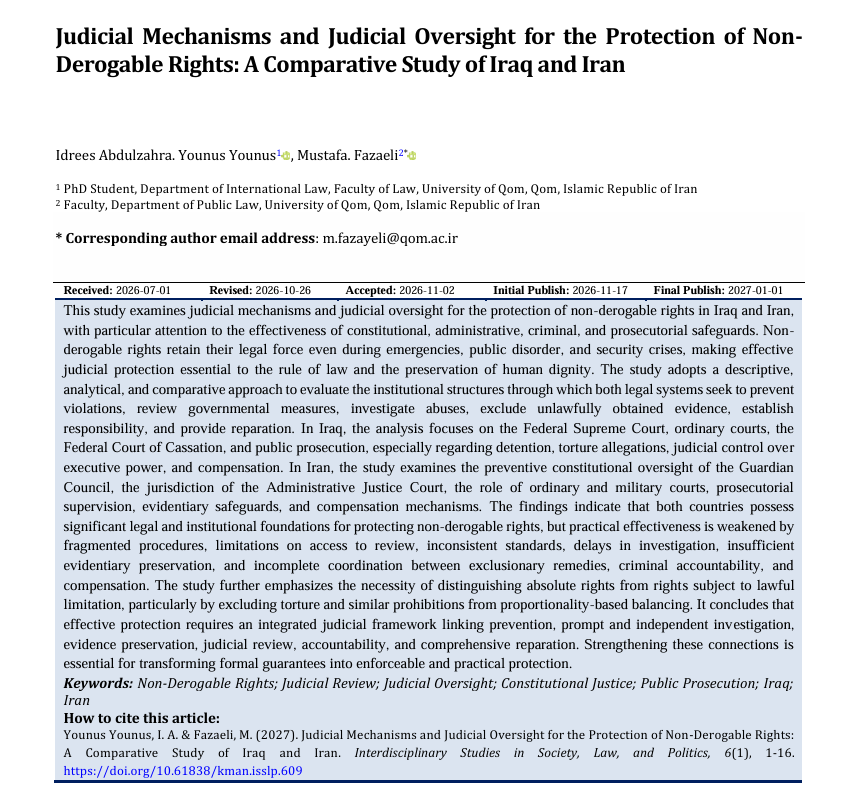
Judicial Mechanisms and Judicial Oversight for the Protection of Non-Derogable Rights: A Comparative Study of Iraq and Iran
DOI:
https://doi.org/10.61838/kman.isslp.609Keywords:
Non, Derogable Rights, Judicial Review, Judicial Oversight, Constitutional Justice, Public Prosecution, Iraq, IranAbstract
This study examines judicial mechanisms and judicial oversight for the protection of non-derogable rights in Iraq and Iran, with particular attention to the effectiveness of constitutional, administrative, criminal, and prosecutorial safeguards. Non-derogable rights retain their legal force even during emergencies, public disorder, and security crises, making effective judicial protection essential to the rule of law and the preservation of human dignity. The study adopts a descriptive, analytical, and comparative approach to evaluate the institutional structures through which both legal systems seek to prevent violations, review governmental measures, investigate abuses, exclude unlawfully obtained evidence, establish responsibility, and provide reparation. In Iraq, the analysis focuses on the Federal Supreme Court, ordinary courts, the Federal Court of Cassation, and public prosecution, especially regarding detention, torture allegations, judicial control over executive power, and compensation. In Iran, the study examines the preventive constitutional oversight of the Guardian Council, the jurisdiction of the Administrative Justice Court, the role of ordinary and military courts, prosecutorial supervision, evidentiary safeguards, and compensation mechanisms. The findings indicate that both countries possess significant legal and institutional foundations for protecting non-derogable rights, but practical effectiveness is weakened by fragmented procedures, limitations on access to review, inconsistent standards, delays in investigation, insufficient evidentiary preservation, and incomplete coordination between exclusionary remedies, criminal accountability, and compensation. The study further emphasizes the necessity of distinguishing absolute rights from rights subject to lawful limitation, particularly by excluding torture and similar prohibitions from proportionality-based balancing. It concludes that effective protection requires an integrated judicial framework linking prevention, prompt and independent investigation, evidence preservation, judicial review, accountability, and comprehensive reparation. Strengthening these connections is essential for transforming formal guarantees into enforceable and practical protection.
Downloads
References
Abdullah, Z. S., Jasim, W. K., & Nasser, N. N. (2026). The Legal Jurisdiction of the Public Prosecution in Iraq between Theory and Practice. Ashur Journal of Legal and Political Sciences, 3(2).
Aghababaei Bakhshayesh, A., Bakzad, B., Mahdavi Thabet, M. A., & Rahmadel, M. (2020). The Need to Reconsider the Criteria and Procedures for Compensating Detained Defendants in the Iranian Criminal Process. Criminal Law Research, 9(33).
Al-Khafaji, I. J. K. (2017). The Role of the Public Prosecution in Protecting Human Rights: A Comparative Study [Master's thesis, University of Dhi Qar, College of Law].
Al-Khalidi, L. H. N. (2021). The Role of Constitutional Judiciary in Protecting the Principle of Equality. Journal of Babylon University for Humanities, 29(10).
Ghannam Jabara, A. (2026). Commentary on the Judgment of the Federal Supreme Court Restricting Freedom of Movement: A Comparison with the Position of the Egyptian Judiciary. University of Anbar Journal of Legal and Political Sciences, 16(2).
Hamad, H. W., & Muhammad, Y. M. A. (2026). The Federal Supreme Court and the Impact of Its Constitutional Review on Ensuring Criminal Justice. Al-Noor Journal of Legal Studies, 3(2).
Hashim, K. K. (2024). The Performance of the Federal Supreme Court of the Republic of Iraq in Guaranteeing the Fundamental Rights of Citizens. Iraqi University Journal, 72(5).
Ibrahim, M. A. (2024). The Concept of Transformation in Criminal Procedures [Higher Diploma Research in Judicial Sciences, Judicial Institute]. Baghdad.
Jaafar, M. H., & Omar, S. F. (2013). Civil Liability of the State for Compensating Detainees and Convicts upon Acquittal and Release in Light of Law No. 15 of 2010 Issued by the Parliament of the Kurdistan Region of Iraq. Legal and Political Studies, 1(2).
Kadkhodai Iladirani, A. A., & Feili, H. (2023). The Optimal Mechanism for the Jurisprudential Review by the Jurists of the Guardian Council of Administrative Regulations. Quarterly Journal of Public Law Studies, 12(42).
Keshavarz, B. (2021). Also, Solitary Confinement? In Collection of Legal Articles.
Mahmoudi, A. (2012). The Role of the Public Prosecutor in Protecting the Rights of the Accused [Master's thesis, Shiraz University, Faculty of Law and Political Science].
Majhoul, M. N. (2024). Reversal by Higher Courts of Previous Judicial Precedents: The Federal Court of Cassation and the Federal Supreme Court as Models [Higher Diploma Research in Judicial Sciences, Judicial Institute]. Baghdad.
Muhammad Ali, N. T. (2025). State Liability for Compensation for Damages Arising from Detention or Imprisonment in Cases of Acquittal and Release. Al-Nahrain Journal of Legal Sciences, 27(1).
Vaezi, S. M. (2009). The Role of the Administrative Justice Court in Jurisprudential Adjudication of Administrative Regulations. Legal Studies, 1(3).
Yazdani, R., & Tavassoli, M. (2018). The Role of the Administrative Justice Court in Achieving and Guaranteeing Citizenship Rights. Journal of Private and Criminal Law Research, 14(4).
Downloads
Additional Files
Publication Timeline
- Submitted
- Revised
- Accepted
Issue
Section
License
Copyright (c) 2025 Idrees Abdulzahra Younus Younus (Author); Mustafa Fazaeli (Corresponding author)

This work is licensed under a Creative Commons Attribution-NonCommercial 4.0 International License.