Challenges and Solutions for the Iraqi and Egyptian Governments in Preventing Abuse of Government Power
Keywords:
abuse of power, public authority, accountability, judicial independence, anti-corruption, Iraq, Egypt, comparative public lawAbstract
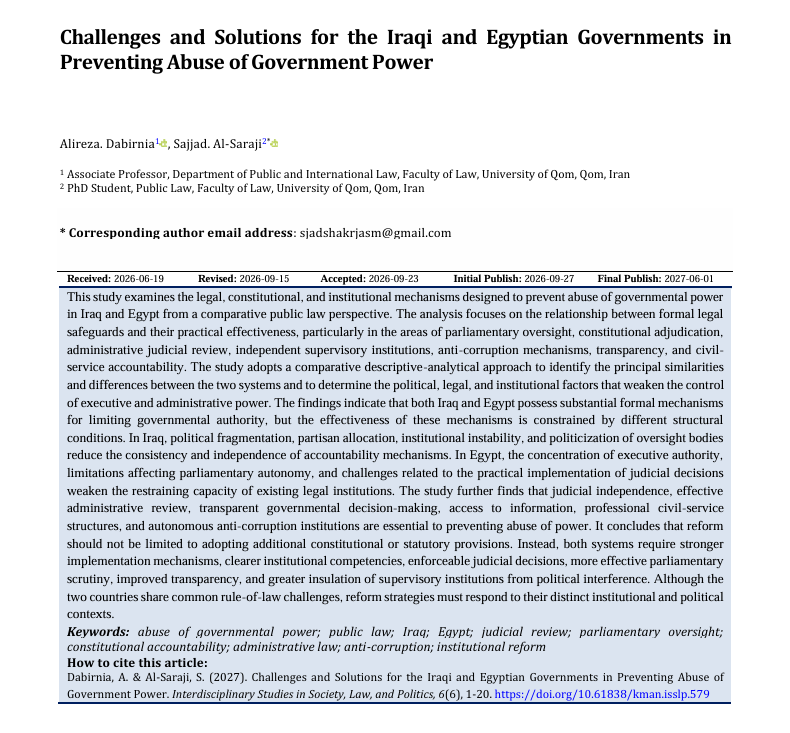
This study examines the legal, constitutional, and institutional mechanisms designed to prevent abuse of governmental power in Iraq and Egypt from a comparative public law perspective. The analysis focuses on the relationship between formal legal safeguards and their practical effectiveness, particularly in the areas of parliamentary oversight, constitutional adjudication, administrative judicial review, independent supervisory institutions, anti-corruption mechanisms, transparency, and civil-service accountability. The study adopts a comparative descriptive-analytical approach to identify the principal similarities and differences between the two systems and to determine the political, legal, and institutional factors that weaken the control of executive and administrative power. The findings indicate that both Iraq and Egypt possess substantial formal mechanisms for limiting governmental authority, but the effectiveness of these mechanisms is constrained by different structural conditions. In Iraq, political fragmentation, partisan allocation, institutional instability, and politicization of oversight bodies reduce the consistency and independence of accountability mechanisms. In Egypt, the concentration of executive authority, limitations affecting parliamentary autonomy, and challenges related to the practical implementation of judicial decisions weaken the restraining capacity of existing legal institutions. The study further finds that judicial independence, effective administrative review, transparent governmental decision-making, access to information, professional civil-service structures, and autonomous anti-corruption institutions are essential to preventing abuse of power. It concludes that reform should not be limited to adopting additional constitutional or statutory provisions. Instead, both systems require stronger implementation mechanisms, clearer institutional competencies, enforceable judicial decisions, more effective parliamentary scrutiny, improved transparency, and greater insulation of supervisory institutions from political interference. Although the two countries share common rule-of-law challenges, reform strategies must respond to their distinct institutional and political contexts.
Downloads
References
Abdul-Kadhim, M., & Jadia, A. (2025). The Constitutionality of the First Amendment Law No. (25) of 2021 to the Federal Supreme Court Law No. (30) of 2005. Journal of Legal Sciences, 40(1), 510-539. https://doi.org/10.35246/zb9ad905
Ahmed, N. K., & Kadhim, M. A. J. (2014). Al-Qada' al-Idari [Administrative Judiciary] (4 ed.). Al-Mustansiriya University Press.
Al-Ali, Z. (2014). The Struggle for Iraq's Future: How Corruption, Incompetence and Sectarianism Have Undermined Democracy. Yale University Press.
Al-Hilu, M. R. (2010). Al-Qada' al-Idari [Administrative Judiciary]. Dar al-Jami'a al-Jadida.
Al-Istrabadi, F. A. (2009). A Constitution without Constitutionalism: Reflections on Iraq's Failed Constitutional Process. Texas Law Review, 87(7), 1627-1655.
Al-Karaawi, B. A. A., & Al-Jayashi, S. F. T. (2020). Anti-Corruption Measures According to the United Nations Convention against Corruption: An Applied Study to Demonstrate the Extent to Which Iraqi Legislation Is Compatible with It. Uruk Journal of Human Sciences, 13(3), 22.
Al-Tamawi, S. M. (1950). Nazariyyat al-Ta'assuf fi Isti'mal al-Sulta Amam Majlis al-Dawla wa-al-Mahakim al-Qada'iyya [The Theory of Abuse in the Exercise of Power before the State Council and Judicial Courts]. Matba'at Dar Nashr al-Thaqafa.
Al-Tamawi, S. M. (1996). Al-Qada' al-Idari: Al-Kitab al-Awwal, Qada' al-Ilgha' [Administrative Judiciary: Vol. 1, Annulment Jurisdiction]. Dar al-Fikr al-Arabi.
Ali, D. A. (2021). The Legal System of the Federal Public Service Council. Researcher Journal for Legal Sciences, 2(2), 232-262. https://doi.org/10.37940/JRLS.2021.2.2.5
Ali, M. N., Musa, N., & Abd Rahman, M. R. (2022). Judicial Control over Administrative Discretion in Iraq. Hasanuddin Law Review, 8(3), 233-247. https://doi.org/10.20956/halrev.v8i3.3876
Alkhalidy, M. K. J., & Abdul Halim, Z. B. (2021). Regulatory Approaches of the Right to Information Access in the Arab States. Law, State and Telecommunications Review, 13(1), 119-130. https://doi.org/10.26512/lstr.v13i1.36619
Alkhozaie, Z. (2021). The Independence of the Administrative Judiciary in Accordance with the Iraqi State Council Law No. 71 of 2017. Ishraqat Tanmawya, 27, 664-700. https://doi.org/10.51424/Ishq.27.24
Alysi, F. H. (2023). Legislative Shortcomings in the Iraqi State Council Law No. 71 of 2017. Journal of Anbar University for Law and Political Sciences, 13(1), 441-468. https://doi.org/10.37651/aujlps.2023.140417.1008
Bernard-Maugiron, N. (2009). Judges and Political Reform in Egypt. American University in Cairo Press. https://doi.org/10.5743/cairo/9789774162015.001.0001
Bernard-Maugiron, N., & Dupret, B. (2002). Egypt and Its Laws. Kluwer Law International.
Craig, P. (2021). Administrative Law (9 ed.). Sweet & Maxwell.
Diab, M. F. S. I. (2017). Deviation of Authority in Issuing Administrative Decision: Analytical Study in the Saudi and Egyptian Systems. Journal of Legal and Economic Research, 63, 536-638. https://doi.org/10.21608/MJLE.2017.155700
El-Borai, N. M. (2009). The Government's Non-Execution of Judicial Decisions. In Judges and Political Reform in Egypt (pp. 199-212). American University in Cairo Press. https://doi.org/10.5743/cairo/9789774162015.003.0013
Hamoudi, H. A. (2011). Notes in Defense of the Iraq Constitution. University of Pennsylvania Journal of International Law, 32(5), 1277-1300.
Hamoudi, H. A. (2013). Negotiating in Civil Conflict: Constitutional Construction and Imperfect Bargaining in Iraq. University of Chicago Press. https://doi.org/10.7208/chicago/9780226068794.001.0001
Khedr, M. A. A. (2021). Efficiency Reports in Law 81 of 2016: An Analytical Study in Light of Public-Function Legislation in Egypt. Journal of the Faculty of Sharia and Law in Tanta, 36(2), 214-289. https://doi.org/10.21608/MKSQ.2021.185925
Meften, R. T. (2026). Judicial Control over Administrative Decisions in Iraq: A Critical Analysis of the Role of Administrative Courts. European Journal of Arts, Humanities and Social Sciences, 3(2), 319-331. https://doi.org/10.59324/ejahss.2026.3(2).22
Moustafa, T. (2007). The Struggle for Constitutional Power: Law, Politics, and Economic Development in Egypt. Cambridge University Press. https://doi.org/10.1017/CBO9780511511202
Moustafa, T. (2008). Law and Resistance in Authoritarian States: The Judicialization of Politics in Egypt. In Rule by Law: The Politics of Courts in Authoritarian Regimes (pp. 132-155). Cambridge University Press. https://doi.org/10.1017/CBO9780511814822.006
Mulla, S. A., & Hassan, S. A. (2026). The Position and Powers of the Federal Supreme Court in Iraq: Constitutional and Legal Challenges (2004-2022). Twejer Journal, 9(5). https://doi.org/10.31918/twejer.2695.01
Nehme, A. M. (2025). The Compatibility of Discretionary Power with the Principle of Legality. Ashur Journal of Legal and Political Sciences, 2(1), 239-261. https://doi.org/10.64184/ajlps.V2.I1.Y2025.P239-261.21
Rose-Ackerman, S., & Palifka, B. J. (2016). Corruption and Government: Causes, Consequences, and Reform (2 ed.). Cambridge University Press.
Talib, M. A. (2019). Constitutional Reform in Iraq (Federal Supreme Court Model). Journal of Legal Sciences, 33(5), 384-418. https://doi.org/10.35246/jols.v0is.96
Zakaria, N. E. (2022). Applications of Modern Administration within the Framework of the State's Administrative Reform Plan: A Study under Civil Service Law No. 81 of 2016. Al-Majalla al-Qanuniyya, 11(2), 427-482. https://doi.org/10.21608/JLAW.2022.221214
Downloads
Additional Files
Publication Timeline
- Submitted
- Revised
- Accepted
Issue
Section
License
Copyright (c) 2025 Alireza Dabirnia (Author); Sajjad Al-Saraji (Corresponding author)

This work is licensed under a Creative Commons Attribution-NonCommercial 4.0 International License.