The Role of the United States, Russia, China, and the European Union in Regional Policies and Their Impact on Stability and Security
Keywords:
Balance of Power, Geopolitical Competition, United States, Russia, China, European Union, Regional Stability and SecurityAbstract
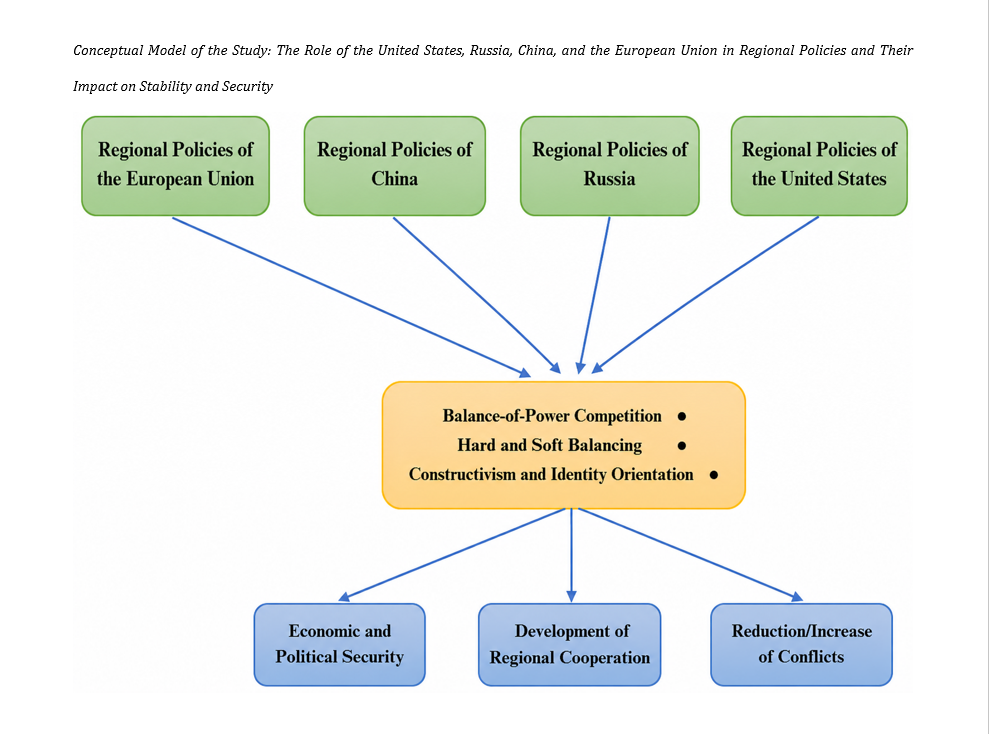
The geopolitical transformations of the past two decades, particularly following the relative decline of United States hegemony, have intensified competition among four major actors—the United States, Russia, China, and the European Union—for influence in strategic regions such as Central Asia and the Middle East. This competition has significantly affected patterns of regional stability and security and can be analyzed through the lenses of balance of power, soft balancing, and multi-level agency. The objective of this study is to explain the roles and strategies of these powers in regional policies and to analyze their implications for stability and security. The research employs a qualitative approach and a documentary analysis method, based on a systematic review of selected scholarly and research sources. The findings indicate that the United States relies on security alliances and military presence; Russia utilizes geopolitical and energy-centered instruments; China advances its influence through the Belt and Road Initiative and soft-balancing strategies; and the European Union pursues a policy of “smart containment” and conditional cooperation. Each actor seeks to consolidate or expand its sphere of influence. While the interactions and rivalries among these four actors create certain opportunities for multilateral cooperation, they more frequently intensify competition, generate short-term instability, and complicate regional security dynamics. The study concludes that sustainable regional stability and security require the effective management of great-power conflicts of interest through multilateral mechanisms and the strengthening of the role of indigenous regional actors.
Downloads
References
Azizbek, B. (2024). Analysis of the Role of Russia, China, the United States and Other Major Powers in the Region's Integration Processes. Modern Science and Research, 3(6), 1221-1224.
Batyuka, V. I., & Morozova, Y. V. (2022). Politics and Strategy of the United States, the Russian Federation, and China in the Middle East. Herald of the Russian Academy of Sciences, 92(Suppl. 4), S321-S330.
Buzan, B. (1991). People, States and Fear: An Agenda for International Security Studies in the Post-Cold War Era. Harvester Wheatsheaf.
Erfani, S. T. (2024). The Confrontation of the United States, Russia, and China in the Geopolitical Network of Central Asia. Scientific-Research Quarterly of Political and International Studies, Khatam al-Nabieen University, 1(4), 53-76.
Gholkhanbaz, K., Yazdani, E., & Ebrahimi, S. (2024). The Impact of Strategic Competition between the United States and China on the Transitional Order of the Middle East. International Studies Quarterly, 21(1), 269-293.
Hurrell, A. (2007). On Global Order: Power, Values, and the Constitution of International Society. Oxford University Press.
Mamedov, R. (2018). Prospects for Cooperation between Russia and China in the Middle East.
Manners, I. (2002). Normative Power Europe: A Contradiction in Terms? Journal of Common Market Studies, 40(2), 235-258.
Mardasov, A., & Semenov, K. (2021). Russian Policy in the Middle East: Re-Balancing.
Mearsheimer, J. J. (2001). The Tragedy of Great Power Politics. W. W. Norton.
Morgenthau, H. J. (1948). Politics among Nations: The Struggle for Power and Peace. Knopf.
Mounk, J. (2021). So Much for a Foreign Policy for the Middle Class.
Nye, J. S. (2004). Soft Power: The Means to Success in World Politics. Public Affairs.
O'Sullivan, D. (2016). EU-US Relations in a Changing World.
Paul, T. V. (2004). Soft Balancing in the Age of US Primacy. International Security, 30(1), 46-71.
Pozdnyakov, A. (2022). The United States Is Afraid of the Influence of the Chinese Model on the Middle East.
Rahmani, M., & Miri, E. (2015). The Impact of China's and Russia's Soft-Balancing Components on United States Hegemony. Central Asia and the Caucasus Quarterly(92), 65-92.
Rebro, O., & Suchkov, M. (2021). The Scattered Superpower: U.S. Foreign Policy in the Post-Bipolar World. International Analytics, 3(12), 23-35.
Salehi, M., & Mohammadinasab, M. (2024). Containing the European Union in Central Asia: Opportunities and Challenges. Foreign Relations Quarterly, 16(2), 145-174.
Salehi, M., & Mohammadinasab, M. (2025). The European Union's Strategy towards China's Influence in Central Asia. Central Eurasia Studies, 18(1), 1-27.
Shear, M., Sanger, D., Cooper, H., Schmitt, E., Barnes, J., & Jakes, L. (2021). Miscue after Miscue, U.S. Exit Plan Unravels. The New York Times.
Trenin, D. (2016). Should We Fear Russia? Polity Press.
Waltz, K. N. (1979). Theory of International Politics. Addison-Wesley.
Wasser, B., & Shatz, H. J. (2022). The Middle East and Great Power Competition.
Wendt, A. (1992). Anarchy Is What States Make of It: The Social Construction of Power Politics. International Organization, 46(2), 391-425.
Zarghami, A., Javidani Moghadam, M., & Kiani, D. (2024). The European Union's Economic and Political Approach toward China and Its Impact on the Islamic Republic of Iran. Quarterly Journal of Fundamental and Applied Studies of the Islamic World, 6(22).
Downloads
Additional Files
Publication Timeline
- Submitted
- Revised
- Accepted
Issue
Section
License
Copyright (c) 2025 Talal Ali Hussein Alakryfi (Corresponding author); Ghadir Nezamipour , Mostafa Moradian (Author)

This work is licensed under a Creative Commons Attribution-NonCommercial 4.0 International License.