A Comparative Examination of the Position and Role of Legal Paternalism in Iranian and French Criminal Law
Keywords:
Legal paternalism, criminal law, public interest (maslahah), self-harm, harm to othersAbstract
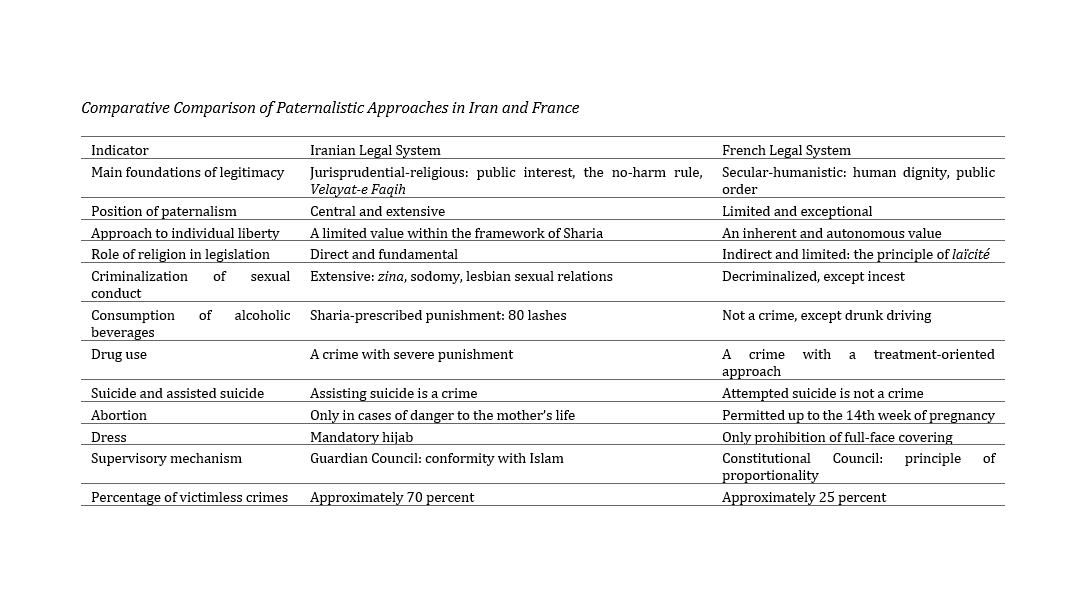
Legal paternalism, as a basis for state intervention in individual behavior with the aim of protecting persons from their own harmful decisions, constitutes one of the most controversial concepts in the philosophy of criminal law. The legal systems of Iran and France, grounded in distinct cultural, historical, and philosophical traditions, have adopted different approaches to this principle. The present study aimed to comparatively examine the position of legal paternalism in the criminal justice systems of Iran and France, analyze its jurisprudential and philosophical foundations, and identify challenges and reform strategies for maintaining a balance between individual liberty and public interests. This research was conducted using a descriptive–analytical method and a comparative approach. Data were collected through documentary analysis of legislation, judicial decisions, jurisprudential and philosophical texts, and scholarly articles, and were examined using qualitative content analysis. The findings indicated that, within the Iranian legal system, legal paternalism occupies a central and extensive position based on jurisprudential foundations such as public interest (maslahah), preservation of religion, the doctrine of Velayat-e Faqih (Guardianship of the Islamic Jurist), and the principle of no harm (La Darar), leading to the criminalization of a broad range of self-regarding harmful behaviors. In contrast, within the French legal system, paternalism is justified through concepts such as human dignity, public order, and the protection of vulnerable individuals and is generally confined to exceptional circumstances. The principal challenges identified in both systems include tensions with individual autonomy, conceptual ambiguity, the limited effectiveness of purely criminal-law approaches, high implementation costs, and the gap between formal and informal norms. Despite fundamental differences in the foundations and scope of paternalism, the legal systems of Iran and France share certain core values, including human dignity, public order, and the protection of vulnerable persons, which may provide a basis for dialogue and mutual learning.
Downloads
References
Al-Abaydh, M., & Bustami, M. R. (2025). Paternalism and Liberalism: A Comparative Analysis of Political Modernity in Western and Non-Western Societies: An Overview. Comparative Sociology, 24(3), 351-383.
Al-Saadoun, A. A., & Montazeri, A. (2024). A Jurisprudential-Legal Examination of the Effect of Public Rights on Criminalization with Emphasis on Public Interest and Public Order. Comparative Criminal Jurisprudence, 1.
Bagheri, M. (2021). Criminalization in the Field of Citizenship Rights: Criminalization, Foundations and Challenges. Mashq-e Shab.
Chamsi-Pasha, H., Albar, M. A., & Chamsi-Pasha, M. (2022). Comparative Study between Islamic and Western Bioethics: The Principle of Autonomy. Journal of the British Islamic Medical Association, 11(4), 1-12.
Fauzan, F. (2022). Alternatives to Criminal Conviction in a Comparative Analysis of Positive Law and Islamic Criminal Law. Al-Istinbath: Jurnal Hukum Islam, 7(1), 183-202.
Gil, R., Billé, M., Svandra, P., & Aumond, F. (2024). Vulnérabilité sociale et autonomie. Séminaire éthique: liberté et vulnérabilité, un temps pour penser,
Hashemi, B., & Hassanzadeh, F. (2019). The Effect of Ethics on Criminalization and Decriminalization in Iranian Criminal Law. Neday-e Karafarin.
Hayat, I. (2024). The Impact of Western Secularism on Modern Islamic Jurisprudence: A Comparative Study of Family, Criminal, and Constitutional Law. Al-Mahdi Research Journal (MRJ), 5(4), 993-999.
Hussain, M., Ismail, M., Falak, N., Ali, S., Qureshi, A. U. R., & Bajwa, A. (2023). Comparative Study of Islamic Law and Western Law in Criminal Law and Justice Systems. Al-Qanṭara, 9(3), 113-119.
Ivand, M., & Shirzadi, M. (2022). The Role of Liberal Principles in Overcriminalization. Proceedings of the 2nd National Conference on Law, Jurisprudence and Culture, Shiraz.
Khajavand, M., & Soltanian, D. (2024). The Position of Public Interest and Individual and Social Freedoms in Criminalization from the Perspective of Jurisprudence and Human Rights. Journal of Human Rights Jurisprudential Research, 2, 1-18.
Lassen, D. D., & Mahler, D. (2023). Free to Choose or Free to Lose? Understanding Individual Attitudes toward Paternalism. Behavioural Public Policy, 7(3), 721-743.
Lehto, O. (2025). It Still Won't Budge: Behavioural Public Policy Struggles to Escape Paternalism. Mind & Society.
Long, B. (2023). Theorising Gambling Self-Exclusion Agreements: The Inadequacy of Procedural Autonomy. Canadian Journal of Law & Jurisprudence, 36(2), 407-435.
Mahmoudi, Y. (2018). The Basis and Scope of the Rule of Priority of Public Interest over Private Interest from the Perspective of Jurisprudence. Mehr Amir al-Mu'minin.
Maniaci, G. (2025). What Is Legal Paternalism? In The Unbearable Lightness of Legal Antipaternalism (pp. 11-56). Springer.
Martinelli, J. P. (2025). Legal Paternalism: A Conceptual Analysis and Its Implications in Criminal Law.
Mashayekhi, J., Hosseini, S. M., & Adaryani, M. R. (2025). Fulfilling Servitude to God: A Resolution to Decision-Making Challenges of Respect for Patient Autonomy and Paternalism Approaches. Journal of the Iranian Scientific Association of Medical Ethics, 25-33.
Mashdurohatun, A., Harahsheh, E. A. A. M., Datuiding, M. I., Syambas, A. H., & Wibowo, P. A. (2026). Contemporary Reassessment of Punishment in Islamic and Secular Law: A Comparative Study of Justice and Penal Philosophy. MILRev: Metro Islamic Law Review, 5(1), 80-100.
Mehrabi, A., & Allahverdi Meygouni, F. (2022). Behavioral Economics and the Problem of Punishment Perception: From Choice Architecture to Critique of Behavioral Paternalism. Criminal law doctrines, 19(23), 297-330.
Mirzaei, K., & Naseri-Moghadam, N. (2025). Justifications for Decriminalizing Unnecessary Crimes with Emphasis on Their Criminalization Foundations. Yafteh.
Neshasteriz, S., & Heidari, M. (2024). The Status of Privacy in Situational Prevention of Economic Crimes in Light of Legal Paternalism. Comparative Criminal Jurisprudence, 3, 183-196.
Nobahar, R., & Nobahari Tehrani, A. (2022). Foundations of Legal Paternalism with a View to Its Role in Criminalization. Legal Studies, 14(2), 373-401.
Poikolainen, K. (2021). Paternalism and Alcohol Policy. Drugs and Alcohol Today, 21(1), 6-14.
Razak, A., Nuraini, N., Putra, R. S., & Kurniawan, R. (2024). Patriarchy and Paternalistic Culture of Religious Leader Deification Causing Sexual Harassment in Islamic Educational Institutions. el Harakah: Jurnal Budaya Islam, 26(1), 139-170.
Sadeghi Ram, R. (2020). Criminal Manifestations of the Right to Education in Light of the Principles of Harm, Paternalism, and Moralism. Proceedings of the 7th Scientific-Research Conference on the Development and Promotion of Educational Sciences and Psychology in Iran,
Sadeghpour, M. J. (2024). The Role of Public Acceptance in Criminalizing Sins from the Perspective of Imami Jurisprudence. Religion and Law(43), 79-90.
Sharafi Masouleh, A., Ghorbani, A., & Zakaeian, P. (2023). The Position of Order and Public Interest in Criminalization in Jurisprudence, Iranian Criminal Law, and European Law. Comparative Criminal Jurisprudence, 5.
Treger, C. (2023). When Do People Accept Government Paternalism? Theory and Experimental Evidence. Regulation & Governance, 17(1), 195-214.
Vogliotti, M. (2022). HLA Hart, Le Droit, la liberté et la morale. Revue interdisciplinaire d'études juridiques, 89(2), 163-170.
Zhi-yu, Y., & Xi, L. (2022). The Mitigating Path of Criminal Governance for Active Euthanasia under Soft Paternalism. Journal of Nanjing University of Traditional Chinese Medicine (Social Science Edition), 23(3), 183-190.
Downloads
Publication Timeline
- Submitted
- Revised
- Accepted
Issue
Section
License
Copyright (c) 2025 Fatemeh Noori (Author); Mohammad Sargazi (Corresponding author)

This work is licensed under a Creative Commons Attribution-NonCommercial 4.0 International License.