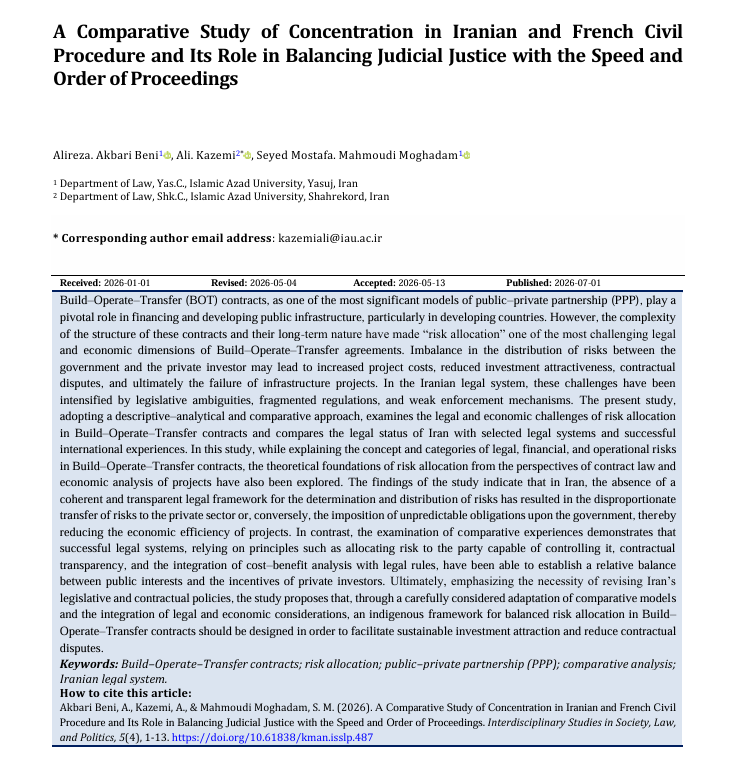
A Comparative Study of Concentration in Iranian and French Civil Procedure and Its Role in Balancing Judicial Justice with the Speed and Order of Proceedings
Keywords:
Build–Operate–Transfer contracts, risk allocation, public–private partnership (PPP), comparative analysis, Iranian legal systemAbstract
Build–Operate–Transfer (BOT) contracts, as one of the most significant models of public–private partnership (PPP), play a pivotal role in financing and developing public infrastructure, particularly in developing countries. However, the complexity of the structure of these contracts and their long-term nature have made “risk allocation” one of the most challenging legal and economic dimensions of Build–Operate–Transfer agreements. Imbalance in the distribution of risks between the government and the private investor may lead to increased project costs, reduced investment attractiveness, contractual disputes, and ultimately the failure of infrastructure projects. In the Iranian legal system, these challenges have been intensified by legislative ambiguities, fragmented regulations, and weak enforcement mechanisms. The present study, adopting a descriptive–analytical and comparative approach, examines the legal and economic challenges of risk allocation in Build–Operate–Transfer contracts and compares the legal status of Iran with selected legal systems and successful international experiences. In this study, while explaining the concept and categories of legal, financial, and operational risks in Build–Operate–Transfer contracts, the theoretical foundations of risk allocation from the perspectives of contract law and economic analysis of projects have also been explored. The findings of the study indicate that in Iran, the absence of a coherent and transparent legal framework for the determination and distribution of risks has resulted in the disproportionate transfer of risks to the private sector or, conversely, the imposition of unpredictable obligations upon the government, thereby reducing the economic efficiency of projects. In contrast, the examination of comparative experiences demonstrates that successful legal systems, relying on principles such as allocating risk to the party capable of controlling it, contractual transparency, and the integration of cost–benefit analysis with legal rules, have been able to establish a relative balance between public interests and the incentives of private investors. Ultimately, emphasizing the necessity of revising Iran’s legislative and contractual policies, the study proposes that, through a carefully considered adaptation of comparative models and the integration of legal and economic considerations, an indigenous framework for balanced risk allocation in Build–Operate–Transfer contracts should be designed in order to facilitate sustainable investment attraction and reduce contractual disputes.
Downloads
References
Bafahm, M., Fahimi, A., & Hasanzadeh, M. (2024). Criterion and Standard of Abuse of Right in Iranian and French Civil Proceedings. Contemporary Comparative Legal Studies, 15(35), 1-32. https://doi.org/10.22034/law.2024.58101.3312
Cadiet, L. (2007). Introduction to French Civil Justice System and Civil Procedural Law. Ritsumeikan Law Review, 28.
Dabiri Qasr-Assemi, M., & Moloudi, M. (2025). A Comparative Study of the Foundations for Determining Sanctions in Civil Proceedings in Iranian and French Law. Comparative Law Research Quarterly, 9(3), 109-120. https://doi.org/10.22080/lps.2024.27161.1639
Davakan, M. R. (2017). La concentration des moyens en droit processuel: entre construction et déconstruction, retour sur un arrêt endurant.
Fathi, B. (2024). Unity of Origin in Iranian and French Civil Proceedings. Private Law Studies, 54(3), 415-446. https://doi.org/10.22059/jlq.2024.373800.1007880
Gutsunaeva, A. (2021). Le principe de concentration en procédure civile Université Côte d'Azur]. https://theses.fr/2021COAZ0014
Kazemi, A. (2018). The Principle of Concentration in Civil Procedure. Journal of Law, University of Isfahan, 5(2), 145-159. https://doi.org/10.22108/law.2018.23108
Lajošová, I. (2024). Judicial and Legal Concentration of Proceedings in the Context of Evidence-Taking. Legestic, 2, 24-33. https://doi.org/10.5219/legestic.10
Mohammadzadeh Vadeghani, A., & Heydari, N. (2024). The Rule of Res Judicata and Its Evolution through the Rules of Concentration of Claims and Grounds in French Law. Private Law Studies, 54(2), 239-260. https://doi.org/10.22059/jlq.2024.364294.1007794
Mohseni, H. (2016). Civil Procedure: Comparative Law, Volumes One and Two. Sherkat-e Sahami Enteshar Publications.
Pernici, B., Bono, C. A., Piro, L., Del Treste, M., & Vecchi, G. (2024). Improving the Analysis of the Judiciary Performance: The Use of Data Mining Techniques to Assess the Timeliness of Civil Trials. International Journal of Public Sector Management, 37(1), 59-76. https://doi.org/10.1108/IJPSM-02-2023-0058
Plissonnier, M. (2022). Concentration et procès civil.
Richter, A. C. (2023). L'absence d'obligation de concentration des demandes en matière de réparation du préjudice, bis repetita.
Saberi, R. (2024). Challenges and Solutions for Avoiding Concentration-Oriented Approaches in Iranian Administrative Proceedings: With a View to the French Model. Comparative Public Law, 1(3), 65-92. https://doi.org/10.22091/cpl.2024.11241.1033
Safaei, S. H., & Razi, S. (2020). Civil Liability of Judges and Its Evolution in Iranian and French Jurisprudence and Law. Comparative Research on Islamic and Western Law, 7(3), 121-148. https://doi.org/10.22091/csiw.2020.4542.1605
Downloads
Additional Files
Publication Timeline
- Submitted
- Revised
- Accepted
Issue
Section
License
Copyright (c) 2026 Alireza Akbari Beni (Author); Ali Kazemi (Corresponding author); Seyed Mostafa Mahmoudi Moghadam (Author)

This work is licensed under a Creative Commons Attribution-NonCommercial 4.0 International License.