Trawling in the Persian Gulf from the Perspective of International Law of the Sea
Keywords:
Trawling, Persian Gulf, International Law of the Sea, UNCLOS, UN Fish Stocks Agreement, FAO, RECOFI, ROPME, Marine Environmental ProtectionAbstract
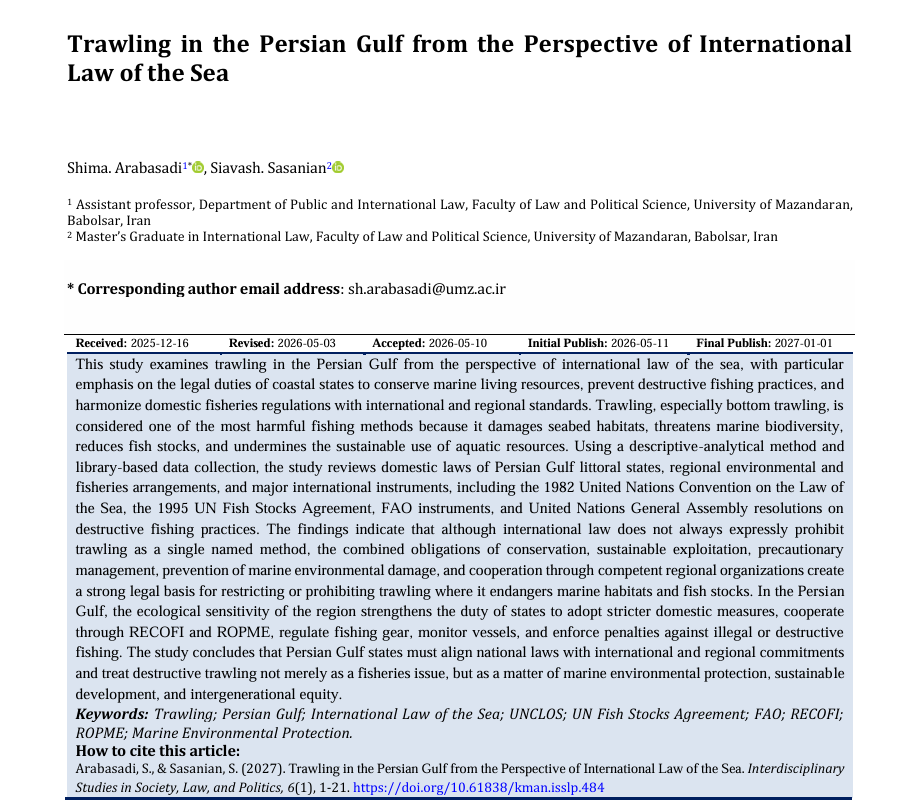
This study examines trawling in the Persian Gulf from the perspective of international law of the sea, with particular emphasis on the legal duties of coastal states to conserve marine living resources, prevent destructive fishing practices, and harmonize domestic fisheries regulations with international and regional standards. Trawling, especially bottom trawling, is considered one of the most harmful fishing methods because it damages seabed habitats, threatens marine biodiversity, reduces fish stocks, and undermines the sustainable use of aquatic resources. Using a descriptive-analytical method and library-based data collection, the study reviews domestic laws of Persian Gulf littoral states, regional environmental and fisheries arrangements, and major international instruments, including the 1982 United Nations Convention on the Law of the Sea, the 1995 UN Fish Stocks Agreement, FAO instruments, and United Nations General Assembly resolutions on destructive fishing practices. The findings indicate that although international law does not always expressly prohibit trawling as a single named method, the combined obligations of conservation, sustainable exploitation, precautionary management, prevention of marine environmental damage, and cooperation through competent regional organizations create a strong legal basis for restricting or prohibiting trawling where it endangers marine habitats and fish stocks. In the Persian Gulf, the ecological sensitivity of the region strengthens the duty of states to adopt stricter domestic measures, cooperate through RECOFI and ROPME, regulate fishing gear, monitor vessels, and enforce penalties against illegal or destructive fishing. The study concludes that Persian Gulf states must align national laws with international and regional commitments and treat destructive trawling not merely as a fisheries issue, but as a matter of marine environmental protection, sustainable development, and intergenerational equity.
Downloads
References
Agreement to Promote Compliance with International Conservation and Management Measures by Fishing Vessels on the High Seas.
Bensch, A., Gianni, M., Dominique, Greboval, J., & Hjort, S. A. (2009). Worldwide Review of Bottom Fisheries in the High Seas.
Clark, M. R., & Dunn, M. R. (2012). Spatial management of deep-sea seamount fisheries: Balancing sustainable exploitation and habitat conservation. Environmental Conservation, 39(3), 204-214.
Committee on, F. (2022). Committee on Fisheries.
Convention on Biological, D. (2011). Convention on Biological Diversity. https://www.cbd.int
Convention on Biological Diversity, (1992).
Convention on Fishing and Conservation of the Living Resources.
Currie, D. E. J. (2004). Protecting the Deep Sea Under International Law: Legal Options for Addressing High Seas Bottom Trawling.
Easley, J. (2000). History of Trawling off the Pacific Coast. IIFET 2000 Proceedings: History of the U.S. West Coast Fishing Industry,
FAO Fisheries and Aquaculture Report No. 889. (2008). (Cairo, Egypt, 27-30 October 2008, Issue.
Food, & Agriculture Organization of the United, N. (2022). FAO Fisheries and Aquaculture Division.
Gianni, M. (2004). High Seas Bottom Fisheries and Their Impact on the Biodiversity of Vulnerable Deep-Sea Ecosystems: Summary Findings.
Gjerde, K. M. (2006). High Seas Marine Protected Areas and Deep-Sea Fishing.
Harrison, J. (2019). Key Challenges Relating to the Governance of Regional Fisheries. In R. Caddell & E. Molenaar (Eds.), Strengthening International Fisheries Law in an Era of Changing Oceans (1 ed., pp. 79-102). Hart Publishing. https://doi.org/10.5040/9781509923373.ch-005
Khalili, I. (2012). Investigation of Iranian Regulations and Laws on the Law of the Sea from the Perspective of International Law. National Conference on International Law in the Mirror of Contemporary Sciences,
Mohammadi, D. (2019). Investigation of the Rights of Local Communities on Coasts and the Right to Exploit Aquatic Resources, Fisheries. Journal of Iranian Natural Resources, 72(4).
Moridnejad, A., & Mazaheri, M. (2011). Investigation of Environmental Priorities of the Persian Gulf and the Sea of Oman.
Naderi, S., Afshari, M., Farshchi, P., & Pourhashemi, A. (2022). Legal Approach of Persian Gulf Littoral States to Sustainable Development Indicators of Marine Environment with Emphasis on International Environmental Law. Quarterly Journal of Judicial Law Perspectives, 27(97).
Downloads
Additional Files
Publication Timeline
- Submitted
- Revised
- Accepted
Issue
Section
License
Copyright (c) 2025 Shima Arabasadi (Corresponding author); Siavash Sasanian (Author)

This work is licensed under a Creative Commons Attribution-NonCommercial 4.0 International License.