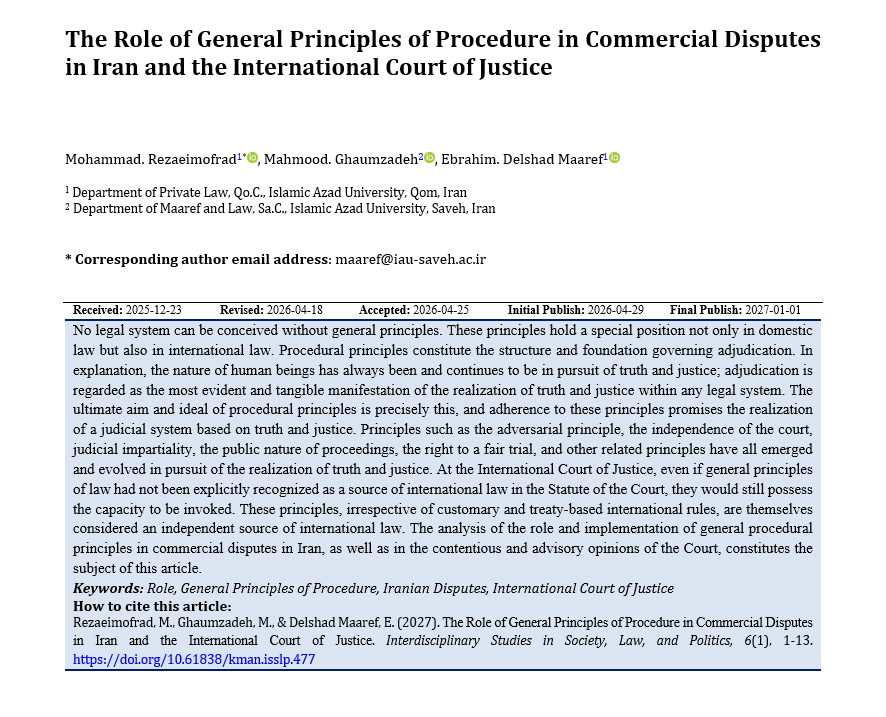
The Role of General Principles of Procedure in Commercial Disputes in Iran and the International Court of Justice
Keywords:
Role, General Principles of Procedure, Iranian Disputes, International Court of JusticeAbstract
No legal system can be conceived without general principles. These principles hold a special position not only in domestic law but also in international law. Procedural principles constitute the structure and foundation governing adjudication. In explanation, the nature of human beings has always been and continues to be in pursuit of truth and justice; adjudication is regarded as the most evident and tangible manifestation of the realization of truth and justice within any legal system. The ultimate aim and ideal of procedural principles is precisely this, and adherence to these principles promises the realization of a judicial system based on truth and justice. Principles such as the adversarial principle, the independence of the court, judicial impartiality, the public nature of proceedings, the right to a fair trial, and other related principles have all emerged and evolved in pursuit of the realization of truth and justice. At the International Court of Justice, even if general principles of law had not been explicitly recognized as a source of international law in the Statute of the Court, they would still possess the capacity to be invoked. These principles, irrespective of customary and treaty-based international rules, are themselves considered an independent source of international law. The analysis of the role and implementation of general procedural principles in commercial disputes in Iran, as well as in the contentious and advisory opinions of the Court, constitutes the subject of this article.
Downloads
References
Cassese, A. (1996). The International Court of Justice and the Right of Peoples to Self-Determination. In V. Lowe & Fitzmaurice (Eds.), Fifty Years of the International Court of Justice: Essays in Honour of Sir Robert Jennings. Cambridge University Press.
Cheng, B. (1987). General Principles of Law as Applied by International Courts and Tribunals. Grotius.
Danilenko, G. M. (1993). Law-Making in the International Community. Nijhoff.
Higgins, R. (1998). The International Court of Justice and Human Rights. In K. Wellens (Ed.), International Law: Theory and Practice: Essays in Honour of Eric Suy. Martinus Nijhoff.
Kelsen, H., & Tucker, R. T. (1967). Principles of International Law (2nd ed.). Holt, Rinehart and Winston.
Meron, T. (2006). The Humanization of International Law. Martinus Nijhoff.
O'Connell, D. P. (1970). International Law (2nd ed., Vol. 1). Stevens and Sons.
Pellet, A. (2006). Article 38. In A. Zimmermann (Ed.), The Statute of the International Court of Justice: A Commentary.
Downloads
Additional Files
Publication Timeline
- Submitted
- Revised
- Accepted
Issue
Section
License
Copyright (c) 2025 Mohammad Rezaeimofrad (Author); Mahmood Ghaumzadeh (Corresponding author); Ebrahim Delshad Maaref (Author)

This work is licensed under a Creative Commons Attribution-NonCommercial 4.0 International License.