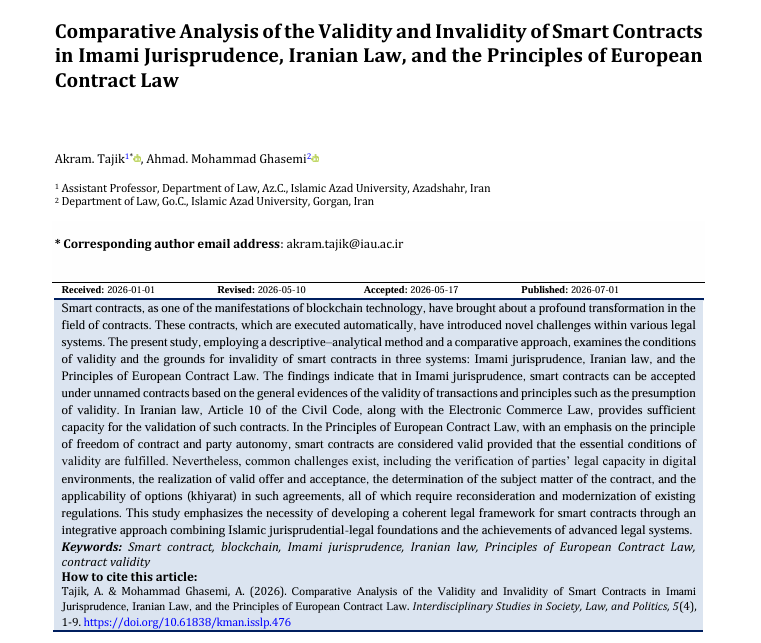
Comparative Analysis of the Validity and Invalidity of Smart Contracts in Imami Jurisprudence, Iranian Law, and the Principles of European Contract Law
DOI:
https://doi.org/10.61838/kman.isslp.476Keywords:
Smart Contract, Blockchain, Imamiyah Jurisprudence, Iranian Law, Principles of European Contract Law, Contract ValidityAbstract
Smart contracts, as one of the manifestations of blockchain technology, have brought about a profound transformation in the field of contracts. These contracts, which are executed automatically, have introduced novel challenges within various legal systems. The present study, employing a descriptive–analytical method and a comparative approach, examines the conditions of validity and the grounds for invalidity of smart contracts in three systems: Imami jurisprudence, Iranian law, and the Principles of European Contract Law. The findings indicate that in Imami jurisprudence, smart contracts can be accepted under unnamed contracts based on the general evidences of the validity of transactions and principles such as the presumption of validity. In Iranian law, Article 10 of the Civil Code, along with the Electronic Commerce Law, provides sufficient capacity for the validation of such contracts. In the Principles of European Contract Law, with an emphasis on the principle of freedom of contract and party autonomy, smart contracts are considered valid provided that the essential conditions of validity are fulfilled. Nevertheless, common challenges exist, including the verification of parties’ legal capacity in digital environments, the realization of valid offer and acceptance, the determination of the subject matter of the contract, and the applicability of options (khiyarat) in such agreements, all of which require reconsideration and modernization of existing regulations. This study emphasizes the necessity of developing a coherent legal framework for smart contracts through an integrative approach combining Islamic jurisprudential-legal foundations and the achievements of advanced legal systems.
Downloads
References
Alavi, S. M. (2023). What Is a Smart Contract? Everything About Smart Contract. 1-8.
Dehghani Tafti, M., Afzali Mehr, M., & Eskini, R. (2022). Comparative Study of the Law Governing Digital Smart Contracts from the Perspective of Private International Law in the Iranian Legal System and Rome I Regulation. Law of New Technologies, 3(6), 1-28.
Dehghani Tafti, M., Afzali Mehr, M., & Eskini, R. (2023). Comparative Study of the Legal Requirements for Designing Digital Smart Contracts in Iranian and French Law. Legal Research, 15(2), 215-240.
Ebadi Nasab, N. (2023). Smart Contracts in Imamiyyah Jurisprudence and Iranian Law Shahid Motahari University].
Ferreira, A. (2021). Smart Contracts and Contract Law. European Review of Private Law, 29(1), 1-30.
Hewa, T., & et al. (2021). Survey on Blockchain-Based Smart Contracts: Applications and Future Directions. IEEE Access, 9, 1-25.
Hurr Amili, M. i. H. (1989). Wasa'il al-Shi'ah ila Tahsil Masa'il al-Shari'ah. Al al-Bayt Institute for Revival of Heritage.
Katouzian, N. (2009). Civil Code in the Current Legal Order (21st ed.). Mizan Legal Foundation.
Lando, O., & Beale, H. (2000). Principles of European Contract Law, Parts I and II. Kluwer Law International.
Mousavi Khomeini, S. R. (2006). Tahrir al-Wasilah (1st ed.). Institute for Compilation and Publication of Imam Khomeini's Works.
Muhaqqiq Hilli, J. i. H. (1990). Shara'i al-Islam fi Masa'il al-Halal wa al-Haram. Ismailian Publications.
Naser, M. (2018). Smart Contracts: A Comparative Study of Iranian and American Law (1st ed.). Majd Publications.
Naser, M., & Sadeghi, H. (2019). Validation and Legal Challenges of Using Smart Contracts: A Comparative Study of the Iranian and American Legal Systems. Private Law Research, 7(27), 255-288.
Nejat-Zadegan, S., & Soltani, M. (2023). Evaluation of the General Conditions for Validity of Smart Contracts from the Perspective of Iranian and American Law. Legal Research Quarterly, 16(1), 175-205.
Nikbakht, H., & Piri, F. (2012). Application of the Principles of International Commercial Contracts by an Arbitral Tribunal as the Law Governing the Dispute. International Legal Journal, 19(46), 35-58.
Rajabloo, M., Gholamalizadeh, M., & Sadeghian Lamraski, M. (2023). Analysis of the Foundations and Legal Consequences of Dissolution of Virtual Contracts from the Perspective of Imamiyyah Jurisprudence and Common Law. Cyber Law Quarterly, 2(4), 75-98.
Safaei, S. H. (2011). Introductory Course in Civil Law: General Rules of Contracts (5th ed.). Mizan Publications.
Sarrafi, T. (2023). What Is a Smart Contract?
Shahid Thani, Z. a.-D. i. A. (1993). Al-Rawdah al-Bahiyyah fi Sharh al-Lumah al-Dimashqiyyah. Islamic Propagation Office Publications.
Shahidi, M. (2009). Contractual and Non-Contractual Obligations (3rd ed.). Majd Publications.
Soltani, V. (2016). Comparative Study of the Law Governing Electronic Contracts from the Perspective of Iranian Law, the European Union, and China Third World Conference on Psychology and Educational Sciences, Law, and Social Sciences,
Szabo, N. (1996). Smart Contracts: Building Blocks for Digital Markets. Extropy(16), 1-10.
Taskforce, U. K. J. (2019). Legal Statement on Cryptoassets and Smart Contracts.
Yousefkhani, M. A. (2022). The Position of Smart Contracts in Commercial Transactions: English Law and European Union Law. 1-15.
Downloads
Additional Files
Publication Timeline
- Submitted
- Revised
- Accepted
Issue
Section
License
Copyright (c) 2026 Akram Tajik (Corresponding author); Ahmad Mohammad Ghasemi (Author)

This work is licensed under a Creative Commons Attribution-NonCommercial 4.0 International License.