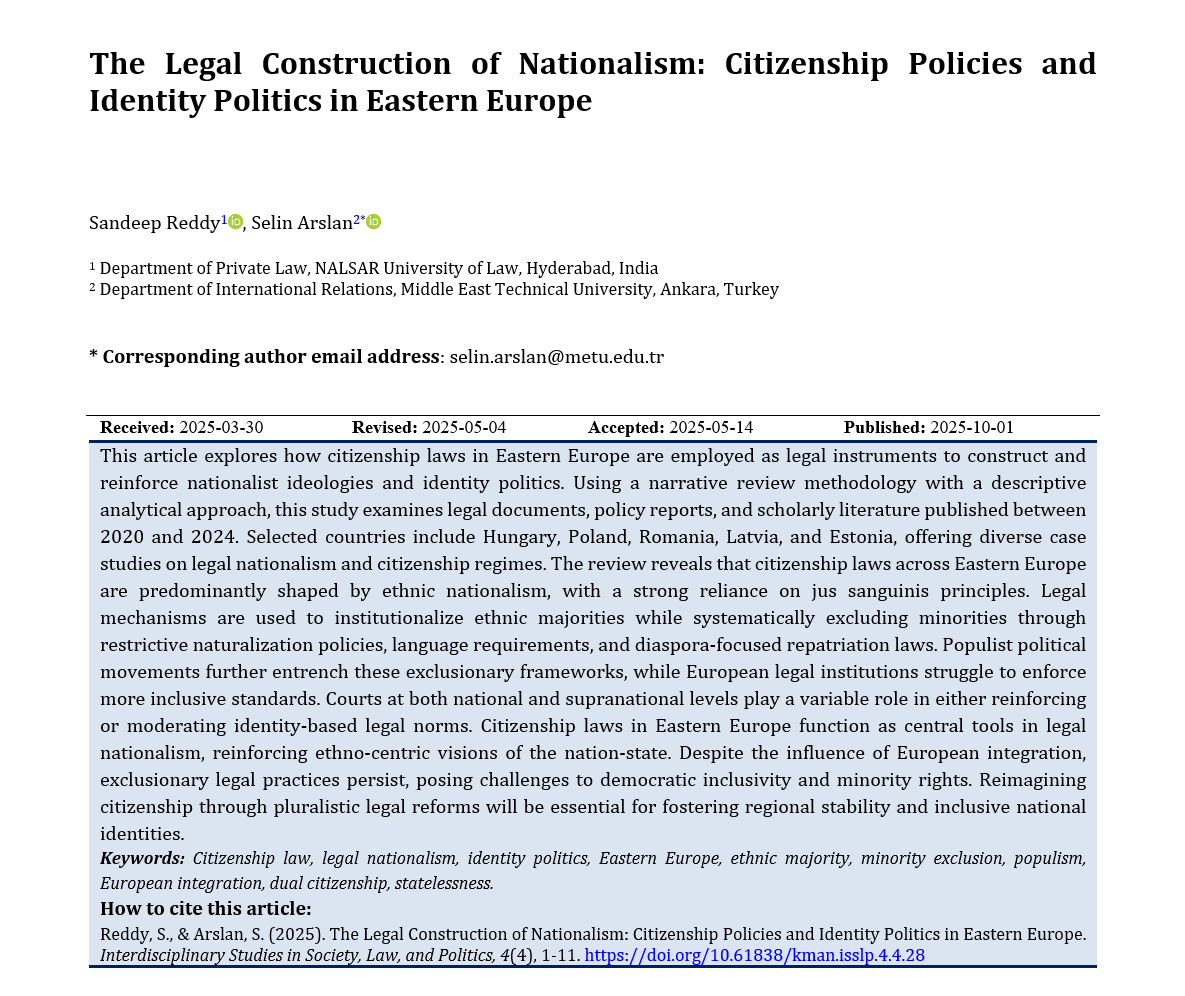
The Legal Construction of Nationalism: Citizenship Policies and Identity Politics in Eastern Europe
DOI:
https://doi.org/10.61838/kman.isslp.4.4.28Keywords:
Citizenship law, legal nationalism, identity politics, Eastern Europe, ethnic majority, minority exclusion, populism, European integration, dual citizenship, statelessnessAbstract
This article explores how citizenship laws in Eastern Europe are employed as legal instruments to construct and reinforce nationalist ideologies and identity politics. Using a narrative review methodology with a descriptive analytical approach, this study examines legal documents, policy reports, and scholarly literature published between 2020 and 2024. Selected countries include Hungary, Poland, Romania, Latvia, and Estonia, offering diverse case studies on legal nationalism and citizenship regimes. The review reveals that citizenship laws across Eastern Europe are predominantly shaped by ethnic nationalism, with a strong reliance on jus sanguinis principles. Legal mechanisms are used to institutionalize ethnic majorities while systematically excluding minorities through restrictive naturalization policies, language requirements, and diaspora-focused repatriation laws. Populist political movements further entrench these exclusionary frameworks, while European legal institutions struggle to enforce more inclusive standards. Courts at both national and supranational levels play a variable role in either reinforcing or moderating identity-based legal norms. Citizenship laws in Eastern Europe function as central tools in legal nationalism, reinforcing ethno-centric visions of the nation-state. Despite the influence of European integration, exclusionary legal practices persist, posing challenges to democratic inclusivity and minority rights. Reimagining citizenship through pluralistic legal reforms will be essential for fostering regional stability and inclusive national identities.
Downloads
References
Bartasevičius, V. (2021). Explaining Access to Citizenship in Central and Eastern Europe. Communist and Post-Communist Studies, 54(3), 27-50. https://doi.org/10.1525/j.postcomstud.2021.54.3.27
Berkovich, I. (2020). Defensive Citizenship in Europe: Definition and Measurement. Political Studies Review, 19(1), 148-156. https://doi.org/10.1177/1478929920906996
Bunout, E. (2020). Olgierd Górka’s Polemics on the Contours of the Polish Nation (1933- 1955). Connexe Les Espaces Postcommunistes en Question(s), 4, 25-36. https://doi.org/10.5077/journals/connexe.2018.e160
Čiubrinskas, V. (2020). Transnational Culture: From Diasporic Nationalism to Cultural Citizenship. Filosofija Sociologija, 30(4). https://doi.org/10.6001/fil-soc.v30i4.4150
Daskalova, K. (2022). The Little Entente of Women, Feminisms, Tensions, and Entanglements Within the Interwar European Women’s Movement. Aspasia, 16(1), 13-36. https://doi.org/10.3167/asp.2022.160103
Gosewinkel, D. (2021). Integrating Europe and Demarcating States. 338-418. https://doi.org/10.1093/oso/9780198846161.003.0007
Osler, A. (2020). Education, Migration and Citizenship in Europe: Untangling Policy Initiatives for Human Rights and Racial Justice. Intercultural Education, 31(5), 562-577. https://doi.org/10.1080/14675986.2020.1794231
Pickel, G., & Pickel, S. (2024). Not in My House: EU-citizenship Among East-Central European Citizens: Comparative Analyses. 20(1), 117-139. https://doi.org/10.2478/pce-2024-0005
Pogonyi, S. (2021). Kin Citizenship in Eastern Europe. https://doi.org/10.1553/978oeaw87752_chapt07
Stan, S., Erne, R., & Gannon, S. R. (2020). Bringing EU Citizens Together or Pulling Them Apart? The European Health Insurance Card, East–west Mobility and the Failed Promise of European Social Integration. Journal of European Social Policy, 31(4), 409-423. https://doi.org/10.1177/0958928720974188
Downloads
Additional Files
Publication Timeline
- Submitted
- Revised
- Accepted
Issue
Section
License

This work is licensed under a Creative Commons Attribution-NonCommercial 4.0 International License.