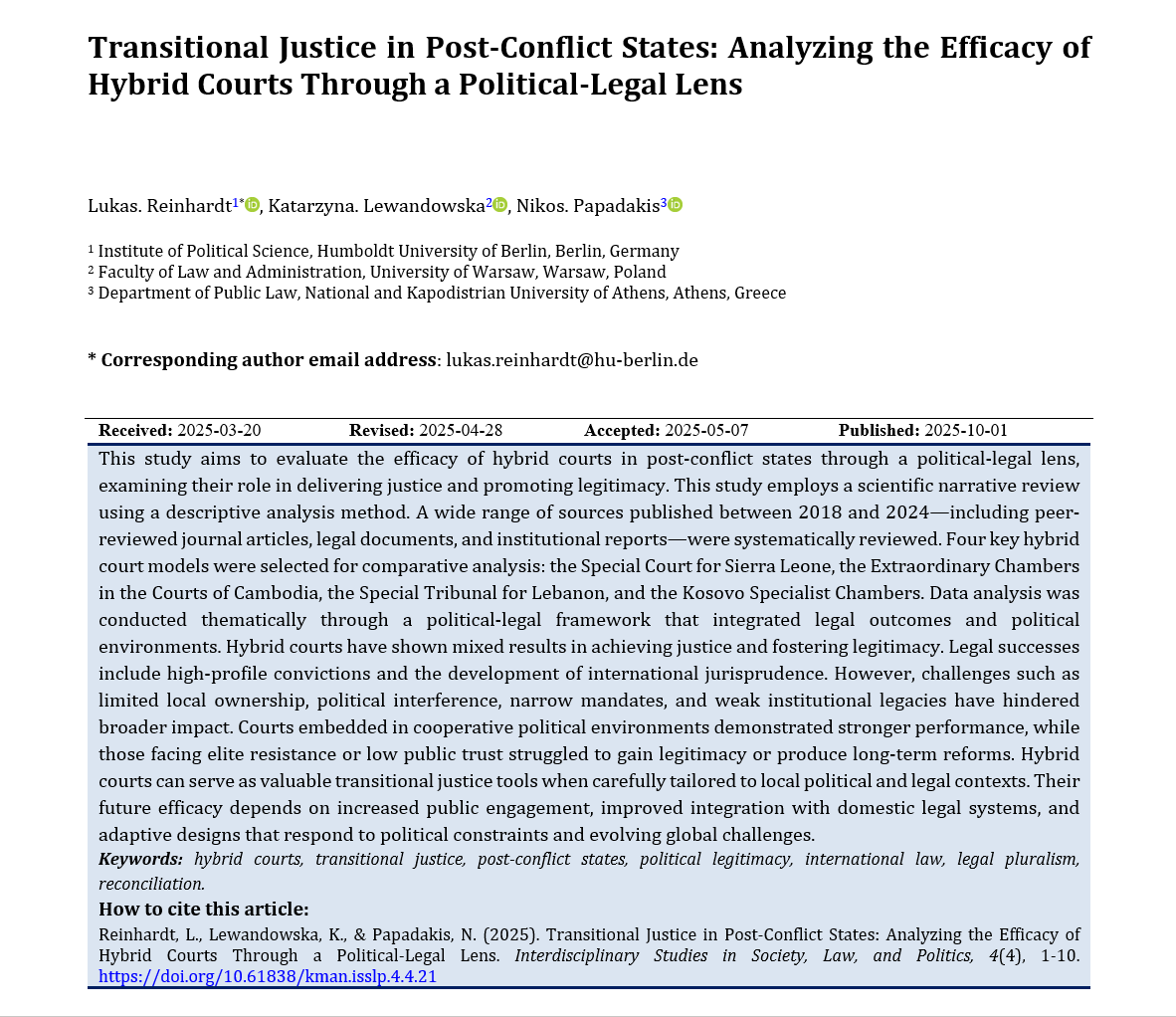
Transitional Justice in Post-Conflict States: Analyzing the Efficacy of Hybrid Courts Through a Political-Legal Lens
DOI:
https://doi.org/10.61838/kman.isslp.4.4.21Keywords:
hybrid courts, transitional justice, post-conflict states, political legitimacy, international law, legal pluralism, reconciliationAbstract
This study aims to evaluate the efficacy of hybrid courts in post-conflict states through a political-legal lens, examining their role in delivering justice and promoting legitimacy. This study employs a scientific narrative review using a descriptive analysis method. A wide range of sources published between 2018 and 2024—including peer-reviewed journal articles, legal documents, and institutional reports—were systematically reviewed. Four key hybrid court models were selected for comparative analysis: the Special Court for Sierra Leone, the Extraordinary Chambers in the Courts of Cambodia, the Special Tribunal for Lebanon, and the Kosovo Specialist Chambers. Data analysis was conducted thematically through a political-legal framework that integrated legal outcomes and political environments. Hybrid courts have shown mixed results in achieving justice and fostering legitimacy. Legal successes include high-profile convictions and the development of international jurisprudence. However, challenges such as limited local ownership, political interference, narrow mandates, and weak institutional legacies have hindered broader impact. Courts embedded in cooperative political environments demonstrated stronger performance, while those facing elite resistance or low public trust struggled to gain legitimacy or produce long-term reforms. Hybrid courts can serve as valuable transitional justice tools when carefully tailored to local political and legal contexts. Their future efficacy depends on increased public engagement, improved integration with domestic legal systems, and adaptive designs that respond to political constraints and evolving global challenges.
Downloads
References
Ani, N. C. (2018). Implications of the African Union's Stance on Immunity for Leaders on Conflict Resolution in Africa: The Case of South Sudan and Lessons From the Habré Case. African Human Rights Law Journal, 18(2). https://doi.org/10.17159/1996-2096/2018/v18n2a1
Crawford, J. (2019). International Criminal Justice. 645-664. https://doi.org/10.1093/he/9780198737445.003.0030
Deinla, I. (2019). Legal Hybridity, Trust, and the Legitimacy of the Shari'ah in the Bangsamoro. Law & Policy, 41(2), 198-219. https://doi.org/10.1111/lapo.12123
Gleason, S. A., & Kissoon, K. (2024). Well Said!: Professional Norms and Female Justices' Evaluation of Lower Court Opinion Text. Law & Policy, 47(1). https://doi.org/10.1111/lapo.12254
Greener, B. K. (2024). Post-Conflict State-Building. 386-397. https://doi.org/10.1017/9781009315234.035
Kirchengast, T. (2019). Mixed and Hybrid Systems of Justice and the Development of the Adversarial Paradigm: European Law, Inquisitorial Processes and the Development of Community Justice in the Common Law States. Revista Da Faculdade De Direito Da Ufmg(75), 513-536. https://doi.org/10.12818/p.0304-2340.2019v75p513
Koshman, A. (2023). Perspectives for the Application of Remote Justice After COVID-19 Pandemic. Naukma Research Papers Law(9-10), 71-76. https://doi.org/10.18523/2617-2607.2022.9-10.71-76
Lipovský, M. (2024). What Is “A Certain International Criminal Court” and Does the Choice of a Fully International or Internationalized (Hybrid) Court/Chambers Matter for the Crime of Aggression Committed Against Ukraine? , 213-238. https://doi.org/10.24425/pyil.2024.152299
Magara, I. (2021). Timing of Transitional Justice Mechanisms and the Implications for the South Sudan Peace Process. Journal of the British Academy, 9s2, 9-33. https://doi.org/10.5871/jba/009s2.009
Masood, A. S., & Kassow, B. J. (2022). What’s in a Name: How US Supreme Court Justices Shape Law and Policy in the Lower Courts. Law & Social Inquiry, 48(2), 463-488. https://doi.org/10.1017/lsi.2022.33
Muharremi, R. (2022). Hybrid Courts and Transitional Justice. 542-550. https://doi.org/10.1007/978-3-030-77954-2_35
Rishan, I. (2022). Doubting the Impartiality: Constitutional Court Judges and Conflict of Interest. Jurnal Jurisprudence, 12(1), 92-105. https://doi.org/10.23917/jurisprudence.v12i1.1058
Rock, S., & Gately, N. (2024). Kids, Courts and Canines: Evaluating the Justice Facility Dog Program Through a Therapeutic Lens in the Perth Children's Court. Journal of Criminology, 57(4), 469-487. https://doi.org/10.1177/26338076241252699
Singh, S., & Trask, B. (2023). Part B Drawing the Curtains in the House of Justice: Analyzing the Impact of Pandemic Measures Within Manitoba Courts on the Open Court Principle, Access to Justice, and Charter Rights. MLJ, 45(5), 40. https://doi.org/10.29173/mlj1347
Townend, J., & Magrath, P. (2021). Remote Trial and Error: How COVID-19 Changed Public Access to Court Proceedings. Journal of media law, 13(2), 107-121. https://doi.org/10.1080/17577632.2021.1979844
Vigita, V. (2020). Impact of the COVID-19 Pandemic on Court Proceedings in Lithuania. Access to Justice in Eastern Europe, 3(2-3), 156-159. https://doi.org/10.33327/ajee-18-3.2-3-n000032
Wiebelhaus‐Brahm, E. (2020). The Concept of Resilience and the Evaluation of Hybrid Courts. Leiden Journal of International Law, 33(4), 1015-1028. https://doi.org/10.1017/s0922156520000400
Downloads
Additional Files
Publication Timeline
- Submitted
- Revised
- Accepted
Issue
Section
License

This work is licensed under a Creative Commons Attribution-NonCommercial 4.0 International License.