HSE Legislation Effects on Reducing Industrial Accidents and Improving Occupational Health: A Systematic Review and Meta-analysis
Keywords:
Occupational Health, Legislation, Occupational Injuries, Government RegulationAbstract
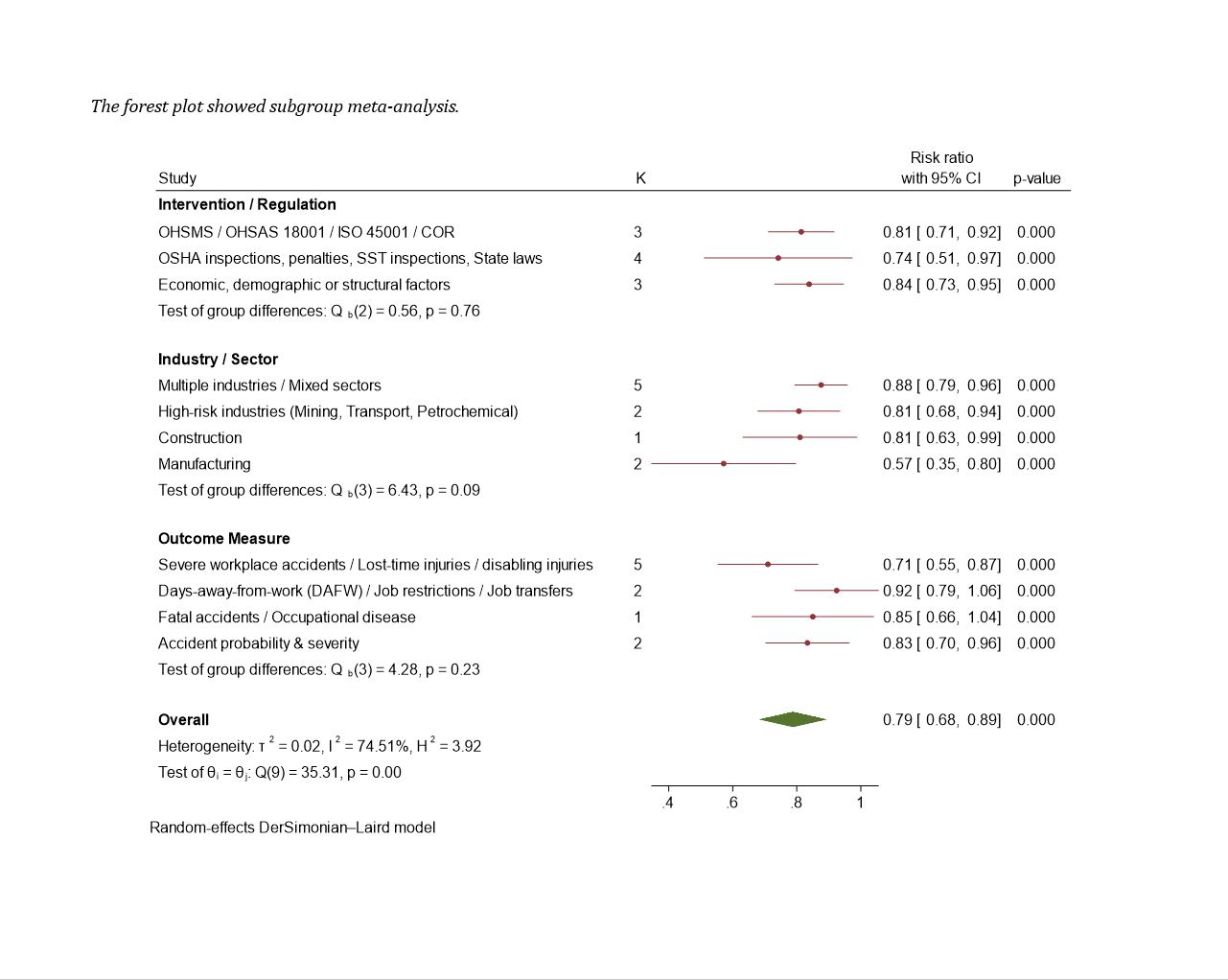
Effective Health, Safety, and Environmental (HSE) legislation is critical for reducing occupational accidents and promoting worker health. Although numerous studies have examined individual interventions, a comprehensive synthesis across industries has been lacking. This meta-analysis aimed to evaluate the impact of HSE legal and managerial interventions on reducing industrial accidents and improving occupational health across multiple high-risk sectors. A systematic search of reputable scientific databases was conducted to identify studies up to January 2026. Twelve studies encompassing manufacturing, construction, high-risk sectors such as mining and transportation, and petrochemical and oil industries were included. Risk ratios (RR) and 95% confidence intervals (CI) were extracted. Random-effects meta-analysis and subgroup analyses were performed based on intervention type, industry, and outcome measures. Overall, HSE interventions significantly reduced occupational accident risk (RR=0.788; 95% CI: 0.682–0.894). Subgroup analyses demonstrated that safety management systems (OHSMS, ISO 45001, OHSAS 18001) and regulatory inspections with penalties significantly lowered accident risk. Economic and demographic factors moderated outcomes, with younger, less-experienced, or male workers at higher risk, mitigated by training, resource allocation, and targeted interventions (RR=0.839). Severe occupational injuries and disabling incidents showed the most significant reduction (RR = 0.769). HSE legislation, combined with systematic safety management and targeted inspections, effectively reduces industrial accidents and enhances worker health. Policy implications include enforcing legal standards, implementing safety management systems, and integrating workforce-focused interventions.
Downloads
References
Acheampong, T., & Kemp, A. G. (2022). Health, safety and environmental (HSE) regulation and outcomes in the offshore oil and gas industry: Performance review of trends in the United Kingdom Continental Shelf. Safety Science, 148, 105634.
Adekoya, O. O., Tula, O. A., Adefemi, A., & Abatan, A. (2023). Health, safety and environmental (HSE) practices in the LNG industry: a review. World Journal of Advanced Researchand Reviews, 20(03), 1757-1776.
Adio, S. A., Ajirotutu, R. O., Olayiwola, R. K., Erinjogunola, F. L., & Sikhakhane-Nwokediegwu, Z. (2025). From Compliance to Competitive Advantage: The Strategic Role of HSE in Business Sustainability.
Ashari, M. R. (2022). Occupational disease prevention strategies through ohs interventions: global evaluation and challenges. Journal of Health Literacy and Qualitative Research, 2(2), 56-70.
Bilim, A. (2025). Demographic analysis of occupational safety in the construction sector: Strategies and insights for risk reduction. Buildings, 15(4), 528.
Birhan, M., & Endawoke, M. (2023). Effects of occupational hazard on employee health and productivity in case of academic institutions. Mathews Journal of Sports Medicine, 3(2), 1-12.
Blanc, F., Ottimofiore, G., & Myers, K. (2022). From OSH regulation to safety results: Using behavioral insights and a “supply chain” approach to improve outcomes–The experience of the health and safety Executive. Safety Science, 145, 105491.
Cao, Z., Zhou, T., Miao, S., Wang, L., & Wang, Z. (2025). Exploring the economic occupational health, safety, and fatal accidents in high-risk industries. BMC Public Health, 25(1), 433.
Dyreborg, J., Thorsen, S. V., Madsen, C. U., & Hasle, P. (2024). Effectiveness of OHSAS 18001 in reducing accidents at work. A follow-up study of 13,102 workplaces. Safety Science, 177, 106573.
Friedman, L. S., & Forst, L. (2007). The impact of OSHA recordkeeping regulation changes on occupational injury and illness trends in the US: a time-series analysis. Occupational and environmental medicine, 64(7), 454-460.
Gray, W. B., & Mendeloff, J. M. (2005). The declining effects of OSHA inspections on manufacturing injuries, 1979–1998. ILR Review, 58(4), 571-587.
Haviland, A. M., Burns, R. M., Gray, W. B., Ruder, T., & Mendeloff, J. (2012). A new estimate of the impact of OSHA inspections on manufacturing injury rates, 1998–2005. American journal of industrial medicine, 55(11), 964-975.
Hesham, M., Hosny, G., Mahmoud, E., & Ghatas, Z. (2025). Developing an integrated model for improving occupational health and safety performance in some industries using safety standards. Discover Public Health, 22(1), 338.
Johnson, M. S., Levine, D. I., & Toffel, M. W. (2017). Organizational and geographic spillover effects of regulatory inspections: Evidence from OSHA. US Department of Labor Scholars Final Report.
Kaplanvural, S., Tosyalı, E., & Ekmekçi, İ. (2026). Forecasting occupational accidents in Turkey using multivariate ARMAX and NLARX models. Scientific reports.
Li, L., & Singleton, P. (2019). The effect of workplace inspections on worker safety. ILR Review, 72(3), 718-748.
McLeod, C. B., & Macpherson, R. A. (2025). Evaluating the Effectiveness of an Occupational Health and Safety Management System Certification Program on Firm Work Injury Rates in Alberta, Canada. American journal of industrial medicine, 68(2), 175-183.
PĂDURE, L. A., & PĂDURE, V. A. (2025). Legislative Aspects of Health and Safety at Work. European Journal of Social Law/Revue Européenne du Droit Social, 66(1).
Smitha, M. W., Kirk, K. A., Oestenstad, K. R., Brown, K. C., & Lee, S.-D. (2001). Effect of state workplace safety laws on occupational injury rates. J Occup Environ Med, 43(12), 1001-1010.
Wang, Y., Zhang, N., Li, X., Du, W., Wang, H., & Shi, X. (2025). Global health burden and inequality patterns of occupational noise exposure from 1990 to 2019. Scientific reports, 15(1), 24844.
Downloads
Additional Files
Publication Timeline
- Submitted
- Revised
- Accepted
Issue
Section
License
Copyright (c) 2025 Ali Amiri (Corresponding author); Ali Mashhadi (Author)

This work is licensed under a Creative Commons Attribution-NonCommercial 4.0 International License.