Soft Balancing and the Challenges to U.S. Hegemony in the Persian Gulf after September 11
Keywords:
Soft balancing, U.S. hegemony, foreign policy, Persian Gulf, post-September 11, regional resistance, soft powerAbstract
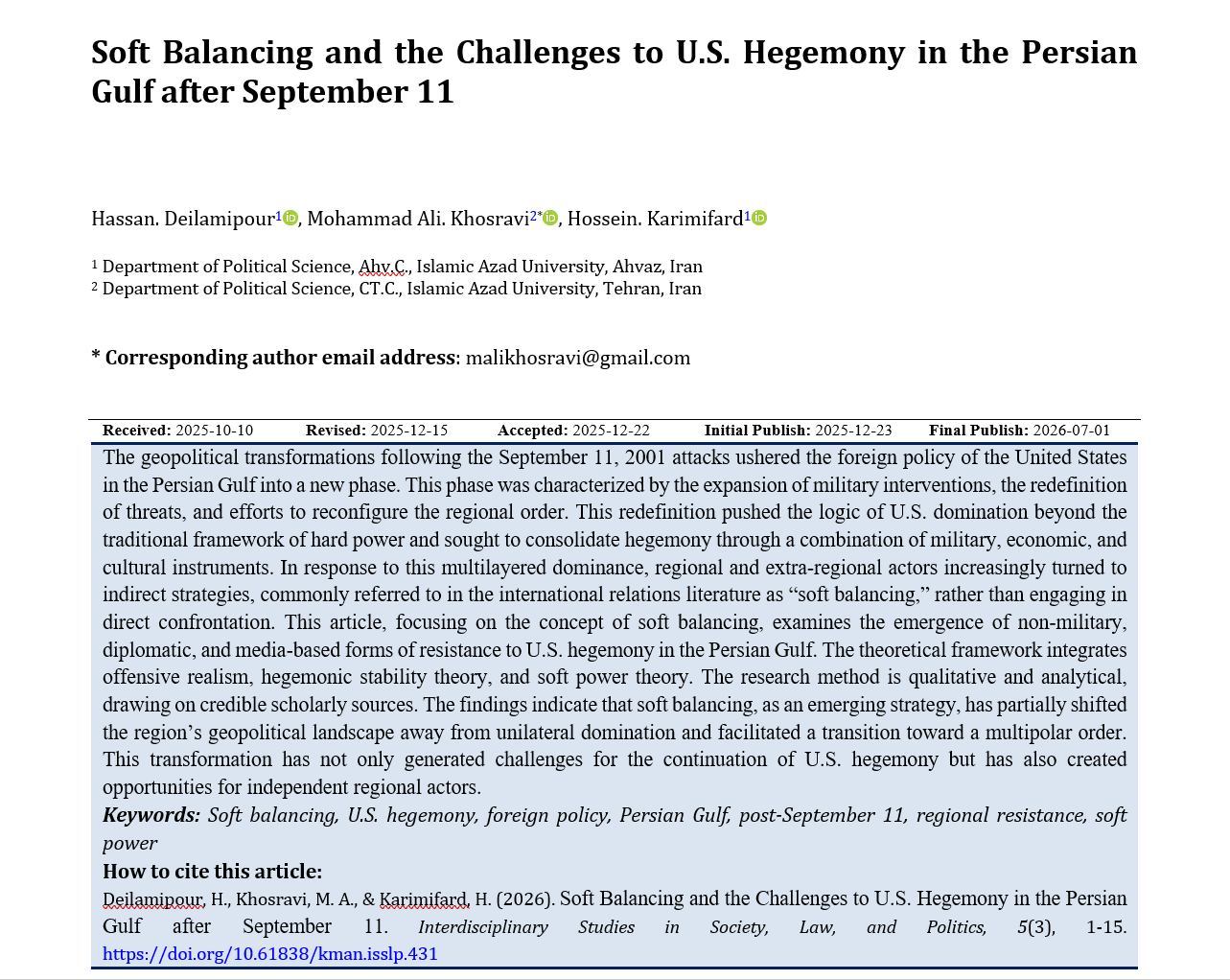
The geopolitical transformations following the September 11, 2001 attacks ushered the foreign policy of the United States in the Persian Gulf into a new phase. This phase was characterized by the expansion of military interventions, the redefinition of threats, and efforts to reconfigure the regional order. This redefinition pushed the logic of U.S. domination beyond the traditional framework of hard power and sought to consolidate hegemony through a combination of military, economic, and cultural instruments. In response to this multilayered dominance, regional and extra-regional actors increasingly turned to indirect strategies, commonly referred to in the international relations literature as “soft balancing,” rather than engaging in direct confrontation. This article, focusing on the concept of soft balancing, examines the emergence of non-military, diplomatic, and media-based forms of resistance to U.S. hegemony in the Persian Gulf. The theoretical framework integrates offensive realism, hegemonic stability theory, and soft power theory. The research method is qualitative and analytical, drawing on credible scholarly sources. The findings indicate that soft balancing, as an emerging strategy, has partially shifted the region’s geopolitical landscape away from unilateral domination and facilitated a transition toward a multipolar order. This transformation has not only generated challenges for the continuation of U.S. hegemony but has also created opportunities for independent regional actors.
Downloads
References
Abbasi Eshlaghi, M. (2023). US military-security relations with the Persian Gulf Cooperation Council after September 11. Quarterly Journal of Middle East Studies, Islamic Azad University, Science and Research Branch, Tehran.
Ghahramanpour, A. (2017). Power and soft balancing in international politics. Institute for Strategic Studies.
Jalilvand, D. R. (2017). Iran's Gas Exports: Political and Economic Determinants.
Jalinousi, A., Alborzi, H., & Tabatabaei, Y. (2014). The divergent role of the United States in the Persian Gulf region after September 11. Quarterly Journal of World Politics, 3(4), 183-218.
Keohane, R. O. (2005). After Hegemony: Cooperation and Discord in the World Political Economy. Princeton University Press. https://doi.org/10.2307/j.ctt7sq9s
Mearsheimer, J. J. (2001). The Tragedy of Great Power Politics. W. W. Norton & Company.
Morgenthau, H. J. (1948). Politics Among Nations: The Struggle for Power and Peace. Alfred A. Knopf.
Nye, J. S. (2004). Soft Power: The Means to Success in World Politics. PublicAffairs.
Rezaei, A. (2008). China and soft balancing against the hegemony of the United States in the international system. Quarterly Journal of Development Strategy, 16.
Salehi, H., Rezaei, A., & Torabi, G. (2025). The constraints of US hegemonic unilateralism in the Middle East (after September 11). Quarterly Journal of Political Studies, Islamic Azad University, Hamedan Branch.
Sharifpour, B., Bagherizadeh, A., Golparvar, M., & Anousheh, E. (2020). An analysis of power balance changes among Iran, Saudi Arabia, and the United States in the Persian Gulf after September 11.
Vaezi, M. (2010). The role of great powers in the Persian Gulf region and the challenges to US hegemony. Quarterly Journal of Foreign Relations, 2(6), 7-47.
Zavari, S. A. (2025). The ritual of power and the balance of power: A fundamental concept in international relations and political science.
Downloads
Additional Files
Publication Timeline
- Submitted
- Revised
- Accepted
Issue
Section
License
Copyright (c) 2025 Hassan Deilamipour (Author); Mohammad Ali Khosravi (Corresponding author); Hossein Karimifard (Author)

This work is licensed under a Creative Commons Attribution-NonCommercial 4.0 International License.