Comparative Study of the Characteristics of Monetary Obligations
Keywords:
Money, Monetary Obligation, Delay Damages, Depreciation of MoneyAbstract
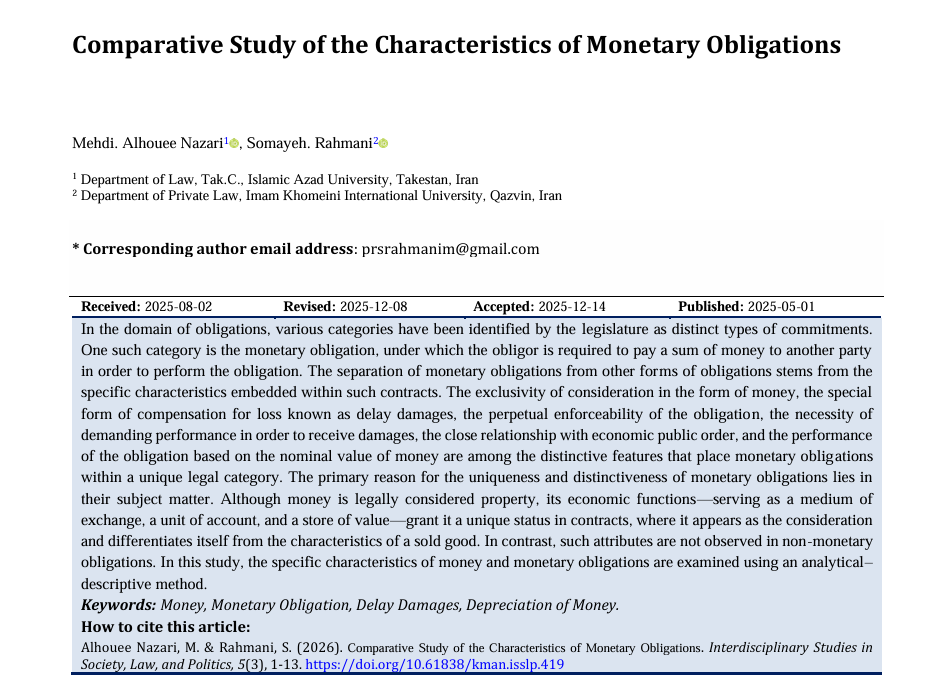
In the domain of obligations, various categories have been identified by the legislature as distinct types of commitments. One such category is the monetary obligation, under which the obligor is required to pay a sum of money to another party in order to perform the obligation. The separation of monetary obligations from other forms of obligations stems from the specific characteristics embedded within such contracts. The exclusivity of consideration in the form of money, the special form of compensation for loss known as delay damages, the perpetual enforceability of the obligation, the necessity of demanding performance in order to receive damages, the close relationship with economic public order, and the performance of the obligation based on the nominal value of money are among the distinctive features that place monetary obligations within a unique legal category. The primary reason for the uniqueness and distinctiveness of monetary obligations lies in their subject matter. Although money is legally considered property, its economic functions—serving as a medium of exchange, a unit of account, and a store of value—grant it a unique status in contracts, where it appears as the consideration and differentiates itself from the characteristics of a sold good. In contrast, such attributes are not observed in non-monetary obligations. In this study, the specific characteristics of money and monetary obligations are examined using an analytical–descriptive method.
Downloads
References
Aghaee, K. (2017). Article 522 of the Code of Civil Procedure in the Light of the Theory of Money Adjustment. Legal Research Quarterly(80).
Anderson, B. (1917). The Value of Money. Macmillan Company.
Assefi, M. M. (1996). Jurisprudential Rulings on Money. Fiqh Ahl al-Bayt Journal, 7(1).
Babaei, I. (2017). Civil Liability Law, Based on Critique and Review of Judicial Opinions and Practice (Vol. 1).
Davoudi, P., & et al. (2011). Money in Islamic Economics.
Elliott, C., & Quinn, F. (2009). Contract Law. Pearson Pub.
Fisher, I. (1920). The Purchasing Power of Money. Macmillan Pub.
Ghasemzadeh, S. M. (2009). Principles of Contracts and Obligations.
Hashemi Shahroudi, S. M. (1996). Fiqh Ahl al-Bayt Journal. 2.
Hurr Amili, M. i. H. (1989). Means of the Shi'a.
Ja'fari Langroudi, M. J. f. (2003). Dictionary of Elementology. In
Kashani, S. M. (2002). Legal Foundations and Regulations of Interest and Default Damages. Bar Association Journal(176).
Katouzian, N. (2012). General Theory of Obligations.
Katouzian, N. (2013). General Rules of Contracts (Vol. 4). https://doi.org/10.4324/9780203081310
Lankskoy, S. (2000). The Legal Nature of Electronic Money. https://www.bcb.gob.bo/webdocs/publicacionesbcb/revista_analisis/ra_vol0302/capitulo6final.pdf
Lapavitsas, C. (2003). Money as 'Universal Equivalent' And Its Origin In Commodity Exchange. https://www.soas.ac.uk/economics/research/workingpapers/file28848.pdf
Makarem Shirazi, N. (2001). Important Jurisprudential Discussions.
Mohseni, H., & Mirshekari, A. (2016). Claiming Damages for Delayed Payment of Debt Arising from Compulsory Guarantee. Private Law Studies Quarterly, 46(1).
Musavi Khomeini, R. (1993). The Book of Sale.
Nelson, A. (1999). Marx's Concept of money. Routledge Publications.
Proctor, C. (2012). Mann on the Legal Aspect of Money. Oxford University Press. https://doi.org/10.1093/law/9780199609178.001.0001
Ribeiro, R. (2002). Damages and Other Remedies for Breach of Commercial Contracts. Thorogood Pub.
Safa'i, S. H. (2014). General Rules of Contracts.
Safa'i, S. H., & Rahimi, H. (2013). Civil Liability (Non-Contractual Obligations).
Shahidi, M. (2011). Formation of Contracts and Obligations.
Shahidi, M. (2012). Effects of Contracts and Obligations.
Shams, A. (2006). Code of Civil Procedure (Vol. 2).
Siddik Yurtcicek, M. (2013). The Legal Nature of Electronic Money and The Effects of EU Regulations Concerning The Electronic Money Market.
Silvestre, M., & Rustel, J. (2015). The Financial Obligations In International Law. Oxford University Press.
Simmel, G. (2004). Philosophy of Money. Routledge Publications.
Tavassoli, M. E. i. (2012). Analysis of the Nature of Money. Islamic Economics Scientific Research Quarterly, 12(48).
Von Mises, L. (2013). The Theory Of Money And Credit. Skyhorse Publication.
Wolfgang, E. (2014). Mensura et mensuratum: money as mesure and mesure and mesure for money. In Money As God? Cambridge University Press.
Wood, R. P. (1995). Principle of International Insolvency. Sweet & Maxwell.
Yazdanian, A. (2007). General Rules of Civil Liability (Vol. 1).
Yousefi, A. A. (1996). New Money from the Viewpoint of Thinkers.
Yousefi, A. A. (2010). Jurisprudential Study of Compensation for the Reduction in Value of Money.
Downloads
Additional Files
Publication Timeline
- Submitted
- Revised
- Accepted
Issue
Section
License
Copyright (c) 2025 Mehdi Alhouee Nazari, Somayeh Rahmani (Author)

This work is licensed under a Creative Commons Attribution-NonCommercial 4.0 International License.