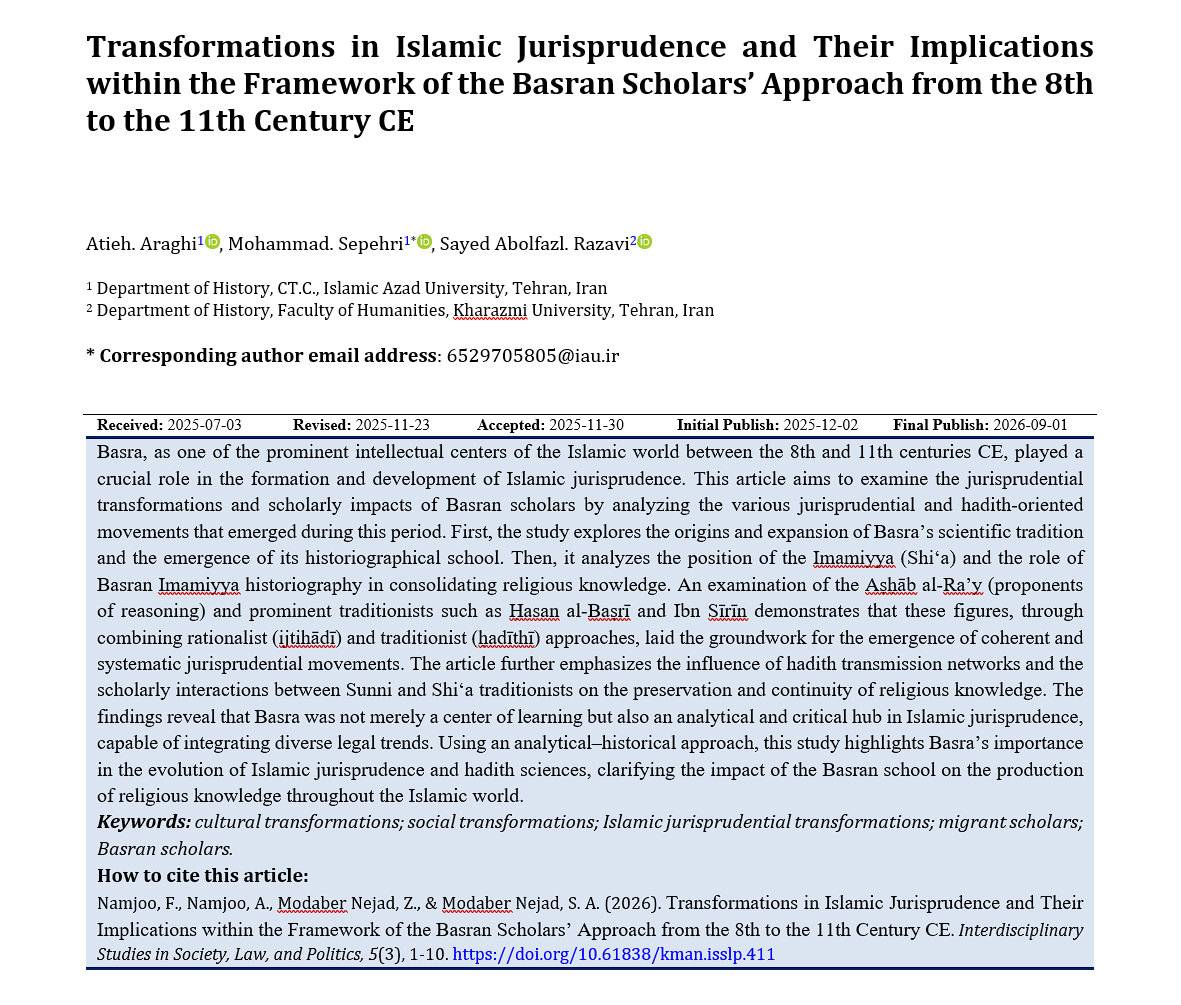
Transformations in Islamic Jurisprudence and Their Implications within the Framework of the Basran Scholars’ Approach from the 8th to the 11th Century CE
DOI:
https://doi.org/10.61838/kman.isslp.411Keywords:
Imamiyyah jurisprudence, Iranian law, groundwater, principle of la-zarar, environmental obligations, environmental justiceAbstract
Basra, as one of the prominent intellectual centers of the Islamic world between the 8th and 11th centuries CE, played a crucial role in the formation and development of Islamic jurisprudence. This article aims to examine the jurisprudential transformations and scholarly impacts of Basran scholars by analyzing the various jurisprudential and hadith-oriented movements that emerged during this period. First, the study explores the origins and expansion of Basra’s scientific tradition and the emergence of its historiographical school. Then, it analyzes the position of the Imamiyya (Shi‘a) and the role of Basran Imamiyya historiography in consolidating religious knowledge. An examination of the Aṣḥāb al-Ra’y (proponents of reasoning) and prominent traditionists such as Ḥasan al-Baṣrī and Ibn Sīrīn demonstrates that these figures, through combining rationalist (ijtihādī) and traditionist (ḥadīthī) approaches, laid the groundwork for the emergence of coherent and systematic jurisprudential movements. The article further emphasizes the influence of hadith transmission networks and the scholarly interactions between Sunni and Shi‘a traditionists on the preservation and continuity of religious knowledge. The findings reveal that Basra was not merely a center of learning but also an analytical and critical hub in Islamic jurisprudence, capable of integrating diverse legal trends. Using an analytical–historical approach, this study highlights Basra’s importance in the evolution of Islamic jurisprudence and hadith sciences, clarifying the impact of the Basran school on the production of religious knowledge throughout the Islamic world.
Downloads
References
Amini, N., & Razania, M. (2018). The Deficiencies and Deviations of Basra Exegesis in the First Two Islamic Centuries. Seraj-e Monir(33), 105-132.
Daftary, F. (1990). The Ismā'īlīs: Their History and Doctrines. Cambridge University Press.
Gorji, A. Q. (1996). Justification for Independent Legal Reasoning. In Encyclopaedia of the World of Islam (Vol. 1). Encyclopaedia Islamica.
Hallaq, W. B. (2005). The Origins and Evolution of Islamic Law. Cambridge University Press. https://doi.org/10.1017/CBO9780511818783
Hitti, P. K. (2002). History of the Arabs. Macmillan. https://doi.org/10.1007/978-1-137-03982-8
Ibn Athir, I. (2004). The Complete History (Vol. 3). Asatir.
Ibn Ḥajar al-ʿAsqalānī, A. b. ʿ. (1971). The Tongue of the Balance (Vol. 2; 4). Mu'assasat al-A'lami lil-Maṭbūʿāt.
Ibn Nadīm, M. The Index (Edited by R. Tajaddod ed.).
Kennedy, H. (2001). The Prophet and the Age of the Caliphates: The Islamic Near East from the Sixth to the Eleventh Century. Longman.
Khateeb Baghdadi, A. B. A. The History of Baghdad and the City of Peace (Vol. 10). Dar al-Fikr.
Krawietz, B. (2002). Authority and Political Culture in Shi'i Islam. Routledge.
Miftakhri, H., & Koushki, F. (2020). Readers and Their Role in the Transformations of the First Islamic Century. History of Islam(22), 45-50.
Motzki, H. (2002). Hadith and the Origins of Islamic Jurisprudence. Brill. https://doi.org/10.1163/9789004491533
Mousavi-Tinyani, S. A. (2017). The Hadithic Movement of the Imamiyya in Basra (Era of Presence). Hadith Sciences(84), 102-127.
Mousavi Tenyani, S. A. (2018). The Historical Current of Imami Historians in Basra from the Beginning until the Mid-Fourth Century AH. History of Islam(73), 67-98.
Paktchi, A. (2020). Jurisprudence in Basra. In Encyclopaedia Islamica.
Qasempour, M. A Study of the Current of Mystical Exegesis.
Qasempour, M. (2014). Ḥammād ibn Zayd in the Struggle. In The Great Islamic Encyclopedia (Vol. 14). Center for the Great Islamic Encyclopedia.
Qureshi, S. H. (2005). Three Iranian Companions of Imam Baqir. Farhang-e Kosar(62), 126-129.
Rostami, A. (2009). The Influence of Political Currents on Exegesis and Commentators. Boostan Ketab.
Sachedina, A. (1981). The Just Ruler in Shī'ī Islam: The Comprehensive Authority of the Jurist in Imamite Jurisprudence. SUNY Press.
Sellheim, R. (2016). Persian Influence on Arabic Literature in Early Islamic Basra. Harrassowitz.
Sijistani, S. b. A. (1989). Sunan Abi Dawud (Vol. 1). Dar al-Fikr.
Tabari, M. b. J. (1996). The History of Al-Tabari (Vol. 4). Asatir.
Tusi, M. b. H. (1996). Rijāl (Edited by J. al-Qayūmī ed.). Mo'asseseh al-Nashr al-Islāmī.
Ya'qūbī, A. b. A. Y. (2003). The History of Ya'qūbī (Translated by M. I. Āyati ed., Vol. 2). Elmi va Farhangi.
Downloads
Additional Files
Publication Timeline
- Submitted
- Revised
- Accepted
Issue
Section
License
Copyright (c) 2025 Atieh Araghi, Mohammad Sepehri, Sayed Abolfazl Razavi (Author)

This work is licensed under a Creative Commons Attribution-NonCommercial 4.0 International License.