Economic Prosperity through a Balanced Formalism Approach in Public Joint-Stock Companies
Keywords:
balanced formalism, freedom of will, public joint-stock company, economic prosperity, foreign investmentAbstract
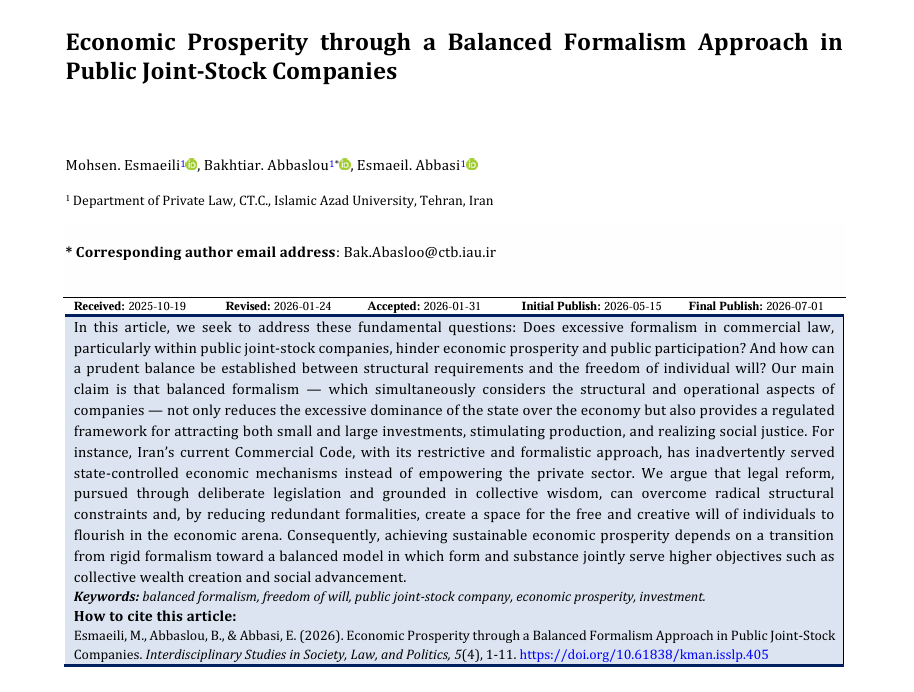
In this article, we seek to address these fundamental questions: Does excessive formalism in commercial law, particularly within public joint-stock companies, hinder economic prosperity and public participation? And how can a prudent balance be established between structural requirements and the freedom of individual will? Our main claim is that balanced formalism — which simultaneously considers the structural and operational aspects of companies — not only reduces the excessive dominance of the state over the economy but also provides a regulated framework for attracting both small and large investments, stimulating production, and realizing social justice. For instance, Iran’s current Commercial Code, with its restrictive and formalistic approach, has inadvertently served state-controlled economic mechanisms instead of empowering the private sector. We argue that legal reform, pursued through deliberate legislation and grounded in collective wisdom, can overcome radical structural constraints and, by reducing redundant formalities, create a space for the free and creative will of individuals to flourish in the economic arena. Consequently, achieving sustainable economic prosperity depends on a transition from rigid formalism toward a balanced model in which form and substance jointly serve higher objectives such as collective wealth creation and social advancement.
Downloads
References
Abedi Firouzjaei, E. (2018). A discourse on the philosophy of commercial company law; Commercial companies, the creation of a spontaneous order or an artificial order? Private Law Studies Quarterly, 49(1), 69-86.
Anari, M. (2014). Establishment of Unrestricted Trading Companies. National Congress of Applied Human Sciences Research,
Bergmann, G., & Zerby, L. (1945). The Formalism in Kelsen's Pure Theory of Law. Ethics, 55(2), 110-130. https://doi.org/10.1086/290438
Bigdeli, A. (2015). The Sovereignty of Will in Imamian Jurisprudence, Roman-German System, and Iranian Law: A Philosophical Introduction. Islamic law research paper, 16(1), 125-150.
Davis, J. P. (1897). The Nature of Corporations. Political Science Quarterly, 12(2), 273-294. https://doi.org/10.2307/2140122
Dehkhoda, A. A. (1994). Dehkhoda Dictionary (Vol. 13). University of Tehran Press.
Eskini, R. (2012). Commercial Law, Business Companies (Vol. 2). Samt Publications.
Esmaeili, M. (2018). The Principle of Sovereignty of Will in Western and Islamic Law: Foundations, Implications, and Historical Background. Comparative Research in Islamic and Western Law, 5(2), 1-26.
Ghasemi, M. (2009). Formalism in Civil Law. Mizan Publications.
Hojjati, S. B. (2019). Obligations of Commercial Companies Before Registration in Iranian and British Law Allameh Tabatabai University].
Imanı, A. (2011). Encyclopedia of Legal Theories, H. Bix.B. Nahid Publications.
Jafari Langerudi, M. J. (1978). Encyclopedia of Civil and Commercial Law. Mash'al Azadi Press.
Jafari Langerudi, M. J. (2002). General Philosophy of Law: The Theory of Balance. Ganji Danesh Library.
Katebi, H. (1989). Commercial Law. Ganje Danesh Publications.
Katouzian, N. (1993). General Principles of Contracts (Vol. 1). Behnashr Publications.
Moazeni, R. (2021). Public Economic Law, V1, Sources and Principles of Comparative Study between Iran and France. Majd Publications.
Montesquieu, B. d. (1991a). The Spirit of the Laws (Translated by Mohaddesi, A. ed., Vol. 2). Amir Kabir Publications.
Montesquieu, B. d. (1991b). The Spirit of the Laws (Translated by Mohaddesi, A ed., Vol. 1). Amir Kabir Publications.
Nozick.R. (1974). Anarchy, State and Utopia. BlackwelL.
Omidvar, S. (2022). Root Cause Analysis and Comparative Assessment of Rawls' and Nozick's Theories of Distributive Justice. Economic Research in Iran, 27(91), 111-157.
Pasban, M. R. (2019). Commercial Companies Law. Samt Publications.
Raei, M., & Moulaeian, M. (2014). The Approach of Imamian Jurisprudence to Commutative Justice and Its Impact on Associated Contracts. Islamic Law, 11(40), 135-165.
Saffar, M. J. (1994). Legal Personality. Dana Publications.
Schmitt, C. (2008). Constitutional theory (translated and edited by Seitzer ed.). Duke University Press. https://doi.org/10.2307/j.ctv1131cm8
Shiravi, A. (2021). Economic Law. Samt Publications.
Tabrizi, M. Y. (2021). Mostashar al-Dowleh. One Word. Aida Institute Publications.
Tusi, A. (2014). Economic Analysis of Company Law. City Knowledge Research Institute.
Wagner, J. A. (1995). Studies of Individualism-Collectivism: Effects on Cooperation in Groups. The Academy of Management Journal, 38(1), 152-172. https://doi.org/10.2307/256731
Zali, M. (2021). The Hidden Hand or Social Contract: Nozick, Rawls, and the Issue of Distributive Justice. Philosophical Journal of Knowledge, Human Sciences Research Institute, 1(84), 111-130.
Downloads
Additional Files
Publication Timeline
- Submitted
- Revised
- Accepted
Issue
Section
License
Copyright (c) 2025 Mohsen Esmaeili, Bakhtiar Abbaslou, Esmaeil Abbasi (Author)

This work is licensed under a Creative Commons Attribution-NonCommercial 4.0 International License.