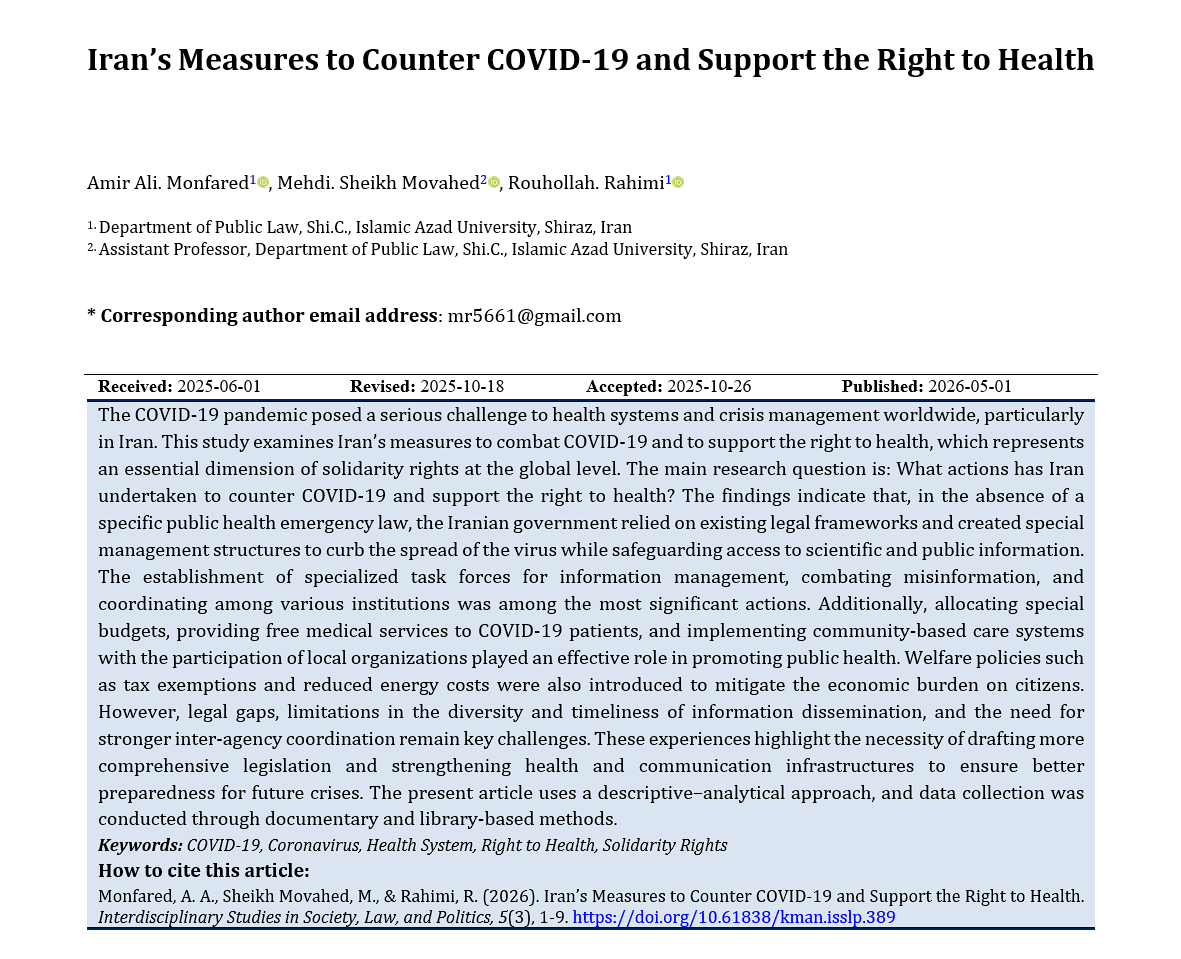
Iran’s Measures to Counter COVID-19 and Support the Right to Health
Keywords:
COVID-19, Coronavirus, Health System, Right to Health, Solidarity RightsAbstract
The COVID-19 pandemic posed a serious challenge to health systems and crisis management worldwide, particularly in Iran. This study examines Iran’s measures to combat COVID-19 and to support the right to health, which represents an essential dimension of solidarity rights at the global level. The main research question is: What actions has Iran undertaken to counter COVID-19 and support the right to health? The findings indicate that, in the absence of a specific public health emergency law, the Iranian government relied on existing legal frameworks and created special management structures to curb the spread of the virus while safeguarding access to scientific and public information. The establishment of specialized task forces for information management, combating misinformation, and coordinating among various institutions was among the most significant actions. Additionally, allocating special budgets, providing free medical services to COVID-19 patients, and implementing community-based care systems with the participation of local organizations played an effective role in promoting public health. Welfare policies such as tax exemptions and reduced energy costs were also introduced to mitigate the economic burden on citizens. However, legal gaps, limitations in the diversity and timeliness of information dissemination, and the need for stronger inter-agency coordination remain key challenges. These experiences highlight the necessity of drafting more comprehensive legislation and strengthening health and communication infrastructures to ensure better preparedness for future crises. The present article uses a descriptive–analytical approach, and data collection was conducted through documentary and library-based methods.
Downloads
References
Al-Kajbaf, H., & Ansarian, M. (2014). The Impact of Unilateral and Multilateral Sanctions on Iran from the Perspective of the Right to Health of Iranian Citizens. Medical Law Quarterly(29).
Ansarian, M. (2023). Human Rights Obligations of States during the Corona Pandemic with a Focus on the Right to Information. Quarterly Scientific Journal of New Administrative Law Research(14).
Bahmaei, M. A., & Shahbazian, A. (2020). Protecting the Right to Health in Investment Disputes Arising from Global Pandemics with Emphasis on COVID-19. Legal Research Quarterly(Special Issue on Law and COVID-19).
Emraei, M., & Faraji Khiyavi, F. (2020). A Comparative Study of the Control Policies of Iran, South Korea, China, and Germany in Response to COVID-19. Monitoring Journal(6). https://doi.org/10.29252/payesh.19.6.633
Hosseini, N., & Samaneh. (2023). The Impact of the COVID Pandemic on the Functions of the Government in Domestic and International Law. Administrative Law Research(14).
Hosseini, S. A., & Ghorosi, H. (2020). The Right to Access Information on the Corona Crisis with Emphasis on the Role of National Media. Biannual Scientific Journal of Human Rights and Citizenship(10).
Karami Qahhi, M. T., Shalchi, V., & Yousefi Khah, S. (2021). Women's Narratives from the Experience of the Iranian Family during COVID-19 and Home Quarantine. Sociological Studies (Letter of Social Sciences), 30(1).
Khwaja, M., Ansari Mohiyari, A., & Raei, M. (2023). The Obligation of International Cooperation during Disasters. Legal Researches(55).
Marvati, M., Riahi Nia, N., & Azimi, A. (2023). The Open Access Movement during the COVID-19 Pandemic: Efforts of the Global Community. Journal of Human-Information Interaction(4).
Masafa, N., & Kiani, R. (2024). The Legitimacy of United Nations Actions during the COVID-19 Solidarity Era. Global Policy Quarterly(47).
Mehrah, N. (2020). The State's Responsibility to Compensate COVID Victims. Legal Research Quarterly, 23(Special Issue on Law and COVID-19).
Ramazani Ghavamabadi, M. H. (2020). The COVID Pandemic and International Peace and Security. Legal Research Journal(Special Issue on Law and COVID-19).
Randolph, H. E., & Barreiro, L. B. (2020). Herd immunity: understanding COVID-19. Immunity, 52(5), 737-741. https://doi.org/10.1016/j.immuni.2020.04.012
Razaghi, A., & Shayegan, F. (2020). The Concept of International Solidarity and Its Impact on the Structure of Modern International Law. Public Law Studies at the University of Tehran(4).
Sheikhzadeh, H. (2019). How Governments Faced the COVID-19 Pandemic and the Impact of This Crisis on Redefining the Powers and Responsibilities of the State. Biannual Scientific Journal of Soft Power Studies(21).
Shirazi Khah, M., & Bahram Puri, S. (2020). Quarantine as an Effective Intervention in Controlling the COVID-19 Disease. Nursing Management Quarterly(1).
Tabnak. (2025). What Some Think Is Quarantine is Lockdown, Which Has Only Been Implemented in One Place. https://www.tabnak.ir/fa/news/968795/
United Nations. (1948). Universal Declaration of Human Rights.
United Nations. (1966). International Covenant on Economic, Social and Cultural Rights.
World Health Organization. (1946). Constitution of the World Health Organization.
Zeyrani, A. (2023). Health System Documents and Laws Are Written but Not Implemented. Newspaper(10221).
Downloads
Additional Files
Publication Timeline
- Submitted
- Revised
- Accepted
Issue
Section
License
Copyright (c) 2024 Amir Ali Monfared (Author); Mehdi Sheikh Movahed (Corresponding author); Rouhollah Rahimi (Author)

This work is licensed under a Creative Commons Attribution-NonCommercial 4.0 International License.