Evaluation of the Comprehensiveness and Efficiency of the Legal System of the World Trade Organization in Energy Trade Management with an Emphasis on Oil and Gas
DOI:
https://doi.org/10.61838/kman.isslp.4.4.18Keywords:
World Trade Organization, energy trade management, oil, gasAbstract
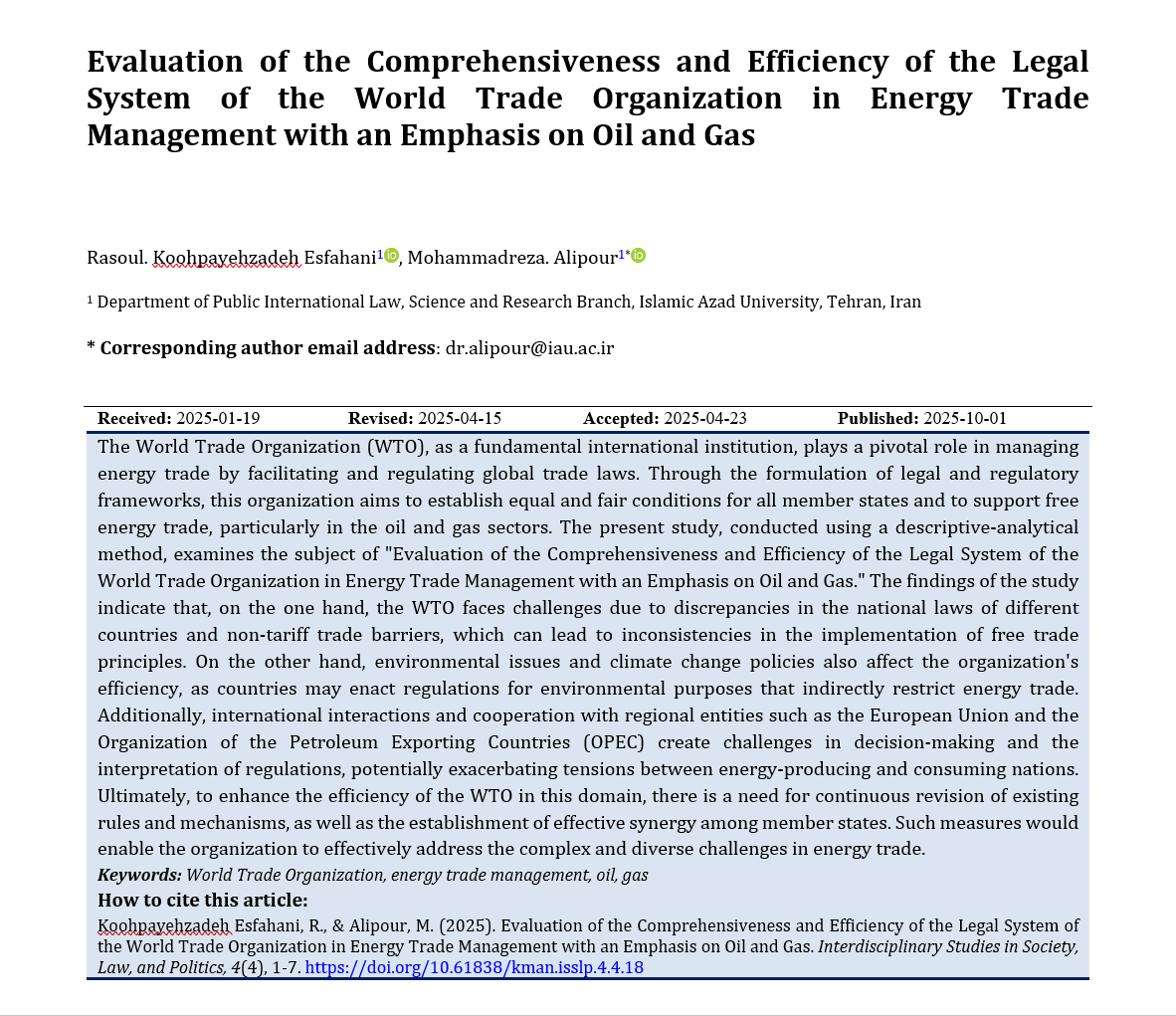
The World Trade Organization (WTO), as a fundamental international institution, plays a pivotal role in managing energy trade by facilitating and regulating global trade laws. Through the formulation of legal and regulatory frameworks, this organization aims to establish equal and fair conditions for all member states and to support free energy trade, particularly in the oil and gas sectors. The present study, conducted using a descriptive-analytical method, examines the subject of "Evaluation of the Comprehensiveness and Efficiency of the Legal System of the World Trade Organization in Energy Trade Management with an Emphasis on Oil and Gas." The findings of the study indicate that, on the one hand, the WTO faces challenges due to discrepancies in the national laws of different countries and non-tariff trade barriers, which can lead to inconsistencies in the implementation of free trade principles. On the other hand, environmental issues and climate change policies also affect the organization's efficiency, as countries may enact regulations for environmental purposes that indirectly restrict energy trade. Additionally, international interactions and cooperation with regional entities such as the European Union and the Organization of the Petroleum Exporting Countries (OPEC) create challenges in decision-making and the interpretation of regulations, potentially exacerbating tensions between energy-producing and consuming nations. Ultimately, to enhance the efficiency of the WTO in this domain, there is a need for continuous revision of existing rules and mechanisms, as well as the establishment of effective synergy among member states. Such measures would enable the organization to effectively address the complex and diverse challenges in energy trade.
Downloads
References
Amini, I., & Mansouri, A. (2017). The justification and reasons of the domestic arbitration award with a look at the judicial procedure. Private Law Research Journal(22), 9.
Berger, K. P. (2007). Re-examining the Arbitration Agreement: Applicable Law-Consensus or Confusion?
Bordbar, M. H. (2014). Jurisdiction in International Arbitration Courts. Iran-United States Claims Arbitration Court.
Ghomashi, M. S. (1997). Qazi Tahakim or the policy of privatization of judgment. Ahl al-Bayt Fiqh Specialized Quarterly(106), 226.
Habibi Majandeh, M. (2013). Arbitrability of disputes arising from intellectual property rights.
Haeri, S. K. (2001). Al-Qada fi Fiqh al-Islami. Majmaal al-Fikr al-Islami.
Katouzian, N. (2005). Validity of the adjudicated matter in civil litigation. Mizan Publications.
Liu, J. D. M., & Jafari, F. (2018). "Realization of the dream": the judgment of self-religion. (40), 172.
Liu, J. D. M., Mastlis, L., Kroll, S. M., & Habibi Majandeh, M. (2011). Comparative International Commercial Arbitration. Mofid University Press.
Lotfi, S., & Saadatkhah, H. (2016). Protest against foreign and international arbitral awards. Journal of Legal Studies(13), 4.
Makrami, A. M. (1996). Recognition and implementation of foreign arbitration awards in Iran. Law Opinions Magazine(4), 146-147.
Moshkelgosh, E. (2013). The guarantee of the implementation of the arbitrator's decision in Iranian law. The specialized database of publishing legal articles, 1-5.
Seifi, S. J. (2013). The importance of organizational arbitration in international commercial disputes. Arbitration report, 21.
Yazidi Fard, A. A., & Fallah, A. (2008). The Legitimacy of Private Judgment in Islam. Islamic Jurisprudence and Law Research Quarterly, 18, 75.
Downloads
Additional Files
Publication Timeline
- Submitted
- Revised
- Accepted
Issue
Section
License
Copyright (c) 2025 Rasoul Koohpayehzadeh Esfahani, Mohammadreza Alipour (Author)

This work is licensed under a Creative Commons Attribution-NonCommercial 4.0 International License.