Regulating the Relationship Between Democracy and Political Authority in the Constitutions of Iran and Malaysia: A Comparative Study of the Formation, Distribution, and Control of Power
Keywords:
democracy, political authority, comparative constitutional law, separation and balance of powers, horizontal accountability, Islamic Republic of Iran, MalaysiaAbstract
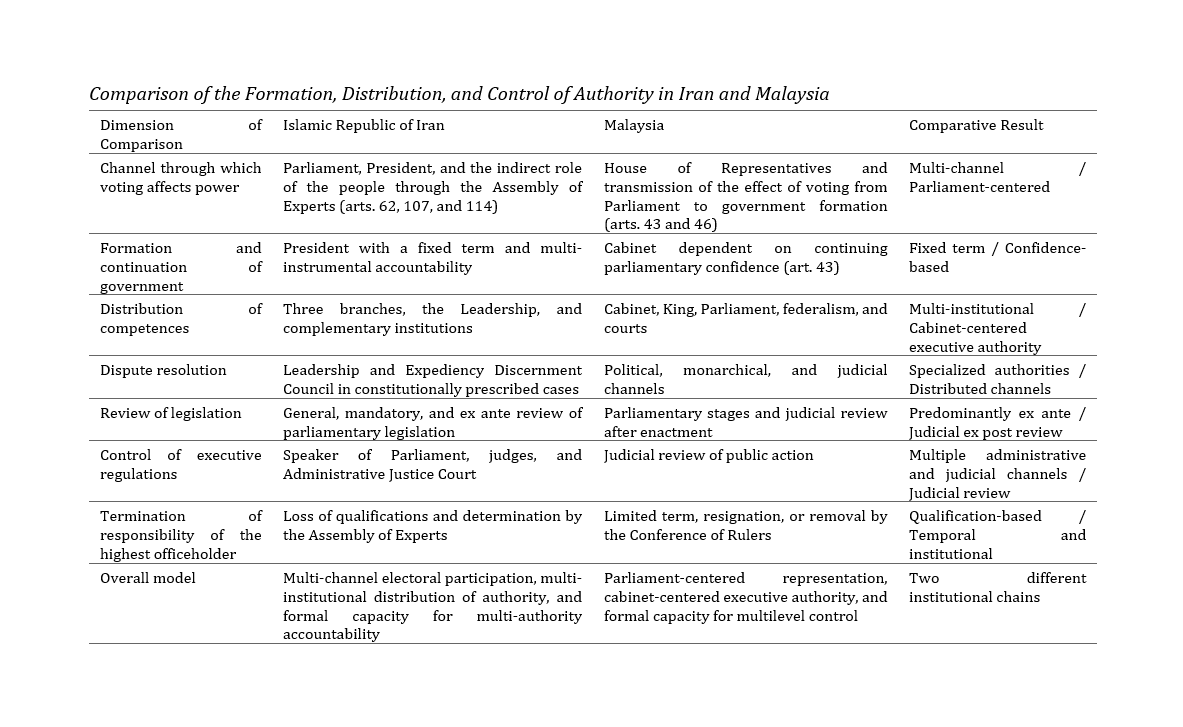
A constitution regulates the relationship between democracy and political authority by determining the manner in which supreme state institutions are constituted, powers are distributed, and oversight mechanisms are established. This article comparatively examines this relationship in the constitutions of the Islamic Republic of Iran and Malaysia. The study was conducted using a qualitative, comparative, and documentary approach, and the relevant provisions of the two constitutions were analyzed through structured and focused comparison along three dimensions: the formation, distribution, and control of authority. The findings indicate that, in Iran, popular participation is connected through multiple electoral channels to a structure characterized by the multi-institutional distribution of authority. The President and members of the Islamic Consultative Assembly are directly elected, the Leader is selected through the Assembly of Experts, and institutional accountability is distributed among parliamentary, judicial, electoral, and supervisory authorities. In Malaysia, the effect of direct voting is concentrated primarily on determining the composition of the House of Representatives; the Prime Minister and Cabinet are formed on the basis of a parliamentary majority, and the continuation of the government depends on maintaining the confidence of Parliament. Political authority is also subject to control through parliamentary, judicial, monarchical, federal, and specialized mechanisms. Accordingly, the Iranian model may be characterized as one of “multi-channel electoral participation, multi-institutional distribution of authority, and formal capacity for multi-authority accountability,” whereas the Malaysian model may be described as one of “parliament-centered representation, cabinet-centered executive authority, and formal capacity for multilevel control.” By introducing the concept of the “institutional chain of power,” the article demonstrates that examining the relationship between democracy and political authority requires consideration of the interconnections among the manner in which holders of power are selected, the scope of their powers, and the mechanisms governing their control and the termination of their tenure
Downloads
References
Beigizadeh, M. (2022). How the Idea of Jurists' Supervision over Parliamentary Enactments Was Realized in the Constitution of the Islamic Republic of Iran. Political-Social Studies of Iranian History and Culture, 1(3), 52-79. https://doi.org/10.61838/kman.jspsich.1.3.3
Bowen, G. A. (2009). Document Analysis as a Qualitative Research Method. Qualitative Research Journal, 9(2), 27-40. https://doi.org/10.3316/QRJ0902027
Dahl, R. A. (1971). Polyarchy: Participation and Opposition. Yale University Press.
George, A. L., & Bennett, A. (2005). Case Studies and Theory Development in the Social Sciences. MIT Press.
Grote, R., & Röder, T. J. (2012). Constitutionalism in Islamic Countries: Between Upheaval and Continuity. Oxford University Press. https://doi.org/10.1093/acprof:osobl/9780199759880.001.0001
Harding, A. (2022). The Constitution of Malaysia: A Contextual Analysis. Hart Publishing.
Harding, A., & Kumarasingham, H. (2022). The Malay Monarchies in Constitutional and Social Conception. Asian Journal of Law and Society, 9(3), 399-417. https://doi.org/10.1017/als.2022.32
Imani Turanposhti, M. (2021). Separation of Powers in the Islamic Republic of Iran and the United States of America. Political-Social Studies of Iranian History and Culture, 1(2), 1-31. https://doi.org/10.61838/kman.jspsich.1.2.1
Lee, H. P. (2012). Malaysia: The Politics of the Judiciary. In (pp. 305-318). Oxford University Press. https://doi.org/10.1093/acprof:osobl/9780199759880.003.0018
Lombardi, C. B. (2013). Designing Islamic Constitutions: Past Trends and Options for a Democratic Future. International Journal of Constitutional Law, 11(3), 615-645. https://doi.org/10.1093/icon/mot038
Madison, J. (1788). The Federalist No. 51. Founders Online, National Archives. https://founders.archives.gov/documents/Madison/01-10-02-0279
Montesquieu, C. d. S. (1989). The Spirit of the Laws. Cambridge University Press.
Neo, J. L. (2020). A Contextual Approach to Unconstitutional Constitutional Amendments: Judicial Power and the Basic Structure Doctrine in Malaysia. Asian Journal of Comparative Law, 15(1), 69-94. https://doi.org/10.1017/asjcl.2020.8
O'Donnell, G. (1998). Horizontal Accountability in New Democracies. Journal of Democracy, 9(3), 112-126. https://doi.org/10.1353/jod.1998.0051
Schirazi, A. (1997). The Constitution of Iran: Politics and the State in the Islamic Republic. I.B. Tauris.
Schreier, M. (2012). Qualitative Content Analysis in Practice. SAGE.
Shirvani, F. (2012). A Different Approach to the Control of Constitutionalism: Iran's Guardian Council. In (pp. 279-290). Oxford University Press. https://doi.org/10.1093/acprof:osobl/9780199759880.003.0016
Tew, Y. (2020). Constitutional Statecraft in Asian Courts. Oxford University Press. https://doi.org/10.1093/oso/9780198716839.001.0001
Downloads
Additional Files
Publication Timeline
- Submitted
- Revised
- Accepted
Issue
Section
License
Copyright (c) 2025 Mostafa Motaghian Nejad (Author); Hamidreza Rahmanizadeh Dehkordi (Corresponding author)

This work is licensed under a Creative Commons Attribution-NonCommercial 4.0 International License.