An Analysis of the Conflict between the Republic of Azerbaijan and Armenia in the Nagorno-Karabakh Crisis Based on Brecher’s Crisis Management Model at the Regional Level
Keywords:
Nagorno-Karabakh crisis, Brecher’s crisis management model, Republic of Azerbaijan, Armenia, South CaucasusAbstract
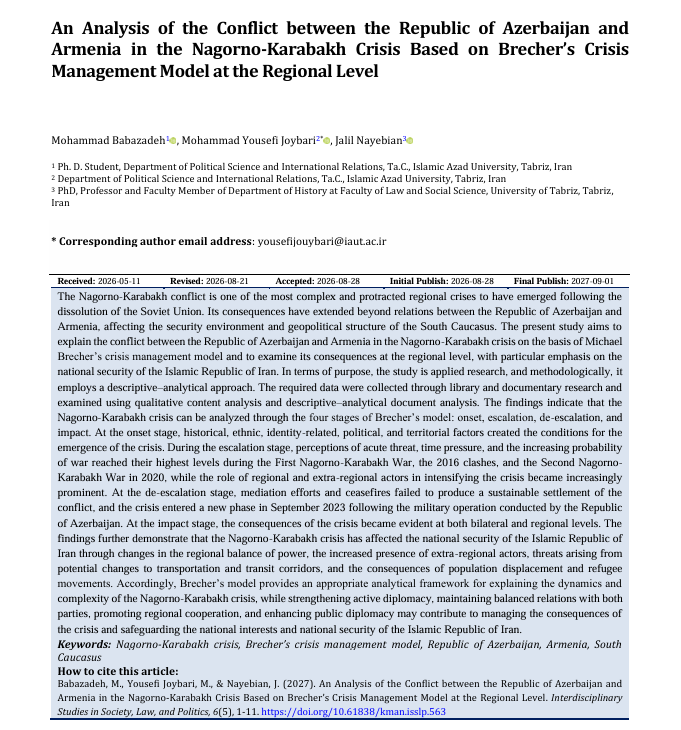
The Nagorno-Karabakh conflict is one of the most complex and protracted regional crises to have emerged following the dissolution of the Soviet Union. Its consequences have extended beyond relations between the Republic of Azerbaijan and Armenia, affecting the security environment and geopolitical structure of the South Caucasus. The present study aims to explain the conflict between the Republic of Azerbaijan and Armenia in the Nagorno-Karabakh crisis on the basis of Michael Brecher’s crisis management model and to examine its consequences at the regional level, with particular emphasis on the national security of the Islamic Republic of Iran. In terms of purpose, the study is applied research, and methodologically, it employs a descriptive–analytical approach. The required data were collected through library and documentary research and examined using qualitative content analysis and descriptive–analytical document analysis. The findings indicate that the Nagorno-Karabakh crisis can be analyzed through the four stages of Brecher’s model: onset, escalation, de-escalation, and impact. At the onset stage, historical, ethnic, identity-related, political, and territorial factors created the conditions for the emergence of the crisis. During the escalation stage, perceptions of acute threat, time pressure, and the increasing probability of war reached their highest levels during the First Nagorno-Karabakh War, the 2016 clashes, and the Second Nagorno-Karabakh War in 2020, while the role of regional and extra-regional actors in intensifying the crisis became increasingly prominent. At the de-escalation stage, mediation efforts and ceasefires failed to produce a sustainable settlement of the conflict, and the crisis entered a new phase in September 2023 following the military operation conducted by the Republic of Azerbaijan. At the impact stage, the consequences of the crisis became evident at both bilateral and regional levels. The findings further demonstrate that the Nagorno-Karabakh crisis has affected the national security of the Islamic Republic of Iran through changes in the regional balance of power, the increased presence of extra-regional actors, threats arising from potential changes to transportation and transit corridors, and the consequences of population displacement and refugee movements. Accordingly, Brecher’s model provides an appropriate analytical framework for explaining the dynamics and complexity of the Nagorno-Karabakh crisis, while strengthening active diplomacy, maintaining balanced relations with both parties, promoting regional cooperation, and enhancing public diplomacy may contribute to managing the consequences of the crisis and safeguarding the national interests and national security of the Islamic Republic of Iran.
Downloads
References
Akbari, H. (2020). Israel's relations with Azerbaijan and the national security of the Islamic Republic of Iran. Political Interpretation Knowledge, 2(7), 142-169.
Akhbari, M. (2020). Geopolitical consequences of the Nagorno-Karabakh crisis for the relations of the Islamic Republic of Iran in the Caucasus. Political Spatial Planning, 3(1).
Akif, N. (2013). A Brief History of the Nagorno-Karabakh War. University of Tabriz Press.
Asadi, A., Zolghadr, M., & Jafari Pabandi, S. F. (2023). Comparing the mediating roles of Iran and Russia in the Nagorno-Karabakh crisis. 14(1).
Ashrafi, M. (2020). An analysis of the Nagorno-Karabakh crisis and the role of the Islamic Republic of Iran in resolving it.
Avedissian, K. (2023). The failure of the European Union to address the threat of ethnic cleansing of Armenians in Nagorno-Karabakh. Genocide Studies International, 15(1), 34-44.
Balian, H. (2026). Anatomy of Peacemaking: Nagorno-Karabakh Conflict & Missed Opportunities. Palgrave Macmillan.
Beyouk, M. (2021). Explaining the factors affecting the establishment of the November 2020 ceasefire in Nagorno-Karabakh.
Beyouk, M. (2023). The future of the Nagorno-Karabakh crisis after the 2020 developments based on convergence and divergence among stakeholders. Strategic Environment Studies Quarterly of the Islamic Republic of Iran, 7(4), 35-70.
Brecher, M. (2003). Crisis in World Politics: The Emergence and Decline of Crises. Institute for Strategic Studies.
Broers, L. (2019). From "frozen conflict" to enduring rivalry: Reassessing the Nagorny Karabakh conflict. Nationalities Papers, 47(6), 1026-1047.
Cavanaugh, C. (2022). Renewed conflict over Nagorno-Karabakh.
Cingöz, M., & Erendor, M. (2026). Iran's policy towards Nagorno-Karabakh crisis within the framework of ontological security approach. British Journal of Middle Eastern Studies, 1-15.
Dadparvar, S., & Parto, A. (2026). New Actors in Arms Procurement in the South Caucasus: The Azerbaijan–Armenia Arms Race after the Dissolution of the Republic of Artsakh. Journal of Eurasian Studies.
Davtyan, E. (2024). Lessons that lead to war: Foreign policy learning and military escalation in the Nagorno-Karabakh conflict. Problems of Post-Communism, 71(1), 26-36.
Ebrahimi, S., & Kheiri, M. (2018). Analysis of Russia's interests in the Caucasus region: A case study of the Nagorno-Karabakh crisis. Central Eurasia Studies Quarterly, 11(2), 265-282.
Elahinia, M. (2022). Political-Security Consequences of the Nagorno-Karabakh Crisis for the National Security of the Islamic Republic of Iran. Rejal Publications.
Feyzollahi, M. (2025). The Nagorno-Karabakh War: Challenges to Iran's Interests from the South Caucasus to West Asia (2nd ed.). Jouyandeh Publishing.
Gale, R. P., Muradyan, A., Danelyan, S., Manukyan, N., Babak, M. V., Arakelyan, S., & Arakelyan, J. (2023). The humanitarian crisis in Nagorno-Karabakh. The lancet, 402(10410), 1324-1325.
Hosseini Atiq, S. Y. (2020). Israel's role in increasing political tensions between Iran and Azerbaijan [Master's thesis, University of Tehran].
Hynek, N., & Ter-Ghazaryan, L. (2026). The enigma of Nagorno-Karabakh: A "hierarchised amoebic composite" with Armenia. Eurasian Geography and Economics, 67(2), 121-148.
Isachenko, D. (2020). Turkey–Russia Partnership in the War over Nagorno-Karabakh.
Jafari, S. (2022). Evaluation of the performance of the United Nations and the Organization for Security and Co-operation in Europe regarding the Nagorno-Karabakh conflict.
Javaheri, S. (2022). The Nagorno-Karabakh War from the Perspective of International Law. Jahan-e Siasat Publications.
Kafi, S. (2021). The Nagorno-Karabakh War: Military-Geopolitical Lessons in the Strategic Environment of the Islamic Republic of Iran. Imam Hossein University.
Kalwar, B. A., Akhtar, M. N., & Khan, A. M. (2022). The Nagorno-Karabakh conflict in 2020: Causes and consequences. Global Political Review, 7(3), 9-17.
Karabakh Liberation, O. (2014). Karabakh: Book of Notes. Namik Habibov.
Khalili, M., Soleimanipour, Z., & Eshrati Khalilabad, F. (2013). Examining the Azerbaijan crisis based on Brecher's crisis management model. Quarterly Journal of the History of Foreign Relations(55), 147-184.
Khodabandelou, B. (2017). The Nagorno-Karabakh crisis and its effects on Iran-Azerbaijan relations from the beginning of the conflict to the present [Master's thesis, University of Guilan].
Kouzehgar Kaleji, V. (2017). The South Caucasus Security Complex. Institute for Strategic Studies.
Lesani, S. H. a.-D., & Movahedi Saveji, M. H. (2023). A legal analysis of international peace efforts in the Nagorno-Karabakh crisis. Central Asia and the Caucasus Studies, 29(124), 151-178.
Mahboubi, G. (2021). Israel-Azerbaijan relations and their impact on the national security of the Islamic Republic of Iran. Political Studies, 13(51), 159-178.
Mianabadi, H., Noufali, R., Mirhashemi Dehkordi, S., Borjesteh, H., & Andik, B. (2013). The ontology of neoliberal institutionalism theory and critiques of it in confronting transboundary water disputes. Iranian Water Resources Research Quarterly, 19(1), 102-124.
Miarka, A. (2021). The 2020 autumn war in Nagorno-Karabakh: Course and implications for the strategic balance of power in the South Caucasus region. Asian Affairs, 52(4), 826-851.
Moeinabadi Bidgoli, H., & Sayyad Sadri Ali, B. (2015). The performance of the Organization for Security and Co-operation in Europe in the Nagorno-Karabakh conflict between the Republic of Azerbaijan and Armenia. Central Eurasia Studies Quarterly, 8(1), 85-106.
Mooradian, M., & Druckman, D. (1999). Hurting stalemate or mediation? The conflict over Nagorno-Karabakh, 1990–95. Journal of Peace Research, 36(6), 709-727.
Moradi, G., & Salehi Yeganeh, M. (2023). Explaining the Nagorno-Karabakh crisis based on Brecher's crisis management model. Crisis Studies of the Islamic World, 10(4), 164-186.
Moradi, M. (2022). Examining the role of the Second Nagorno-Karabakh War in the defense-security considerations of the Islamic Republic of Iran [Master's thesis, Lorestan University].
Najafi Sayar, R. (2021). Effects and consequences of the 2020 Nagorno-Karabakh ceasefire agreement on the security and national interests of the Islamic Republic of Iran. Foreign Relations, 13(51), 499-532.
Nasri, G. (2007). Methodology in the school of neorealism. Strategic Studies Quarterly, 10(2), 215-238.
Norouzani, M. (2025). Analysis of the impact of social and economic conflicts on the military thinking of Azerbaijan and Armenia in the Second Nagorno-Karabakh War (2020) and its consequences for the Islamic Republic of Iran. Central Eurasia Studies, 18(1).
Osuli Odlu, Q., Naseri, F., & Rezaei Rad, E. (2026). Effecting factors of Iran's foreign policy toward the Republic of Azerbaijan after the Second Nagorno-Karabakh War. Journal of Eurasian Studies, 17(1), 88-100.
Rácz, A. (2020). War in Nagorno-Karabakh: A Two-Track Strategy for the EU.
Rasouli, E. (2025). The Second Nagorno-Karabakh War and the power structure in the South Caucasus. Central Eurasia Studies, 18(1), 85-110.
Rasulzadeh, M. (2019). Iran's foreign policy in the South Caucasus: Interests and challenges. Central Asia and the Caucasus, 20(1), 36-45.
Sahakyan, N. E. (2024). Framing the Nagorno-Karabakh conflict: An analysis of the narratives of the state leaders of Azerbaijan, Armenia and Turkey, 2002–2022. Central Asian Survey, 43(3), 383-399.
Seifi, A., & Hasanvand, A. (2023). Expansion of the Republic of Azerbaijan's relations with the Zionist regime and its impact on the national security of the Islamic Republic of Iran. Crisis Studies of the Islamic World, 9(4), 84-102.
Soltan, Z. a.-D. (2005). The Nagorno-Karabakh War. Akhtar Publications.
Souleimanov, E. A. (2024). Unlikely alliances: How the wars in Karabakh and Gaza shape Northwest Asian security. Middle East Policy, 31(2), 83-94.
Sultanov, Z. a.-D. (2018). The Nagorno-Karabakh War. Akhtar.
Taghinejad Fashtakeh, M. (2024). Examining U.S. foreign policy toward the Republic of Azerbaijan and its role in the Nagorno-Karabakh crisis. Afaq-e Olum-e Ensani, 8(89).
Tousirkani, M. (2011). An analysis of the dimensions and levels of intervention in the Nagorno-Karabakh geopolitical crisis. Central Asia and the Caucasus Studies Quarterly, 16(69).
Valigholizadeh, A. (2012). Examination and analysis of the nature of international mediation in the Nagorno-Karabakh geopolitical crisis. Central Asia and the Caucasus Studies Quarterly(79), 105-137.
Valizada, A. (2026). Of thesis: Analysis of the Nagorno Karabakh conflict. Journal on Group Rights, 3(2), 161-167.
Vits, K., & Götz, E. (2026). Nagorno-Karabakh. In The Palgrave Geopolitical Atlas: State and Quasi-State Actors in Great Power Competition (pp. 525-538). Springer Nature Singapore.
Yadollahi, A. (2022). Examining the concept of aggression in international instruments and judicial practice with emphasis on the Armenia-Republic of Azerbaijan War (Nagorno-Karabakh 2020) [Master's thesis, Payame Noor University, Semnan Branch].
Yemelianova, G. M. (2023). The de facto state of Nagorno-Karabakh: Historical and geopolitical perspectives. Europe-Asia Studies, 75(8), 1336-1359.
Zaki, Y., & Pashalou, S. (2017). The mediation performance of the Islamic Republic of Iran in the Nagorno-Karabakh geopolitical crisis. Political and International Research(33).
Бижан, А. (2021). Russia's security strategy toward the crisis in Georgia and Nagorno-Karabakh (2008-2020). Iranian Review of Foreign Affairs, 11(32).
Downloads
Additional Files
Publication Timeline
- Submitted
- Revised
- Accepted
Issue
Section
License
Copyright (c) 2025 Mohammad Babazadeh (Author); Mohammad Yousefi Joybari (Corresponding author); Jalil Nayebian (Author)

This work is licensed under a Creative Commons Attribution-NonCommercial 4.0 International License.