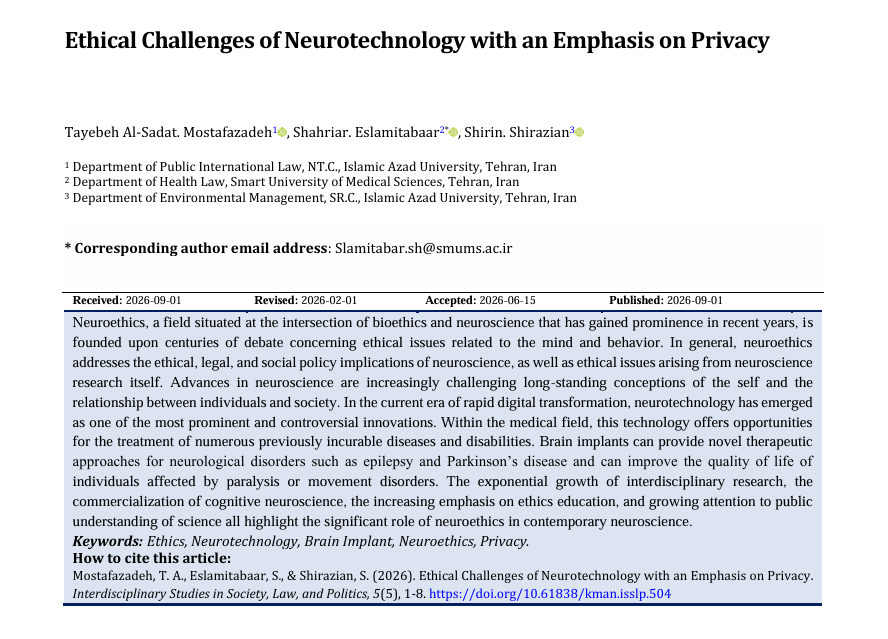
Ethical Challenges of Neurotechnology with an Emphasis on Privacy
Keywords:
Ethics, Neurotechnology, Brain Implant, Neuroethics, PrivacyAbstract
Neuroethics, a field situated at the intersection of bioethics and neuroscience that has gained prominence in recent years, is founded upon centuries of debate concerning ethical issues related to the mind and behavior. In general, neuroethics addresses the ethical, legal, and social policy implications of neuroscience, as well as ethical issues arising from neuroscience research itself. Advances in neuroscience are increasingly challenging long-standing conceptions of the self and the relationship between individuals and society. In the current era of rapid digital transformation, neurotechnology has emerged as one of the most prominent and controversial innovations. Within the medical field, this technology offers opportunities for the treatment of numerous previously incurable diseases and disabilities. Brain implants can provide novel therapeutic approaches for neurological disorders such as epilepsy and Parkinson’s disease and can improve the quality of life of individuals affected by paralysis or movement disorders. The exponential growth of interdisciplinary research, the commercialization of cognitive neuroscience, the increasing emphasis on ethics education, and growing attention to public understanding of science all highlight the significant role of neuroethics in contemporary neuroscience.
Downloads
References
Baylis, F. (2013). I Am Who I Am: On the Perceived Threats to Personal Identity from Deep Brain Stimulation. Neuroethics, 6, 513-526.
Bechtel, W. (1985). Attributing Responsibility to Computer Systems. Metaphilosophy, 16, 296.
Bublitz, C. (2024). Neurotechnologies and Human Rights: Restating and Reaffirming the Multi-Layered Protection of the Person. The International Journal of Human Rights, 28(5), 782-807.
Cabrera, L., & Carter-Johnson, J. (2021). Emergent Neurotechnologies and Challenges to Responsibility Frameworks. Akron Law Review, 54(1).
Chinen, M. A. (2016). The Coevolution of Autonomous Machines and Legal Responsibility. Journal of Law and Technology, 20, 1.
Dubiel, H. (2009). Deep in the Brain. Europa Editions.
Edward, M. (2018). Securing Wireless Neurotransmitters. (pp. 218).
Farah, M. J., & Wolpe, P. R. (2004). Neuroethics: Toward Broader Discussion. Hastings Center Report, 34, 35-45.
Fischer, J. M. (1999). Recent Work on Moral Responsibility. Ethics, 110, 93.
Frankfurt, H. G. (1982). Freedom of the Will and the Concept of a Person. Journal of Philosophy, 68, 5-10.
Glannon, W. (2009). Stimulating Brains, Altering Minds. Journal of Medical Ethics, 35, 289-292. https://doi.org/10.1136/jme.2008.027789
Glannon, W. (2012). Neuromodulation, Agency and Autonomy. Brain Topography, 27, 46.
Hage, J. (2017). Theoretical Foundations for the Responsibility of Autonomous Agents. Artificial Intelligence and Law, 25, 255-259.
Himma, K. E. (2008). Artificial Agency and Criteria for Moral Agency. (pp. 19).
Illes, J. (2003). From Neuroimaging to Neuroethics. Nature Neuroscience, 6, 205. https://doi.org/10.1038/nn0303-205
Matthias, A. (2004). The Responsibility Gap: Ascribing Responsibility for the Actions of Learning Automata. Ethics and Information Technology, 6, 175-176.
Merkel, R., Boer, G., Fegert, J., Galert, T., Hartmann, D., & Nuttin, B. (2007). Intervening in the Brain: Changing Psyche and Society. Springer.
Nagenborg, M., Capurro, R., Weber, J., & Pingel, C. (2007). Ethical Regulations on Robotics in Europe. Ai & Society, 22, 349.
Nollkaemper, A., & Jacobs, D. (2013). Shared Responsibility in International Law: A Conceptual Framework. Michigan Journal of International Law, 34, 359-364.
Pontius, A. A. (1993). Neuroethics vs Neurophysiologically and Neuropsychologically Uninformed Influences in Child-Rearing and Education. Psychological Reports, 72, 451-458.
Roskies, A. (2002). Neuroethics for the New Millennium. Neuron, 35, 21-23. https://doi.org/10.1016/S0896-6273(02)00763-8
Santoro, M., Marino, D., & Tamburrini, G. (2008). Learning Robots Interacting with Humans: From Epistemic Risk to Responsibility. Ai & Society, 22, 301-309.
Schermer, M. (2011). Ethical Issues in Deep Brain Stimulation. Frontiers in Integrative Neuroscience, 5, 17.
Sparrow, R. (2007). Killer Robots. Journal of Applied Philosophy, 24, 62-70.
Stahl, B. C. (2006). Responsible Computers? A Case for Ascribing Quasi-Responsibility to Computers Independent of Personhood or Agency. Ethics and Information Technology, 8, 205-210.
van de Poel, I. (2015). Responsibility and the Problem of Many Hands.
Vogeley, K., & Gallagher, S. (2011). Self in the Brain. In S. Gallagher (Ed.), The Oxford Handbook of the Self (pp. 111-136). Oxford University Press.
Yuste, R., Goering, S., & Arcas, B. (2017). Four Ethical Priorities for Neurotechnologies and AI. Nature, 551, 159-163. https://doi.org/10.1038/551159a
Downloads
Additional Files
Publication Timeline
- Submitted
- Revised
- Accepted
Issue
Section
License
Copyright (c) 2025 Tayebeh Al-Sadat Mostafazadeh (Author); Shahriar Eslamitabaar (Corresponding author); Shirin Shirazian (Author)

This work is licensed under a Creative Commons Attribution-NonCommercial 4.0 International License.