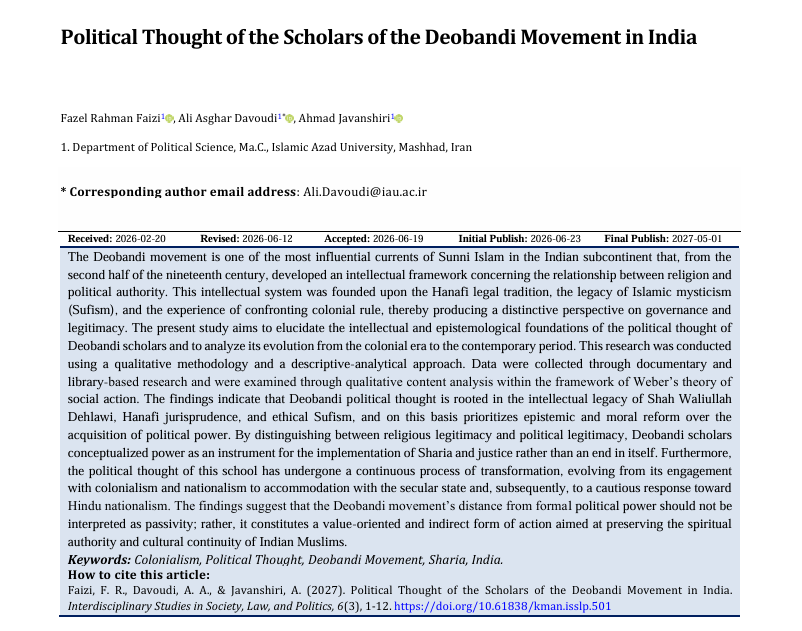
Political Thought of the Scholars of the Deobandi Movement in India
Keywords:
Colonialism, Political Thought, Deobandi Movement, Sharia, IndiaAbstract
The Deobandi movement is one of the most influential currents of Sunni Islam in the Indian subcontinent that, from the second half of the nineteenth century, developed an intellectual framework concerning the relationship between religion and political authority. This intellectual system was founded upon the Hanafi legal tradition, the legacy of Islamic mysticism (Sufism), and the experience of confronting colonial rule, thereby producing a distinctive perspective on governance and legitimacy. The present study aims to elucidate the intellectual and epistemological foundations of the political thought of Deobandi scholars and to analyze its evolution from the colonial era to the contemporary period. This research was conducted using a qualitative methodology and a descriptive-analytical approach. Data were collected through documentary and library-based research and were examined through qualitative content analysis within the framework of Weber’s theory of social action. The findings indicate that Deobandi political thought is rooted in the intellectual legacy of Shah Waliullah Dehlawi, Hanafi jurisprudence, and ethical Sufism, and on this basis prioritizes epistemic and moral reform over the acquisition of political power. By distinguishing between religious legitimacy and political legitimacy, Deobandi scholars conceptualized power as an instrument for the implementation of Sharia and justice rather than an end in itself. Furthermore, the political thought of this school has undergone a continuous process of transformation, evolving from its engagement with colonialism and nationalism to accommodation with the secular state and, subsequently, to a cautious response toward Hindu nationalism. The findings suggest that the Deobandi movement’s distance from formal political power should not be interpreted as passivity; rather, it constitutes a value-oriented and indirect form of action aimed at preserving the spiritual authority and cultural continuity of Indian Muslims.
Downloads
References
Abdolrashid Arshad, M. A. H. (2018). Deobandi Scholars and Indian Notables. Sheikh al-Islam Ahmad Jam.
Abedi, R. (2019). Suluki Sufism in the Deobandi School. Studies in Sufism and Islamic Mysticism, 10(2).
Ahmadian, A. (2016). Transformation of Religious Currents after the Partition of India. South and Central Asian Studies(16).
Ansari, S. F. D. (2011). Islam and Politics in South Asia. Modern Asian Studies, 45(1), 63-84.
Azad, M. S. (2023). The Secret of Deoband: Secrets of the Success of the Deobandi School and Familiarity with the Mujtahid-Oriented View of Deobandi Scholars. Maktabat al-Bushra.
Bourdieu, P. (2005). The Theory of Practice: Practical Reasons and Rational Choice (M. Mardiha, Trans.). Naghsh o Negar.
Ingram, B. D. (2018). Revival from Below: The Deoband Movement and Global Islam. University of California Press.
Jaffrelot, C. (2021). Modi's India: Hindu Nationalism and the Rise of Ethnic Democracy. Princeton University Press.
Jaffrelot, C., & Therwath, C. (2022). The Hindu Nationalist Movement in India. Oxford University Press.
Madani, H. A. (2005). Composite Nationalism and Islam (M. T. Ansari, Trans.). Manohar.
Mahmudabad, A. K. (2020). Indian Muslims and the Anti-CAA Protests: From Marginalization towards Exclusion. South Asia Multidisciplinary Academic Journal.
Malekzadeh, M. (2013). The Deoband Movement and the Reconstruction of Islamic Identity in India. Political Science Quarterly(52).
Metcalf, B. D. (1982). Islamic Revival in British India: Deoband, 1860-1900. Princeton University Press.
Modarresi, M. (2006). Islam and Politics in the Indian Subcontinent. SAMT Publications.
Rahmani, M. (2011). Jurisprudential and Political Approaches of Deobandi Scholars. Islamic Knowledge Research Journal(21).
Robinson, F. (2001). The 'Ulama of Farangi Mahall and Islamic Culture in South Asia. C. Hurst & Co.
Safari Foroushani, N. (2011). Intellectual and Cultural Developments of the Indian Subcontinent. Research Institute of Hawzah and University.
Sikand, Y. (2005). Bastions of the Believers: Madrasas and Islamic Education in India. Penguin Books.
Teorell, J. (2006). Political Participation and Three Theories of Democracy: A Research Inventory and Agenda. European Journal of Political Research, 45(5), 787-810.
Weber, M. (1978). Economy and Society: An Outline of Interpretive Sociology. University of California Press.
Zaman, M. Q. (2002). The Ulama in Contemporary Islam: Custodians of Change. Princeton University Press.
Downloads
Additional Files
Publication Timeline
- Submitted
- Revised
- Accepted
Issue
Section
License
Copyright (c) 2025 Fazel Rahman Faizi (Author); Ali Asghar Davoudi (Corresponding author); Ahmad Javanshiri (Author)

This work is licensed under a Creative Commons Attribution-NonCommercial 4.0 International License.