Analysis of Judicial and Executive Policy in Dealing with the Smuggling of Goods and Currency through Official Channels
Keywords:
Judicial policy, executive policy, smuggling of goods and currency, official channels, fair trial, presumption of innocence.Abstract
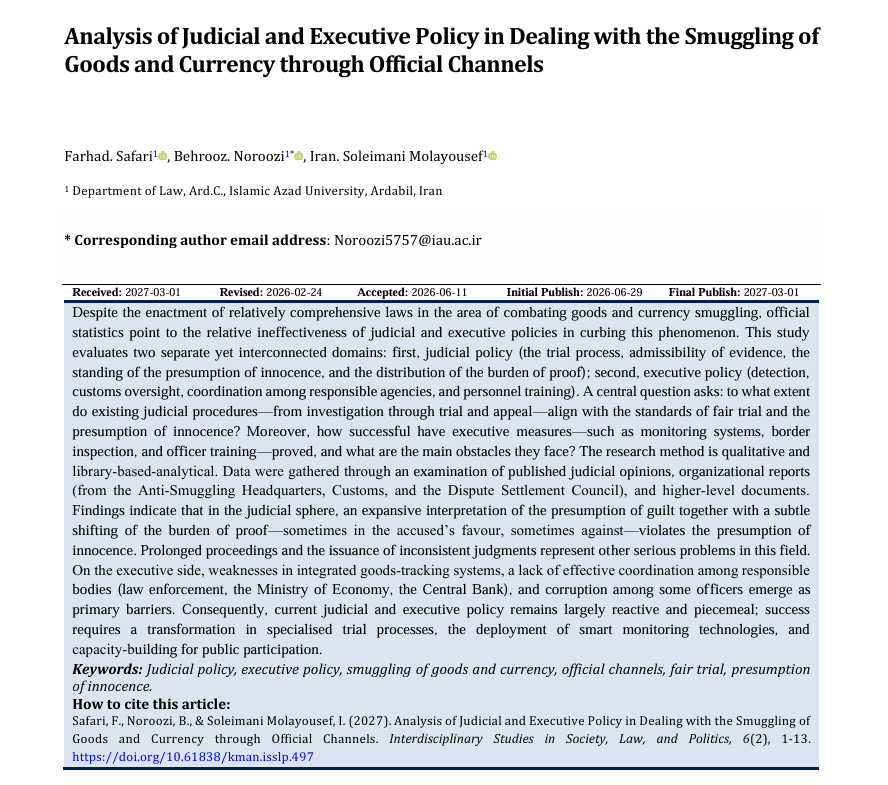
Despite the enactment of relatively comprehensive laws in the area of combating goods and currency smuggling, official statistics point to the relative ineffectiveness of judicial and executive policies in curbing this phenomenon. This study evaluates two separate yet interconnected domains: first, judicial policy (the trial process, admissibility of evidence, the standing of the presumption of innocence, and the distribution of the burden of proof); second, executive policy (detection, customs oversight, coordination among responsible agencies, and personnel training). A central question asks: to what extent do existing judicial procedures—from investigation through trial and appeal—align with the standards of fair trial and the presumption of innocence? Moreover, how successful have executive measures—such as monitoring systems, border inspection, and officer training—proved, and what are the main obstacles they face? The research method is qualitative and library‑based‑analytical. Data were gathered through an examination of published judicial opinions, organizational reports (from the Anti‑Smuggling Headquarters, Customs, and the Dispute Settlement Council), and higher‑level documents. Findings indicate that in the judicial sphere, an expansive interpretation of the presumption of guilt together with a subtle shifting of the burden of proof—sometimes in the accused’s favour, sometimes against—violates the presumption of innocence. Prolonged proceedings and the issuance of inconsistent judgments represent other serious problems in this field. On the executive side, weaknesses in integrated goods‑tracking systems, a lack of effective coordination among responsible bodies (law enforcement, the Ministry of Economy, the Central Bank), and corruption among some officers emerge as primary barriers. Consequently, current judicial and executive policy remains largely reactive and piecemeal; success requires a transformation in specialised trial processes, the deployment of smart monitoring technologies, and capacity‑building for public participation.
Downloads
References
Ashouri, M. (2009). Criminal Policy and Criminal Justice System (2nd ed.). Mizan.
Hosseini, S. M., & Mansouri, S. M. (2025). Differentiation of Goods and Currency Smuggling in Iran's Legislative Criminal Policy. Quarterly Journal of Arā’, 6(15), 50-73.
Kariri, M. Y., Zia, R., & Akbari, A. A. (2025). Criminological Analysis of the Law on Combating the Smuggling of Goods and Currency. Interdisciplinary Studies in Society, Law, and Politics, 4(3), 221-235. https://doi.org/10.61838/kman.isslp.4.3.22
Mirzaei, R., Kosha, J., & Shamlou, B. (2025). Evaluating the Efficiency of Iran's Executive Criminal Policy in Preventing Smuggling and Customs Violations with a Critical Approach to Organisational Performance. Encyclopedia of Jurisprudence and Comparative Law, 1(4), 1-22.
Riazat, Z., & Ahmadi Natour, Z. (2022). Economic Crimes in Iran's Criminal Policy: A Criminological Analysis. Journal of Criminal Law Research, 13(49), 7-31.
Rostami Ghazani, O., & Rahmani Fard, M. (2022). Differentiated Criminal Policy towards Organised Smuggling of Goods and Currency. Judicial Law Journal, 86(119), 13-42.
Zare Mahdavi, Q., & Sohrabi, M. (2017). Pathology of the Legislative Policies of the Islamic Republic of Iran in Combating Goods Smuggling. Political Studies Quarterly, 10(37), 19-44.
Downloads
Additional Files
Publication Timeline
- Submitted
- Revised
- Accepted
Issue
Section
License
Copyright (c) 2025 Farhad Safari (Author); Behrooz Noroozi (Corresponding author); Iran Soleimani Molayousef (Author)

This work is licensed under a Creative Commons Attribution-NonCommercial 4.0 International License.