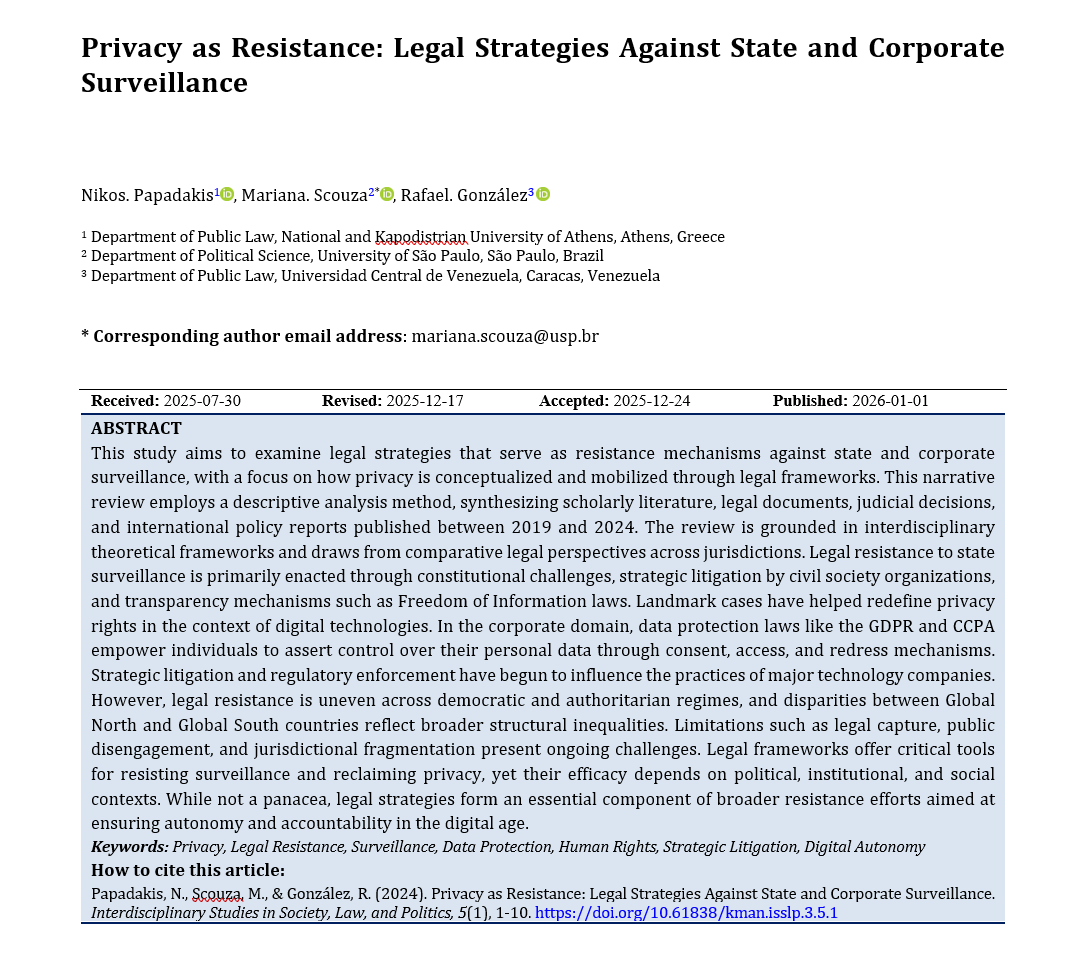
Privacy as Resistance: Legal Strategies Against State and Corporate Surveillance
DOI:
https://doi.org/10.61838/kman.isslp.463Keywords:
Privacy, Legal Resistance, Surveillance, Data Protection, Human Rights, Strategic Litigation, Digital AutonomyAbstract
This study aims to examine legal strategies that serve as resistance mechanisms against state and corporate surveillance, with a focus on how privacy is conceptualized and mobilized through legal frameworks. This narrative review employs a descriptive analysis method, synthesizing scholarly literature, legal documents, judicial decisions, and international policy reports published between 2019 and 2024. The review is grounded in interdisciplinary theoretical frameworks and draws from comparative legal perspectives across jurisdictions. Legal resistance to state surveillance is primarily enacted through constitutional challenges, strategic litigation by civil society organizations, and transparency mechanisms such as Freedom of Information laws. Landmark cases have helped redefine privacy rights in the context of digital technologies. In the corporate domain, data protection laws like the GDPR and CCPA empower individuals to assert control over their personal data through consent, access, and redress mechanisms. Strategic litigation and regulatory enforcement have begun to influence the practices of major technology companies. However, legal resistance is uneven across democratic and authoritarian regimes, and disparities between Global North and Global South countries reflect broader structural inequalities. Limitations such as legal capture, public disengagement, and jurisdictional fragmentation present ongoing challenges. Legal frameworks offer critical tools for resisting surveillance and reclaiming privacy, yet their efficacy depends on political, institutional, and social contexts. While not a panacea, legal strategies form an essential component of broader resistance efforts aimed at ensuring autonomy and accountability in the digital age.
Downloads
References
Cheng, X., Qiao, L., Yang, B., & Xiao-ping, Z. (2022). Investigation on Users’ Resistance Intention to Facial Recognition Payment: A Perspective of Privacy. Electronic Commerce Research, 24(1), 275-301. https://doi.org/10.1007/s10660-022-09588-y
Dc, S. (2023). Umpiring Technology and Tactical and Strategic Privacy in Cricket. Unity Journal, 4(01), 82-93. https://doi.org/10.3126/unityj.v4i01.52232
Gowthami, M., & V, G. (2024). Autonomous Vehicle Data Protection : A Review of Security Threats, Challenges and Protective Mechanism. International Journal of Scientific Research in Computer Science Engineering and Information Technology, 10(5), 524-528. https://doi.org/10.32628/cseit2410429
Lim, E. (2023). Revolutionary Tactics: Abolish Privacy. Aoir Selected Papers of Internet Research. https://doi.org/10.5210/spir.v2023i0.13665
McElroy, S., & McKee, L. (2023). Developing Privacy Incident Responses to Combat Information Warfare. International Conference on Cyber Warfare and Security, 18(1), 256-263. https://doi.org/10.34190/iccws.18.1.958
Rizzo, J. (2023). Asking for It: Gendered Dimensions of Surveillance Capitalism. Emancipations. https://doi.org/10.55533/2765-8414.1010
Spinello, R. A. (2020). The Ethical Consequences of “Going Dark”. Business Ethics the Environment & Responsibility, 30(1), 116-126. https://doi.org/10.1111/beer.12313
Swanlund, D. J. (2021). Disconnection and Reconnection as Resistance to Geosurveillance. 23-40. https://doi.org/10.1093/oso/9780197571873.003.0002
Wagner, B., Sanchez, A., Sekwenz, M.-T., Dideriksen, S., & Murray-Rust, D. (2023). The Politics of Digital (Human) Rights. https://doi.org/10.1093/acrefore/9780190846626.013.694
Watson, A., & Lupton, D. (2020). Tactics, Affects and Agencies in Digital Privacy Narratives: A Story Completion Study. Online Information Review, 45(1), 138-156. https://doi.org/10.1108/oir-05-2020-0174
Downloads
Additional Files
Publication Timeline
- Submitted
- Revised
- Accepted
Issue
Section
License

This work is licensed under a Creative Commons Attribution-NonCommercial 4.0 International License.