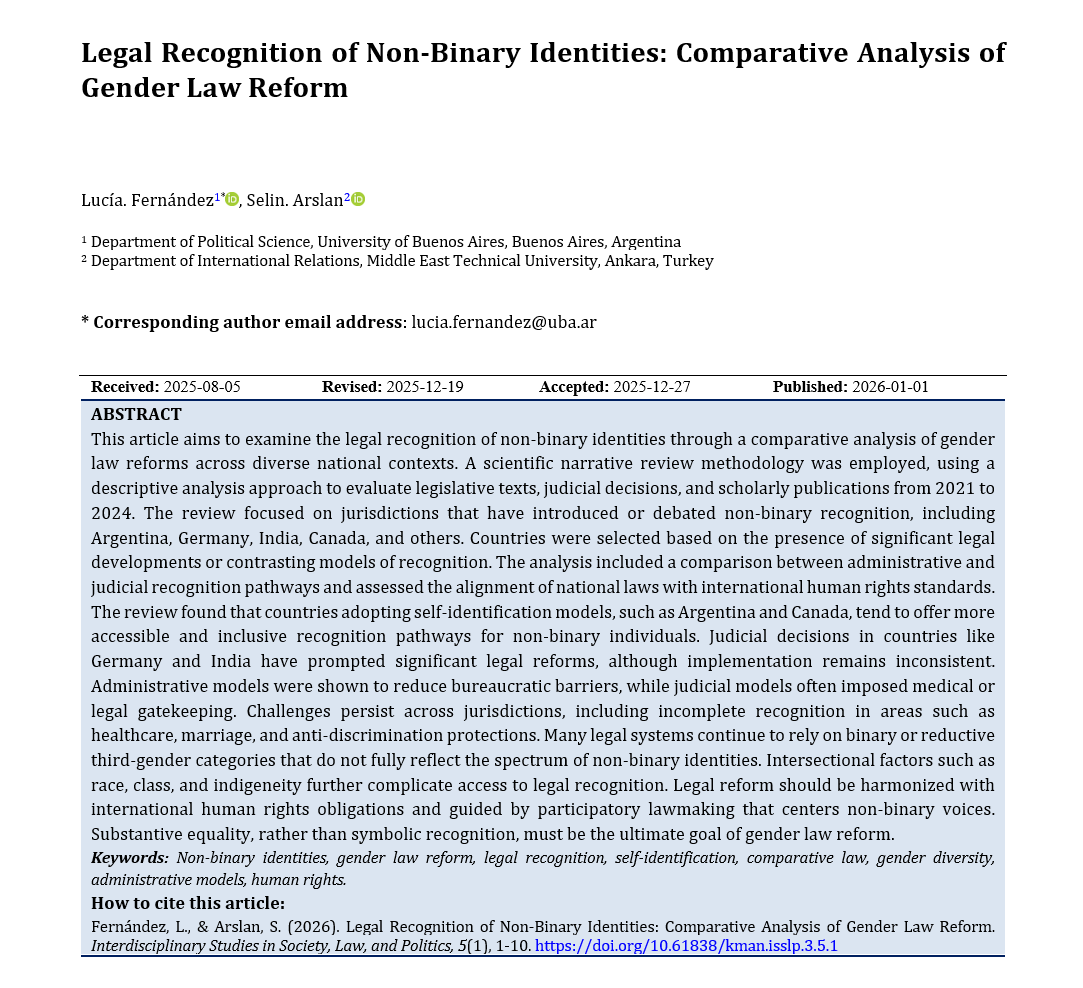
Legal Recognition of Non-Binary Identities: Comparative Analysis of Gender Law Reform
Keywords:
Non-binary identities, gender law reform, legal recognition, self-identification, comparative law, gender diversity, administrative models, human rightsAbstract
This article aims to examine the legal recognition of non-binary identities through a comparative analysis of gender law reforms across diverse national contexts. A scientific narrative review methodology was employed, using a descriptive analysis approach to evaluate legislative texts, judicial decisions, and scholarly publications from 2021 to 2024. The review focused on jurisdictions that have introduced or debated non-binary recognition, including Argentina, Germany, India, Canada, and others. Countries were selected based on the presence of significant legal developments or contrasting models of recognition. The analysis included a comparison between administrative and judicial recognition pathways and assessed the alignment of national laws with international human rights standards. The review found that countries adopting self-identification models, such as Argentina and Canada, tend to offer more accessible and inclusive recognition pathways for non-binary individuals. Judicial decisions in countries like Germany and India have prompted significant legal reforms, although implementation remains inconsistent. Administrative models were shown to reduce bureaucratic barriers, while judicial models often imposed medical or legal gatekeeping. Challenges persist across jurisdictions, including incomplete recognition in areas such as healthcare, marriage, and anti-discrimination protections. Many legal systems continue to rely on binary or reductive third-gender categories that do not fully reflect the spectrum of non-binary identities. Intersectional factors such as race, class, and indigeneity further complicate access to legal recognition. Legal reform should be harmonized with international human rights obligations and guided by participatory lawmaking that centers non-binary voices. Substantive equality, rather than symbolic recognition, must be the ultimate goal of gender law reform.
Downloads
References
Beretta, E. (2024). Gender in Pixels: Pathways to Non-Binary Representation in Computer Vision. Aies, 7, 107-119. https://doi.org/10.1609/aies.v7i1.31622
Bhattacharya, S., Ghosh, D., & Purkayastha, B. (2022). ‘Transgender Persons (Protection of Rights) Act’ of India: An Analysis of Substantive Access to Rights of a Transgender Community. Journal of Human Rights Practice, 14(2), 676-697. https://doi.org/10.1093/jhuman/huac004
Dev, S., Monajatipoor, M., Ovalle, A., Subramonian, A., Phillips, J. M., & Chang, K.-W. (2021). Harms of Gender Exclusivity and Challenges in Non-Binary Representation in Language Technologies. https://doi.org/10.18653/v1/2021.emnlp-main.150
Dorn, R., Jiang, J., Abramson, J. S., & Lerman, K. (2023). Non-Binary Gender Expression in Online Interactions. https://doi.org/10.48550/arxiv.2303.04837
González-Salzberg, D. A., & Perisanidi, M. (2021). Belonging Beyond the Binary: From Byzantine Eunuchs and Indian Hijras to Gender‐fluid and Non‐binary Identities. Journal of Law and Society, 48(4), 669-689. https://doi.org/10.1111/jols.12323
Graaf, N. M. d., Huisman, B., Cohen‐Kettenis, P. T., Twist, J., Hage, K., Carmichael, P., Kreukels, B. P., & Steensma, T. D. (2021). Psychological Functioning in Non-Binary Identifying Adolescents and Adults. Journal of sex & marital therapy, 47(8), 773-784. https://doi.org/10.1080/0092623x.2021.1950087
Hidalgo, S. L. (2022). Trans Rights: The Ongoing Debate in Latin American Legal Agendas. The Age of Human Rights Journal(18), 163-180. https://doi.org/10.17561/tahrj.v18.7061
Kaplan, J. (2022). Pluri-Grammars for Pluri-Genders: Competing Gender Systems in the Nominal Morphology of Non-Binary French. Languages, 7(4), 266. https://doi.org/10.3390/languages7040266
Lee, H.-S. (2023). Constitutional Approach to Gender Diversity: Focusing on the Federal Constitutional Court of Germany's Ruling on the Third Gender. Wonkwang University Legal Research Institute, 30, 199-226. https://doi.org/10.22397/bml.2023.30.199
Ljubić, A., Stanojević, M., Chervenak, F. A., & Kurjak, A. (2024). Non-Binary Patients in ART: New Challenges and Considerations. Journal of Perinatal Medicine, 52(8), 804-810. https://doi.org/10.1515/jpm-2024-0256
Merritt, B. (2023). Speech Beyond the Binary: Some Acoustic-Phonetic and Auditory-Perceptual Characteristics of Non-Binary Speakers. Jasa Express Letters, 3(3). https://doi.org/10.1121/10.0017642
Mirabella, M., Giannantonio, B. D., Giovanardi, G., Piras, I., Fisher, A. D., Lingiardi, V., Chianura, L., Ristori, J., Speranza, A. M., & Fortunato, A. (2023). Exploring Gender Diversity in Transgender and Non-Binary Adults Accessing a Specialized Service in Italy. Healthcare, 11(15), 2150. https://doi.org/10.3390/healthcare11152150
Mirabella, M., Piras, I., Fortunato, A., Fisher, A. D., Lingiardi, V., Mosconi, M., Ristori, J., Speranza, A. M., & Giovanardi, G. (2022). Gender Identity and Non-Binary Presentations in Adolescents Attending Two Specialized Services in Italy. Journal of Sexual Medicine, 19(6), 1035-1048. https://doi.org/10.1016/j.jsxm.2022.03.215
Nirta, C. (2021). A Critique of the Model of Gender Recognition and the Limits of Self-Declaration for Non-Binary Trans Individuals. Law and Critique, 32(2), 217-233. https://doi.org/10.1007/s10978-021-09286-y
Osella, S. (2022). When Comparative Law Walks the Path of Anthropology: The Third Gender in Europe. German Law Journal, 23(7), 920-942. https://doi.org/10.1017/glj.2022.65
Osella, S., & Rubio-Marín, R. (2021). The Right to Gender Recognition Before the Colombian Constitutional Court: A Queer and Travesti Theory Analysis. Bulletin of Latin American Research, 40(5), 650-664. https://doi.org/10.1111/blar.13297
Quinan, C., & Hunt, M. (2021). Non-Binary Gender Markers: Mobility, Migration, and Media Reception in Europe and Beyond. European Journal of Women S Studies, 30(3), 380-390. https://doi.org/10.1177/13505068211024891
Rutherford, L., Stark, A., Ablona, A., Klassen, B., Higgins, R., Jacobsen, K., Draenos, C. J., Card, K. G., & Lachowsky, N. J. (2021). Health and Well-Being of Trans and Non-Binary Participants in a Community-Based Survey of Gay, Bisexual, and Queer Men, and Non-Binary and Two-Spirit People Across Canada. PLoS One, 16(2), e0246525. https://doi.org/10.1371/journal.pone.0246525
Swenson, R., Alldred, P., & Nicholls, L. (2021). Doing Gender and Being Gendered Through Occupation: Transgender and Non-Binary Experiences. British Journal of Occupational Therapy, 85(6), 446-452. https://doi.org/10.1177/03080226211034422

Downloads
Additional Files
Published
Submitted
Revised
Accepted
Issue
Section
License

This work is licensed under a Creative Commons Attribution-NonCommercial 4.0 International License.