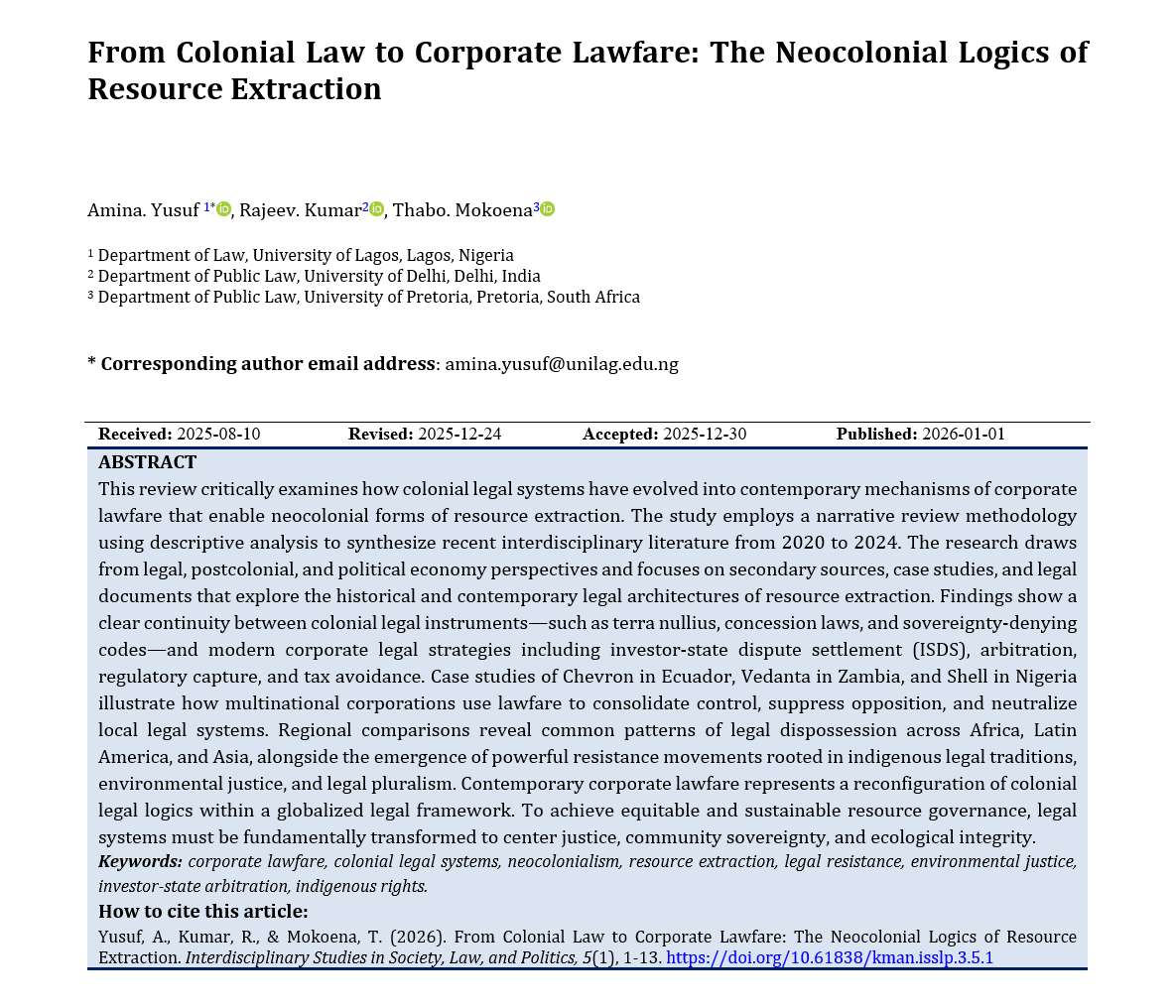
From Colonial Law to Corporate Lawfare: The Neocolonial Logics of Resource Extraction
DOI:
https://doi.org/10.61838/kman.isslp.457Keywords:
corporate lawfare, colonial legal systems, neocolonialism, resource extraction, legal resistance, environmental justice, investor-state arbitration, indigenous rightsAbstract
This review critically examines how colonial legal systems have evolved into contemporary mechanisms of corporate lawfare that enable neocolonial forms of resource extraction. The study employs a narrative review methodology using descriptive analysis to synthesize recent interdisciplinary literature from 2020 to 2024. The research draws from legal, postcolonial, and political economy perspectives and focuses on secondary sources, case studies, and legal documents that explore the historical and contemporary legal architectures of resource extraction. Findings show a clear continuity between colonial legal instruments—such as terra nullius, concession laws, and sovereignty-denying codes—and modern corporate legal strategies including investor-state dispute settlement (ISDS), arbitration, regulatory capture, and tax avoidance. Case studies of Chevron in Ecuador, Vedanta in Zambia, and Shell in Nigeria illustrate how multinational corporations use lawfare to consolidate control, suppress opposition, and neutralize local legal systems. Regional comparisons reveal common patterns of legal dispossession across Africa, Latin America, and Asia, alongside the emergence of powerful resistance movements rooted in indigenous legal traditions, environmental justice, and legal pluralism. Contemporary corporate lawfare represents a reconfiguration of colonial legal logics within a globalized legal framework. To achieve equitable and sustainable resource governance, legal systems must be fundamentally transformed to center justice, community sovereignty, and ecological integrity.
Downloads
References
Abd-Elwahab, H.-t.-A. (2022). Environmental Injustice in Helon Habila’s Oil on Water (2011). Miṣriqiyā, 2(2), 69-91. https://doi.org/10.21608/misj.2023.181039.1039
Adekanbi, O. A. (2024). The Ultimate Economic Model Hidden in Plain Sight. American Journal Of Social Sciences And Humanity Research, 04(11), 100-106. https://doi.org/10.37547/ajsshr/volume04issue11-14
Brisbois, B., Feagan, M., Stime, B., Paz, I. K., Berbés‐Blázquez, M., Gaibor, J., Cole, D. C., Ruggiero, E. D., Hanson, L., Janes, C. R., Plamondon, K., Spiegel, J., & Yassi, A. (2021). Mining, Colonial Legacies, and Neoliberalism: A Political Ecology of Health Knowledge Minerıa, Legados Coloniales Y Neoliberalismo: Una Ecologıa Polıtica Del Conocimiento en Salud. New Solutions a Journal of Environmental and Occupational Health Policy, 31(1), 48-64. https://doi.org/10.1177/10482911211001051
Campling, L. (2021). The Corporation and Resource Geography. 188-200. https://doi.org/10.4324/9780429434136-16
Guo, Z. (2024). Innovative Functionality of the Scientific and Technical Information System of China. Visnyk of Kharkiv State Academy of Culture(65), 53-68. https://doi.org/10.31516/2410-5333.065.04
John, O. I., Messina, G., & Odumegwu, A. C. (2023). The Effects of Neocolonialism on Africa’s Development. Panafrican Journal of Governance and Development (Pjgd), 4(2), 3-35. https://doi.org/10.46404/panjogov.v4i2.4846
Junejo, M. (2022). Land Deterioration and Environmental Damage: A Postcolonial Eco-Critical Study of How Beautiful We Were (2021). University of Chitral Journal of Linguistics and Literature, 6(I), 67-88. https://doi.org/10.33195/jll.v6ii.354
Jurema, B., & Maria Cecília da Silva, O. (2023). The Indigenous Struggle Against ‘New’ Extractivism in the Peruvian Amazon. Cosmopolitan Civil Societies an Interdisciplinary Journal, 15(1), 126-138. https://doi.org/10.5130/ccs.v15.i1.8543
Kusen, F. J., Saputra, F. C., Tambunan, A. J., Silaen, G. L., & Patricia, C. (2023). Neocolonialism in Black Panther “Wakanda Forever” Movie. https://doi.org/10.31219/osf.io/7rjey
Lacy‐Vawdon, C. d., Vandenberg, B., & Livingstone, C. (2023). Power and Other Commercial Determinants of Health: An Empirical Study of the Australian Food, Alcohol, and Gambling Industries. International Journal of Health Policy and Management, 12, 7723. https://doi.org/10.34172/ijhpm.2023.7723
Lucas, A. (2021). Investigating Networks of Corporate Influence on Government Decision-Making: The Case of Australia’s Climate Change and Energy Policies. Energy Research & Social Science, 81, 102271. https://doi.org/10.1016/j.erss.2021.102271
Mireille, R., Alain, T. B. B., & Adejare, A. S. (2024). Neocolonial Realities of Western Aid in Africa During 21st Century. Asian Journal of Education and Social Studies, 50(12), 292-300. https://doi.org/10.9734/ajess/2024/v50i121697
Sharma, N. K. (2023). China in Africa. Curj, 2(1), 75-85. https://doi.org/10.37513/curj.v2i1.716
Usacheva, V. (2024). African Countries in Quest for Information Sovereignty: Past and Present. Uchenie Zapiski Instituta Afriki Ran, 68(3), 44-63. https://doi.org/10.31132/2412-5717-2024-68-3-44-63
Wood, B., Williams, O. D., Baker, P., Nagarajan, V., & Sacks, G. (2021). The Influence of Corporate Market Power on Health: Exploring the Structure-Conduct-Performance Model From a Public Health Perspective. Globalization and Health, 17(1). https://doi.org/10.1186/s12992-021-00688-2
Downloads
Additional Files
Publication Timeline
- Submitted
- Revised
- Accepted
Issue
Section
License

This work is licensed under a Creative Commons Attribution-NonCommercial 4.0 International License.