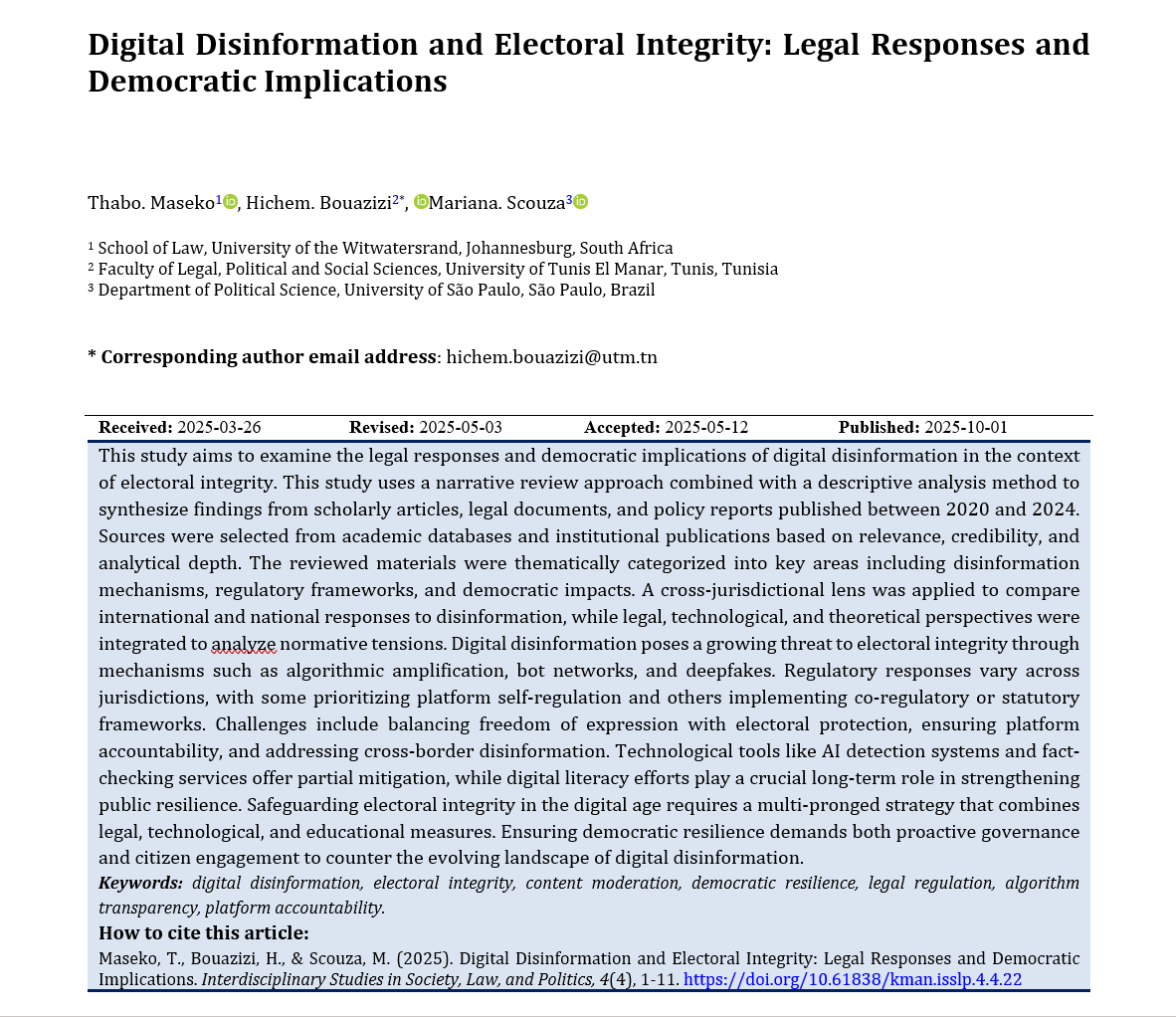
Digital Disinformation and Electoral Integrity: Legal Responses and Democratic Implications
DOI:
https://doi.org/10.61838/kman.isslp.4.4.22Keywords:
digital disinformation, electoral integrity, content moderation, democratic resilience, legal regulation, algorithm transparency, platform accountabilityAbstract
This study aims to examine the legal responses and democratic implications of digital disinformation in the context of electoral integrity. This study uses a narrative review approach combined with a descriptive analysis method to synthesize findings from scholarly articles, legal documents, and policy reports published between 2020 and 2024. Sources were selected from academic databases and institutional publications based on relevance, credibility, and analytical depth. The reviewed materials were thematically categorized into key areas including disinformation mechanisms, regulatory frameworks, and democratic impacts. A cross-jurisdictional lens was applied to compare international and national responses to disinformation, while legal, technological, and theoretical perspectives were integrated to analyze normative tensions. Digital disinformation poses a growing threat to electoral integrity through mechanisms such as algorithmic amplification, bot networks, and deepfakes. Regulatory responses vary across jurisdictions, with some prioritizing platform self-regulation and others implementing co-regulatory or statutory frameworks. Challenges include balancing freedom of expression with electoral protection, ensuring platform accountability, and addressing cross-border disinformation. Technological tools like AI detection systems and fact-checking services offer partial mitigation, while digital literacy efforts play a crucial long-term role in strengthening public resilience. Safeguarding electoral integrity in the digital age requires a multi-pronged strategy that combines legal, technological, and educational measures. Ensuring democratic resilience demands both proactive governance and citizen engagement to counter the evolving landscape of digital disinformation.
Downloads
References
Abhijit, B. (2024). Disruptive Technology and Impact on Public Law a Perspective From Criminal Law Constitutional Law and International Law. 11-18. https://doi.org/10.58532/nbennurdtch2
Alamsyah, P., Hakim, L. N., Wijaya, G., & Wicaksono, A. (2024). Debunking Disinformation on YouTube: A Fact Check on the 2024 Indonesian Election. Jurnal Studi Komunikasi (Indonesian Journal of Communications Studies), 8(3), 547-560. https://doi.org/10.25139/jsk.v8i3.8348
Banchio, P. R. (2024). Legal Responses to Disinformation and Hate Speech in the Digital Age. https://doi.org/10.2139/ssrn.4879162
Chałubińska–Jentkiewicz, K., & Nowikowska, M. (2024). Disinformation and Cyberterrorism in Light of the Standards of the Council of Europe. 53-75. https://doi.org/10.4335/2024.2.2
Cucoreanu, C. (2024). Cyber Risks to National Security: Manipulation of the Electoral Process Through the Use of Bots and Algorithms on Social Platforms. European Journal of Law and Public Administration, 11(2), 226-236. https://doi.org/10.18662/eljpa/11.2/244
Domalewska, D. (2024). Dezinformacja Jako Zagrożenie Dla Demokracji I Regulacje Prawne W Zakresie Jej Przeciwdziałania W Polsce I Wybranych Krajach Europejskich. Politeja, 21(5(92)), 359-379. https://doi.org/10.12797/politeja.21.2024.92.16
Fusiek, D. A., Stougiannou, A. E., & Efthymiou-Egleton, T. W. (2022). Digital Democracy and Disinformation: The European Approach to Disinformation on Social Media in the Case of 2019 European Parliament Elections. Journal of Politics and Ethics in New Technologies and Ai, 1(1), e31215. https://doi.org/10.12681/jpentai.31215
Gorazdowski, K. (2024). Disinformation in Poland in the Context of Fake News and Their Impact on Civil Society. Studia Administracji I Bezpieczeństwa, 17(17), 223-251. https://doi.org/10.5604/01.3001.0054.9410
Gosztonyi, G. (2024). How the European Union Had Tried to Tackle Fake News and Disinformation With Soft Law and What Changed With the Digital Services Act? Frontiers in Law, 3, 102-113. https://doi.org/10.6000/2817-2302.2024.03.12
Hill, L., Douglass, M., & Baltutis, R. (2022). The Effects of False Campaign Statements. 15-22. https://doi.org/10.1007/978-981-19-2123-0_2
Khmyrov, І., Khriapynskyi, A., Svoboda, I., Shevchuk, M., & Dotsenko, K. (2023). The Impact of Disinformation on the State Information Policy. Revista Amazonia Investiga, 12(71), 93-102. https://doi.org/10.34069/ai/2023.71.11.8
Lahmann, H. (2022). Infecting the Mind: Establishing Responsibility for Transboundary Disinformation. European Journal of International Law, 33(2), 411-440. https://doi.org/10.1093/ejil/chac023
Magbanua, K. S. (2022). An Analysis of the Legal and Ethical Implications of Online Disinformation in the Philippines. Journal of Public Representative and Society Provision, 2(2), 52-55. https://doi.org/10.55885/jprsp.v2i2.201
Marsden, C. T., Brown, I., & Veale, M. (2021). Responding to Disinformation. 195-220. https://doi.org/10.1093/oso/9780197616093.003.0012
Marushchak, A. (2021). International-Legal Approaches and National-Legal Regulation of Counteraction to Misinformation. Information Security of the Person Society and State(31-33), 64-71. https://doi.org/10.51369/2707-7276-2021-(1-3)-7
Ohlin, J. D. (2021). A Roadmap for Fighting Election Interference. Ajil Unbound, 115, 69-73. https://doi.org/10.1017/aju.2020.87
Paar-Jakli, G. (2024). The Digital Agora Fights Back: Building Disinformation Resilience One Initiative at a Time. Studies in Media and Communication, 12(3), 335. https://doi.org/10.11114/smc.v12i3.6959
Pranisitha, A. K., Yuliani, N. M., & Dasih, I. G. A. R. P. (2024). Strategi Komunikasi Kpu Bali Dalam Meningkatkan Literasi Informasi Bagi Pemilih Pemula Pada Pemilu 2024. Anubhava Jurnal Ilmu Komunikasi Hindu, 4(2), 721-730. https://doi.org/10.25078/anubhava.v4i2.3915
Radu, R. (2020). Fighting the ‘Infodemic’: Legal Responses to COVID-19 Disinformation. Social Media + Society, 6(3). https://doi.org/10.1177/2056305120948190
Shattock, E. (2023). Lies, Liability, and Lawful Content: Critiquing the Approaches to Online Disinformation in the EU. Common Market Law Review, 60(Issue 5), 1313-1348. https://doi.org/10.54648/cola2023094
Suing, A. (2024). Perceptions of Disinformation Regulation in the Andean Community. Frontiers in Communication, 9. https://doi.org/10.3389/fcomm.2024.1457480
Sun, H. (2023). Regulating Algorithmic Disinformation. The Columbia Journal of Law & the Arts, 46(4). https://doi.org/10.52214/jla.v46i3.11237
Tapsell, R., & Chandrarao, J. (2024). Gendered Disinformation and Election Campaigning: A Malaysia Case Study. Georgetown Journal of International Affairs, 25(1), 193-199. https://doi.org/10.1353/gia.2024.a934903
Yang, C.-C. (2023). Fighting Against Disinformation From Foreign Forces? Or Suppressing Criticism From Domestic Opposition Parties? Asia Pacific Journal on Human Rights and the Law, 24(1), 43-74. https://doi.org/10.1163/15718158-24010003
Downloads
Additional Files
Publication Timeline
- Submitted
- Revised
- Accepted
Issue
Section
License

This work is licensed under a Creative Commons Attribution-NonCommercial 4.0 International License.