The Status of the Judicial and Advisory Practice of the International Court of Justice in Determining the Legitimacy of Sanctions
Keywords:
International Court of Justice, international sanctions, judicial practice, advisory opinions, legal legitimacyAbstract
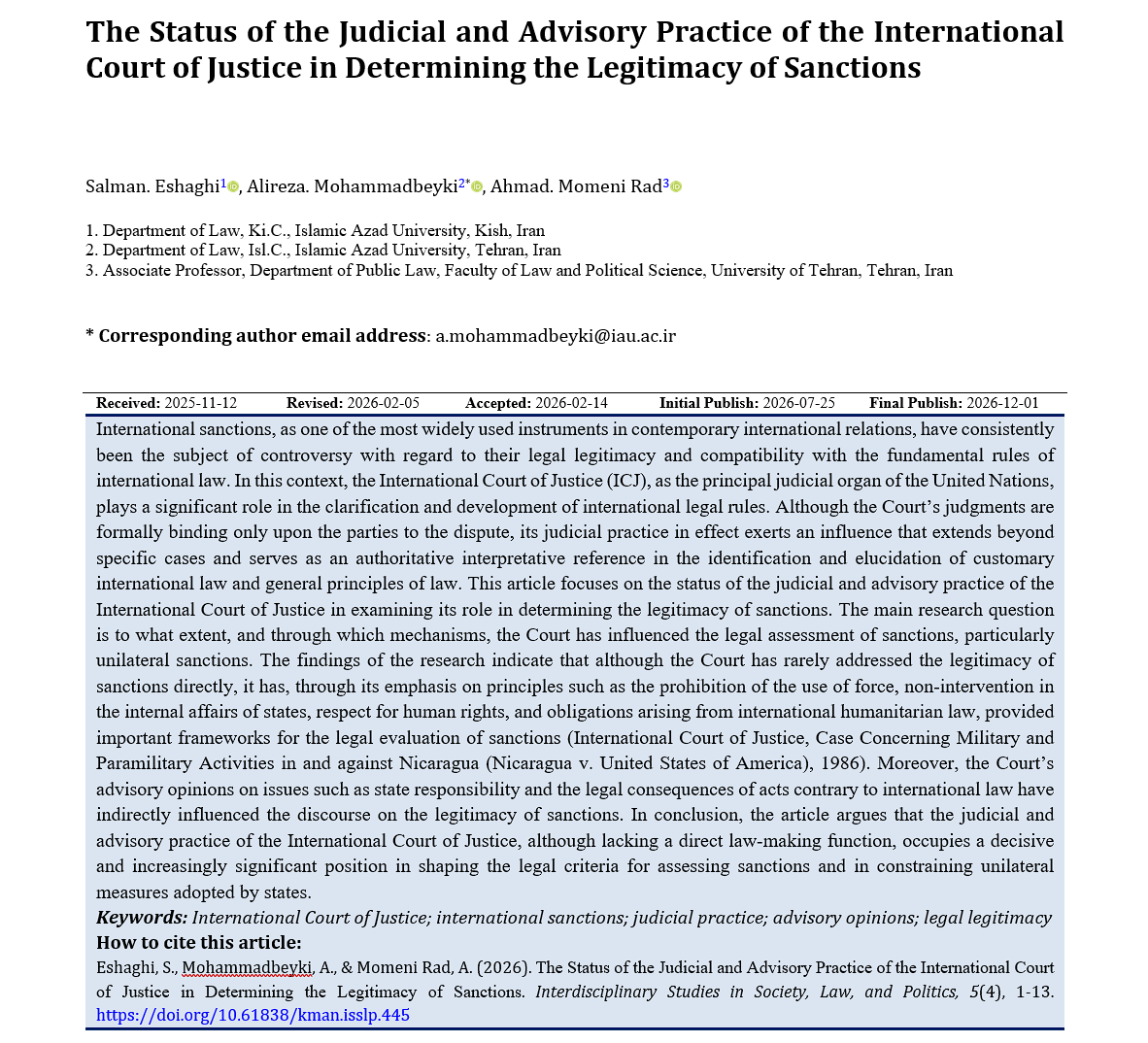
International sanctions, as one of the most widely used instruments in contemporary international relations, have consistently been the subject of controversy with regard to their legal legitimacy and compatibility with the fundamental rules of international law. In this context, the International Court of Justice (ICJ), as the principal judicial organ of the United Nations, plays a significant role in the clarification and development of international legal rules. Although the Court’s judgments are formally binding only upon the parties to the dispute, its judicial practice in effect exerts an influence that extends beyond specific cases and serves as an authoritative interpretative reference in the identification and elucidation of customary international law and general principles of law. This article focuses on the status of the judicial and advisory practice of the International Court of Justice in examining its role in determining the legitimacy of sanctions. The main research question is to what extent, and through which mechanisms, the Court has influenced the legal assessment of sanctions, particularly unilateral sanctions. The findings of the research indicate that although the Court has rarely addressed the legitimacy of sanctions directly, it has, through its emphasis on principles such as the prohibition of the use of force, non-intervention in the internal affairs of states, respect for human rights, and obligations arising from international humanitarian law, provided important frameworks for the legal evaluation of sanctions (International Court of Justice, Case Concerning Military and Paramilitary Activities in and against Nicaragua (Nicaragua v. United States of America), 1986). Moreover, the Court’s advisory opinions on issues such as state responsibility and the legal consequences of acts contrary to international law have indirectly influenced the discourse on the legitimacy of sanctions. In conclusion, the article argues that the judicial and advisory practice of the International Court of Justice, although lacking a direct law-making function, occupies a decisive and increasingly significant position in shaping the legal criteria for assessing sanctions and in constraining unilateral measures adopted by states.
Downloads
References
Abbasi, B. (2014). A comparative study of administrative civil liability. Administrative Law Quarterly(5).
Abraham, K. S. (2002). The Forms and Functions of Tort Law. Foundation Press.
Anis, A., & Bashiriyeh, H. (1992). Theories of the State (1st ed.). Ney Publishing.
Ansari, V. (1998). General Principles of Administrative Law. Mizan Publishing.
Badini, H. (2005). Philosophy of Civil Liability (1st ed.). Entishar Co.
Badini, H. (2013). Philosophy of Civil Liability (2nd ed.). Entishar Co.
Dagan, H. (1999). The Distributive Foundation of Corrective Justice. Michigan Law Review, 98. https://doi.org/10.2139/ssrn.182575
Dobbs, D. B., Hayden, P. T., & Bublick, E. M. (2016). Hornbook on Torts. West Academic Publishing.
Emami, M., & Ostovar Sangari, K. (2009). Administrative Law (7th ed., Vol. 1). Mizan Legal Foundation.
Geistfeld, M. A. (2014). Tort Law in the Age of Statutes. Iowa Law Review, 99, 957-1020.
Ghamami, M. (1997). Civil Liability of the State toward its Employees. Dadgostar Publications.
Ghasemzadeh, S. M. (2008). Foundations of Civil Liability (1st ed.). Mizan Publishing.
Ghasemzadeh, S. M. (2011). Non-Contractual Obligations and Civil Liability (9th ed.). Mizan Publishing.
Katouzian, N. (2007). Civil Law: Legal Acts. Entishar Co.
Katouzian, N. (2010). Introductory Course of Civil Law: Legal Facts-Civil Liability (4th ed.). Entishar Co.
Klar, L. N. (2011). The Impact of U.S. Tort Law in Canada. Pepperdine Law Review.
Landis, M. L. (1999). Responsibility, Fate, and Natural Disaster Relief. Law & Society Review, 33.
Nateghi Elahi, F. (1999). Earthquake Crisis Management in Iran. International Institute of Seismology and Earthquake Engineering.
Nazari, I. (2013). Non-Contractual Obligations (1st ed.). Majd Publications.
Priest, G. L. (2011). The Modern Expansion of Tort Liability. Journal of Economic Perspectives.
Prosser, W. P., & Keeton, W. P. (1984). Prosser and Keeton on the Law of Torts. West Publishing.
Rah-Peyk, H. (2009). The Law of Civil Liability and Remedies (1st ed.). Khorsandi Publications.
Rah-Peyk, H. (2010). Civil Liability of the State: General Rules (Vol. 1-2). Mizan Publishing.
Rah-Peyk, H. (2011). Non-Contractual Obligations and Civil Liability (9th ed.). Mizan Publishing.
Rahigh Aghsan, A. (2005). Encyclopedia of Political Science. Farhang-e Saba Publications.
Safai, H., & Rahimi, H. (2010). Civil Liability (Non-Contractual Obligations) (1st ed.). SAMT Publications.
Saffar, M. J. (1994). Legal Personality (1st ed.). Dana Publishing.
Seyed Fatemi, S. Q. (2003). Human Rights in the Contemporary World. Shahid Beheshti University Press.
Smith, K. (2002). Environmental Hazards. Routledge. https://doi.org/10.4324/9780203595015
Tabatabaei Motameni, M. (2008). Administrative Law (14th ed.). SAMT Publications.
Wells, G. S., & Puchalt, I. (2012). Back to Nature: Beware of Immunity Traps.
White, G. E. (2003). Tort Law in America: An Intellectual History. Oxford University Press. https://doi.org/10.1093/oso/9780195139648.001.0001
Downloads
Additional Files
Publication Timeline
- Submitted
- Revised
- Accepted
Issue
Section
License
Copyright (c) 2025 Salman Eshaghi (Author); Alireza Mohammadbeyki (Corresponding author); Ahmad Momeni Rad (Author)

This work is licensed under a Creative Commons Attribution-NonCommercial 4.0 International License.