Examining the Conflict Between Predominant Practical Custom and the Rationales of Legal Rulings in the Tension Between Tradition and Modernity
Keywords:
dominance of modernity, predominant practical custom, manṭaqat al-farāgh, fiqh al-maṣlaḥa, conventional nature of imḍāʾī rulingsAbstract
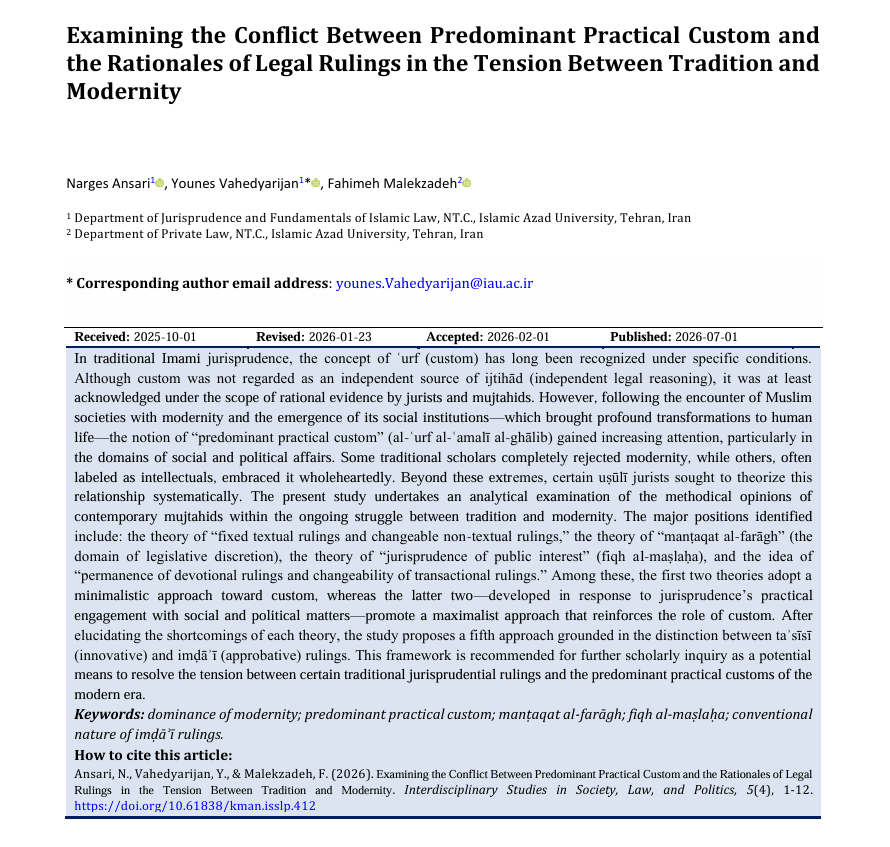
In traditional Imami jurisprudence, the concept of ʿurf (custom) has long been recognized under specific conditions. Although custom was not regarded as an independent source of ijtihād (independent legal reasoning), it was at least acknowledged under the scope of rational evidence by jurists and mujtahids. However, following the encounter of Muslim societies with modernity and the emergence of its social institutions—which brought profound transformations to human life—the notion of “predominant practical custom” (al-ʿurf al-ʿamalī al-ghālib) gained increasing attention, particularly in the domains of social and political affairs. Some traditional scholars completely rejected modernity, while others, often labeled as intellectuals, embraced it wholeheartedly. Beyond these extremes, certain uṣūlī jurists sought to theorize this relationship systematically. The present study undertakes an analytical examination of the methodical opinions of contemporary mujtahids within the ongoing struggle between tradition and modernity. The major positions identified include: the theory of “fixed textual rulings and changeable non-textual rulings,” the theory of “manṭaqat al-farāgh” (the domain of legislative discretion), the theory of “jurisprudence of public interest” (fiqh al-maṣlaḥa), and the idea of “permanence of devotional rulings and changeability of transactional rulings.” Among these, the first two theories adopt a minimalistic approach toward custom, whereas the latter two—developed in response to jurisprudence’s practical engagement with social and political matters—promote a maximalist approach that reinforces the role of custom. After elucidating the shortcomings of each theory, the study proposes a fifth approach grounded in the distinction between taʾsīsī (innovative) and imḍāʾī (approbative) rulings. This framework is recommended for further scholarly inquiry as a potential means to resolve the tension between certain traditional jurisprudential rulings and the predominant practical customs of the modern era.
Downloads
References
Alidoust, A. (2009). Fiqh and Custom. Research Center for Islamic Culture and Thought.
Amin, S. M. (1982). A'yan al-Shi'ah. Dar al-Ta'aruf lil-Matbu'at.
Arab Salehi, M. (2019). The Nature of Approbative Rulings (Ahkam-e Emdai), Emphasizing a Critique of the Views of Some Contemporaries. Quarterly Journal of Jurisprudential and Principles Inquiries(15), 7-25.
Fadil Miqdad, M. i. A. (1984). Al-Tanqih al-Ra'i' li Mukhtasar al-Shara'i'. Maktabat Ayatollah al-Mar'ashi al-Najafi.
Fayz Kashani, M.-M. (1981). Mafatih al-Shara'i'. Majma' al-Dhakha'ir al-Islamiyyah.
Fayz Kashani, M.-M. (1992). Dah Resaleh. Imam Amir al-Mu'minin Ali (AS) Scientific and Religious Research Center.
Gharavi Esfahani, M.-H. (1995). Nihayat al-Dirayah fi Sharh al-Kifayah (Vol. 3). Mu'assasat Sayyid al-Shuhada.
Gharavi Na'ini, M.-H. (2003). Tanbih al-Ummah wa Tanzih al-Millah. Bustan-e Ketab.
Gharavi Na'ini, M.-H., & Kazemi Khorasani, M. A. (1996). Fawa'id al-Usul. The Lectures of Muhaqqiq Na'ini, transcribed by Muhammad Ali Kazemi Khorasani. Islamic Publications Office.
Golbaghi Masouleh, S. A.-J. (1999). An Introduction to Custom. Islamic Propagation Office.
Kadivar, M. (2008). Islam and Human Rights. Kavir.
Khomeini, S. M. (1997). Tahrirat fi al-Fiqh. Vol. 4: Kitab al-Khiyarat. The Institute for Compilation and Publication of Imam Khomeini's Works.
Khomeini, S. R. (2010). Sahifeh-ye Nur. The Institute for Compilation and Publication of Imam Khomeini's Works.
Khomeini, S. R. (2013). Kitab al-Bay'. The Institute for Compilation and Publication of Imam Khomeini's Works.
Malekzadeh, F., & Ahmadiou, M. (2012). The Status of Custom in Law with an Approach to the Thoughts of Imam Khomeini. Matin Quarterly Journal(56), 139-163.
Motahhari, M. (1999). A General Overview of Islamic Movements in the Last Hundred Years. Sadra.
Muhaqqiq al-Hilli, A.-Q. N. a.-D. (1987). Shara'i' al-Islam fi Masa'il al-Halal wa al-Haram. Isma'iliyan Institute.
Nouzari, H.-A. (2000). The Formulation of Modernity and Postmodernity (Historical Formative Contexts and Social Evolutionary Grounds). Naqsh-e Jahan-e Mehr.
Sadr, S. M.-B. Al-Fatawa al-Wadihah. Matba'at al-Adab.
Sadr, S. M.-B. (1979). A Preliminary Jurisprudential Glance at the Draft Constitution of the Islamic Republic of Iran. Matba'at al-Khayyam.
Saljuqi, M. (1968). The Role of Custom in Iranian Civil Law. University of Tehran.
Sallar al-Daylami, H. i. A. a.-A. (1984). Al-Marasim fi Fiqh al-Imamiyah. Manshurat al-Haramayn.
Sohrabi Far, M.-T. (2016). Modernity from the Perspective of Religion. Farhangi-ye Danesh va Andisheh-ye Mo'aser Institute.
Takyeh Fard, F. (2021). The Implementation of Divine Limits (Hudud) in the Age of Modernity Islamic Azad University, North Tehran Branch]. Tehran.
Vase'i, S. M. (2005). The Status of Custom in Fiqh. Kanoon-e Andisheh-ye Javan.
Zargarinezhad, G.-H. (1998). Resa-ye Mashrutiyat. Kavir.
Downloads
Additional Files
Publication Timeline
- Submitted
- Revised
- Accepted
Issue
Section
License
Copyright (c) 2025 Narges Ansari, Younes Vahedyarijan, Fahimeh Malekzadeh (Author)

This work is licensed under a Creative Commons Attribution-NonCommercial 4.0 International License.