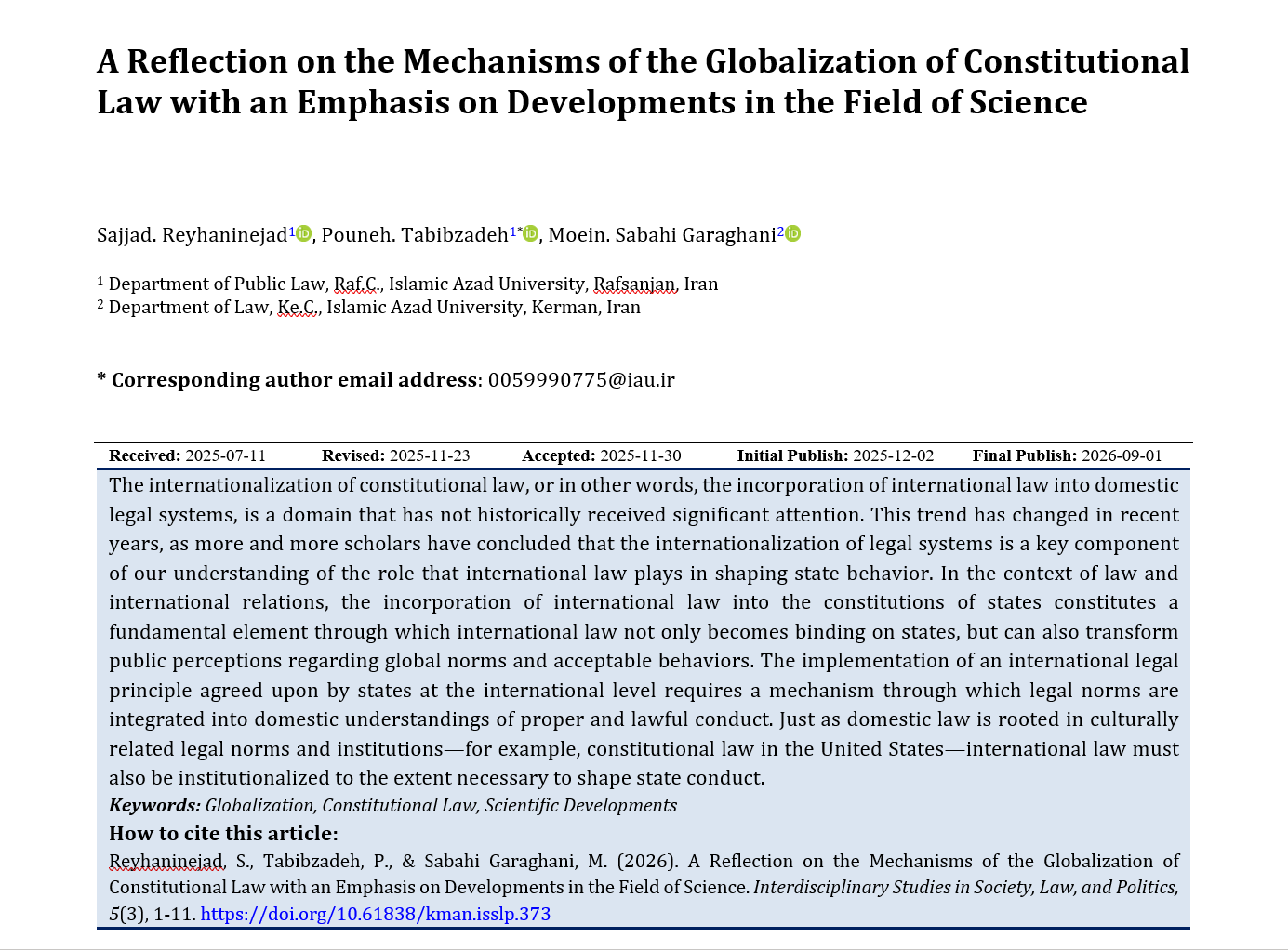
A Reflection on the Mechanisms of the Globalization of Constitutional Law with an Emphasis on Developments in the Field of Science
DOI:
https://doi.org/10.61838/kman.isslp.373Keywords:
Globalization , Constitutional Law, Scientific DevelopmentsAbstract
The internationalization of constitutional law, or in other words, the incorporation of international law into domestic legal systems, is a domain that has not historically received significant attention. This trend has changed in recent years, as more and more scholars have concluded that the internationalization of legal systems is a key component of our understanding of the role that international law plays in shaping state behavior. In the context of law and international relations, the incorporation of international law into the constitutions of states constitutes a fundamental element through which international law not only becomes binding on states, but can also transform public perceptions regarding global norms and acceptable behaviors. The implementation of an international legal principle agreed upon by states at the international level requires a mechanism through which legal norms are integrated into domestic understandings of proper and lawful conduct. Just as domestic law is rooted in culturally related legal norms and institutions—for example, constitutional law in the United States—international law must also be institutionalized to the extent necessary to shape state conduct.
Downloads
References
Ahmadinejad, B. (2014). Modernity and Critical Thought. Markaz Publishing.
Ahmadinejad, S. M. S., Shahi, M. S., & Shamii, M. (2018). Challenges of Deviating from the Strategic Criminal Principles Stated in the Constitution. Journal of Private and Criminal Law Research(37).
Ansari, B. (2007). Sanitizing Laws and Regulations: A Measure for Combating Legal Ambiguity. Legal Information Journal, 6.
Arthurs, H. W. (2009). Law and Learning in an Era of Globalization. German Law Journal, 10, 629-640. https://doi.org/10.1017/S2071832200001279
Baer, S. (2004). Verfassungsvergleichung und reflexive Methode: Interkulturelle und intersubjektive Kompetenz. Heidelberg Journal of International Law, 64, 735-758.
Bakken, L. (2004). AALS Panel - Global Legal Education - Can American Law Schools Respond to the Opportunities? German Law Journal, 5, 335-338. https://doi.org/10.1017/S2071832200012475
Chalmers, A. (2019). What is Science? Samt.
de Wet, E. (2012). The Constitutionalization of Public International Law. In M. Rosenfeld & A. Sajo (Eds.), The Oxford Handbook of Comparative Constitutional Law (pp. 1209-1230). Oxford University Press. https://doi.org/10.1093/oxfordhb/9780199578610.013.0060
Ghazi Noori, S. S. (2018). Extracting Paths for Reforming Iran's National Innovation System Based on a Comparative Study of Selected Countries. Quarterly Journal of Science and Technology Policy.
Hall, H., & Lewis, W. (2017). History and Philosophy of Science (3rd ed.). Soroush Publishing.
Hedayat, M., & Mashhadi, A. (2010). Principles of Administrative Law in the Light of the Opinions of the Administrative Justice Court (1st ed.). Khorasandi.
Heidegger, M. (2018). Philosophy of Technology. Markaz Publishing.
Heywood, A. (2018). Key Concepts in Political Science (1st ed.). Scientific and Cultural Publishing.
Lachmayer, K., Busch, J., Kelleher, J., & Turcanu, G. (2014). International Constitutional Law in Legal Education. Proceedings of the Erasmus Intensive Programme NICLAS 2007-2012. https://doi.org/10.5771/9783748930662
Molki, M. (2017). Science and the Sociology of Knowledge. Nashr-e Ney.
Nabi Rahni, D. (2013). Opportunities and Scientific Competitions of Developing Countries in the Twenty-First Century. Rahyafteh, 29.
No Behhar, R. (2018). Criminal Law Protection for Public and Private Spheres (1st ed.). Jungle Publishing; Javadaneh.
Petersen, N. (2011). Lawmaking by the International Court of Justice - Factors of Success. German Law Journal, 12, 1295-1316. https://doi.org/10.1017/S2071832200017314
Rahmati Far, S. (2020). How is the World Governed? (Analysis of the Nature of Global Administrative Law). Journal of Policy, Faculty of Law and Political Science(50), 3.
Saunders, C. (2006). The Use and Misuse of Comparative Constitutional Law. Indiana Journal of Global Legal Studies, 13, 37-76. https://doi.org/10.1353/gls.2006.0003
Thornhill, C. (2011). A Sociology of Constitutions. Constitutions and State Legitimacy in Historical-Sociological Perspective. Cambridge University Press. https://doi.org/10.1017/CBO9780511895067
Zarei, M. H. (2002). From Human Rights and Dignity to the Proposal for Respecting the Supreme Administrative Council. Journal of Management and Development of Institute for Higher Education and Research in Management and Planning(56 and 57).
Zarei, M. H. (2007). An Introduction to the Comparative Study of the Institution of Sanitizing Laws and Regulations. Legal Information Journal, 6.
Downloads
Additional Files
Publication Timeline
- Submitted
- Revised
- Accepted
Issue
Section
License
Copyright (c) 2025 Sajjad Reyhaninejad, Pouneh Tabibzadeh, Moein Sabahi Garaghani (Author)

This work is licensed under a Creative Commons Attribution-NonCommercial 4.0 International License.